Record investment, integrated infrastructure, and the convergence of power, hydrogen, and AI are reshaping China’s industrial and energy landscape.
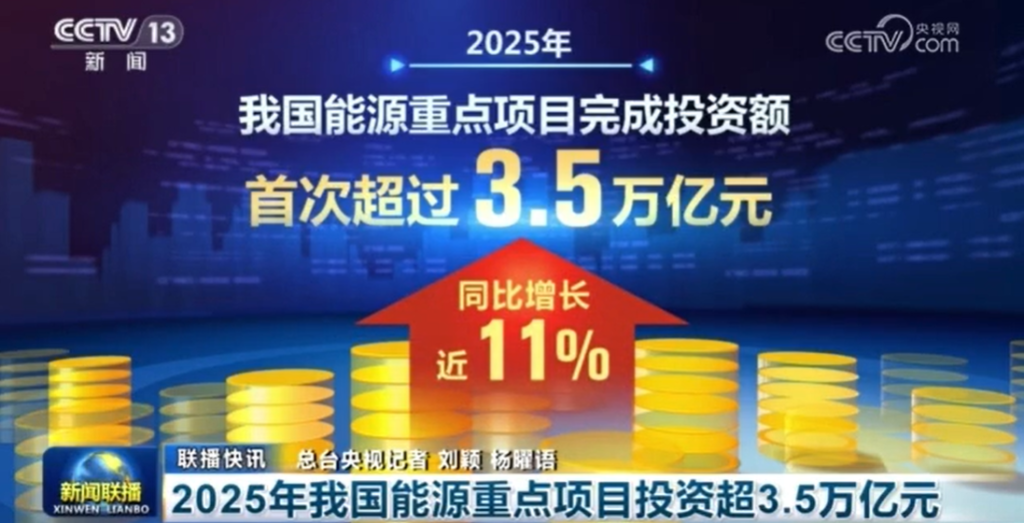
China’s energy transition crossed both a financial and structural threshold in 2025, as completed investment in national key energy projects exceeded CNY 3.5 trillion for the first time, according to data released by the National Energy Administration (NEA) on January 30.
The scale and composition of this capital deployment, concentrated in renewables, advanced power grids, energy storage, and hydrogen, highlight how energy policy is evolving into a core lever of industrial competitiveness, digital growth, and regional development. Five provinces, Inner Mongolia, Xinjiang, Shandong, Guangdong, and Jiangsu, each recorded more than CNY 200 billion in completed energy investment, reflecting a dual dynamic: resource-driven expansion in western regions and demand-led growth in coastal manufacturing hubs.
Beyond the headline number, the shift underway is structural. Instead of merely adding generation capacity, China is assembling an integrated, system-level energy architecture designed to support AI computing, the large-scale electrification of heavy industry, and the early formation of a national hydrogen economy.
Investment scale meets system transition
In 2025, renewable energy accounted for more than 60% of China’s total installed power generation capacity, with annual renewable electricity output reaching approximately 4,000 TWh – exceeding the combined electricity consumption of the EU’s 27 member states. This milestone reflects not only sustained capacity additions, but also higher utilization enabled by grid expansion and operational optimization.
Onshore wind emerged as a key growth engine. Completed investment in major onshore wind projects increased by nearly 50% year on year, driven by large-scale deployments in Inner Mongolia, Xinjiang, and northern China, where land availability and wind resources remain globally competitive. In parallel, investment in new-type energy storage and hydrogen projects doubled compared with the previous year, signalling a strategic shift from generation-led expansion toward system flexibility, balancing capacity, and cross-sector integration.
Policy coordination played an important role. Throughout 2025, the NEA strengthened alignment between supply-side expansion and demand-side reform, accelerating capital flows into what it terms “new energy formats,” including green power direct supply mechanisms, zero-carbon industrial parks, and integrated hydrogen value chains.
Energy transition at scale: from UHV grids to green hydrogen
At the infrastructure level, China’s nationwide ultra-high-voltage (UHV) transmission network has become the backbone of this transformation. Built to address the structural mismatch between energy-rich western regions and demand centers along the eastern coast, UHV corridors enable long-distance power transmission with materially lower losses than conventional high-voltage lines. This capability is increasingly critical in an AI-driven economy, where electricity must be both abundant and geographically flexible.
By the end of 2025, China’s renewable hydrogen production capacity exceeded 250,000 tons per year, doubling from the previous year. Flagship projects, including Kuqa in Xinjiang, Chifeng in Inner Mongolia, and Daan and Songyuan in Jilin, have entered commercial operation. These facilities typically integrate large-scale wind or solar generation with alkaline or PEM electrolyzer systems, on-site hydrogen storage, and downstream industrial or mobility applications.
The technical significance extends beyond capacity growth. Across these projects, the full hydrogen value chain, from production to storage, transport, and end use, is increasingly being demonstrated at commercial scale. At the same time, domestic manufacturers have achieved notable breakthroughs in critical equipment, such as high-capacity electrolyzers, hydrogen compressors, and composite storage vessels, strengthening supply-chain resilience and cost competitiveness.
Cost, customers, and policy alignment
From a commercial standpoint, China’s energy transition is becoming increasingly cost-led rather than subsidy-driven. In western regions, industrial electricity prices average around CNY 0.2/kWh (approximately US$0.03), less than a quarter of typical prices in U.S. AI and technology hubs, where power costs commonly range from US$0.12 to US$0.15/kWh. This cost differential is emerging as a strategic advantage.
The national “East Data, West Computing” strategy illustrates how energy and digital policies are converging. By the end of 2024, direct investment in the eight national computing hub nodes exceeded CNY 43.5 billion, catalyzing more than CNY 200 billion in related investment. Many of these hubs, located in Inner Mongolia, Ningxia, and Gansu, have attracted green data centers designed to operate predominantly on renewable electricity. Their combined computing capacity has reached 215.5 exaflops, with intelligent computing accounting for more than 80%.
For energy developers, this convergence is creating a new class of anchor customers: data centers, semiconductor fabrication plants, aluminum smelters, and biopharmaceutical facilities with both high load factors and explicit decarbonization requirements. The NEA’s green power direct supply policy, now implemented in more than 20 provinces, allows renewable generators to sell electricity directly to such users, reducing market friction and improving project bankability.
Hydrogen follows a similar trajectory. Early demand remains concentrated in refining, coal-to-chemicals, and heavy transport pilots, but declining electrolyzer costs and access to low-cost renewable power are steadily improving competitiveness relative to grey hydrogen. In regions with strong policy support, green hydrogen is approaching cost parity for industrial users once carbon and environmental considerations are factored in.
Energy as an industrial platform
Looking ahead to 2026, the NEA has signalled a stronger emphasis on market activation and execution. Planned measures include multi-user green power direct supply, accelerated rollout of zero-carbon industrial parks and green microgrids, and market mechanisms better adapted to high renewable penetration. Equally critical are “last-mile” enablers: land-use approvals, grid access, and marine resource coordination, aimed at reducing project bottlenecks and execution risk.
Strategically, China’s approach stands apart from that of many global peers. Rather than treating renewables, grids, storage, hydrogen, and digital infrastructure as discrete sectors, policy and capital are being aligned into a single, integrated value chain. Cheap green electricity is no longer viewed as an end in itself, but as a foundational input for AI computing, advanced manufacturing, and future fuels.
For global climate tech and hydrogen markets, the implications are twofold. China’s scale and cost advantages are likely to intensify competition in equipment manufacturing, from wind turbines, energy storage, to electrolyzers. At the same time, its integrated deployment model offers a reference point for how large economies can synchronize decarbonization with growth in data- and energy-intensive industries.
In the AI era, sheer electricity output is no longer sufficient. What matters is the ability to move power across regions, convert it efficiently into computing capacity or molecules, and deliver it at predictable cost. With a national grid that enables energy to flow freely, and annual investment now exceeding CNY 3.5 trillion, China is positioning energy infrastructure as a core platform for its next phase of economic development, where green power, hydrogen, and digital capacity advance in lockstep.