Lunar New Year Special I: AI Robotics – From Gala to Global
Commercial-ready humanoid robots have entered mainstream public awareness with dynamic motion, multi-robot coordination, and robust engineering—signalling the maturation of China’s robotics sector, underpinned by high-tech firms such as Wuxi-based Magic Atom.
At China’s 2026 CCTV Spring Festival Gala, the MagicBot Z1 by MagicLab Robot Technology (Magic Atom) delivered a breakthrough demonstration of humanoid robotics. Through high-dynamic multi-robot choreography and advanced motion feats, the performance shifted public perception from novelty to near-commercial capability. The spectacle highlighted engineering maturity, accelerating market readiness and sharpening strategic positioning in the global robotics race.
A public technology milestone
In the headline program “Intelligent Manufacturing the Future,” six MagicBot Z1 units and two MagicBot Gen1 robots shared the stage with leading entertainers, executing rapid directional changes, coordinated formations, and rhythmically precise choreography synchronized to music.
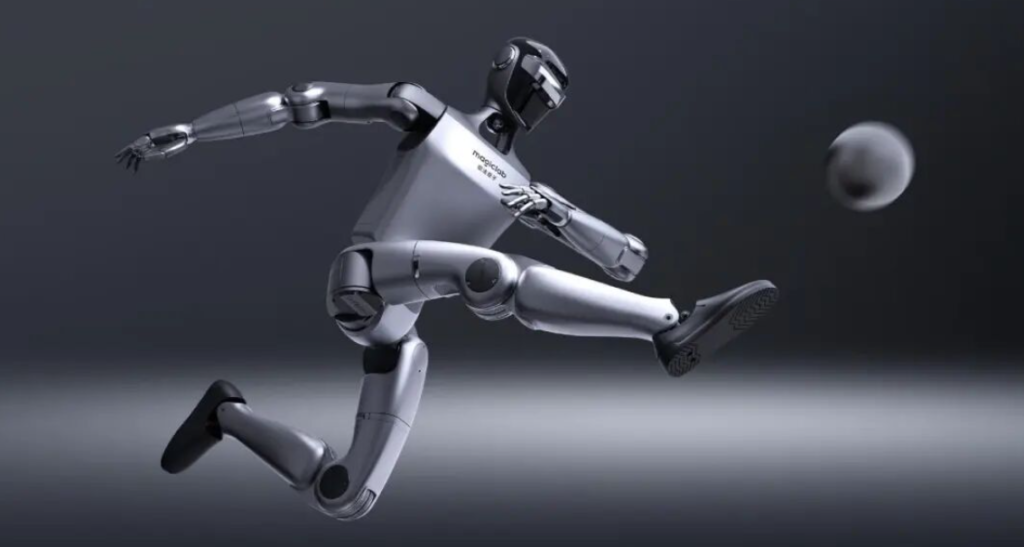
The Z1’s fluid execution of the “Thomas 360°” acrobatic move drew widespread attention as a striking example of breakthrough engineering. This marked the first time a medium-sized humanoid robot in its class had publicly completed the maneuver at scale. The move requires the robot to jump and land under single-point support while maintaining continuous rotation and posture transitions. It places extreme demands on whole-body coordination, center-of-mass control, and instantaneous power distribution—representing one of the highest levels of public validation for bipedal robot capability.
Beyond individual extreme motion, the gala also showcased robotics at scale. The Z1 demonstrated peak single-unit athletic performance, while, in parallel segments, one hundred panda-clad MagicDo robots delivered large-scale coordinated choreography. Meanwhile, the Gen1 and Z1 platforms demonstrated full-chain real-world task capabilities in applied service scenarios.
Gen1 prepared noodles while Z1 handled food delivery—bringing, for the first time, the tangible image of “robots at work” into the living rooms of hundreds of millions of viewers. The scene shifted humanoid robotics from a staged spectacle toward visible, practical application.
Robot swarms, including quadruped MagicDog units, executed high-density group-control performances with millisecond-level synchronization. The display highlighted scalable multi-agent coordination systems capable of operating reliably in dense and complex environments.
This public unveiling marks both a psychological and commercial inflection point. Moving beyond trade shows and laboratory demonstrations, humanoid robots were presented as credible real-world agents even within scripted performance settings, accelerating public acceptance and market confidence.
Key technologies and specifications
Behind the spectacle lies a tightly integrated hardware–software stack. The Z1’s architecture reflects a shift from proof-of-concept robotics toward deployable embodied intelligence platforms designed for stability, scalability, and rapid iteration.
I. Platform Architecture
The MagicBot Z1 is a 1.4-meter-tall, around 40 kg bipedal humanoid built on a modular mechanical and sensor architecture optimized for agility and dynamic balance. Its core mechanical system features self-developed high-torque joints with 24 degrees of freedom (DoF) in the standard configuration, expandable to approximately 50 DoF.
Joint torques exceed 130 N·m, with motion ranges up to 320°, enabling high-difficulty maneuvers such as fall recovery, deep bending, explosive take-offs, and stable landings. The Thomas 360° move, in particular, demonstrates precise torque control under extreme dynamic loads.
II. Mobility and Perception
To translate mechanical capability into environmental adaptability, the Z1 integrates a comprehensive sensor suite including 3D LiDAR, depth cameras, and binocular fisheye vision. These systems support environmental perception, balance control, and autonomous navigation.
The robot can traverse varied terrains, including flat surfaces, gravel, and steps, at locomotion speeds of up to approximately 2.5 m/s. Real-time disturbance rejection, dynamic posture adjustment, and continuous locomotion without external stabilization underscore operational robustness beyond laboratory conditions.
III. Control and Interaction Software
At the software layer, the robot operates on Magic Atom’s proprietary motion control and embodied AI platform. The system supports rapid motion learning, with new action sequences reportedly trainable in as little as 20 minutes, significantly lowering customization barriers for developers and commercial users.
Multimodal interaction, including voice, touch, and gesture recognition, combined with Wi-Fi 6, Bluetooth 5.2, and OTA update capability, enables flexible integration into diverse operational scenarios.
IV. Thermal and Power Management
Sustained dynamic performance requires careful systems engineering. Advanced thermal simulation, optimized airflow design, and the use of high-strength aluminum alloys and engineering plastics ensure thermal stability during high-load operations such as continuous dance routines and dynamic running sequences.
Runtime under standard configurations is approximately 120 minutes.
Compared with some global benchmarks, such as publicly demonstrated prototypes of the Tesla Optimus humanoid, MagicBot Z1’s demonstrated agility, sensor fusion, and high-dynamic performance suggest a notable step toward operational readiness outside controlled environments.
Commercialization and ecosystem
The gala performance propelled advanced robotics into mainstream public consciousness, generating significant brand equity for Chinese robotics firms. For companies such as Magic Atom and Unitree Robotics, this visibility supports the transition narrative from R&D demonstration to real-world deployment.
I. Market positioning
Z1’s high-torque joints, high-speed locomotion, and rich sensor array enable applications beyond entertainment, extending into industrial, service, research, and educational sectors. Potential use cases include factory navigation, logistics assistance, public venue services, event hosting, and interactive demonstrations.
The Gen1’s noodle-preparation and service demonstration at the gala reinforced the message that humanoid robotics is entering early-stage commercial validation in hospitality and service contexts.
II. Developer ecosystem
Magic Atom’s open development platform supports third-party motion programming and scenario development, aligning with strategies that prioritize ecosystem building over closed-system hardware products. Similar to smartphone application marketplaces, modular motion libraries and embodied AI skill sets could catalyze a scalable robotics ecosystem.
III. Supply chain and regional ecosystem
Magic Atom is headquartered in Liangxi District, Wuxi, and is backed by a multi-billion CNY industry fund, reflecting a strong local government commitment to robotics and advanced manufacturing clusters. The strategy aims to attract upstream suppliers, system integrators, and high-level technical talent.
Liangxi District is also rapidly advancing aerospace as a strategic pillar sector, building on Wuxi’s established deep-tech manufacturing base. The district is expanding aerospace component manufacturing, satellite systems, and precision engineering projects, supported by a 10 billion CNY industry fund aimed at developing a trillion CNY industrial cluster.
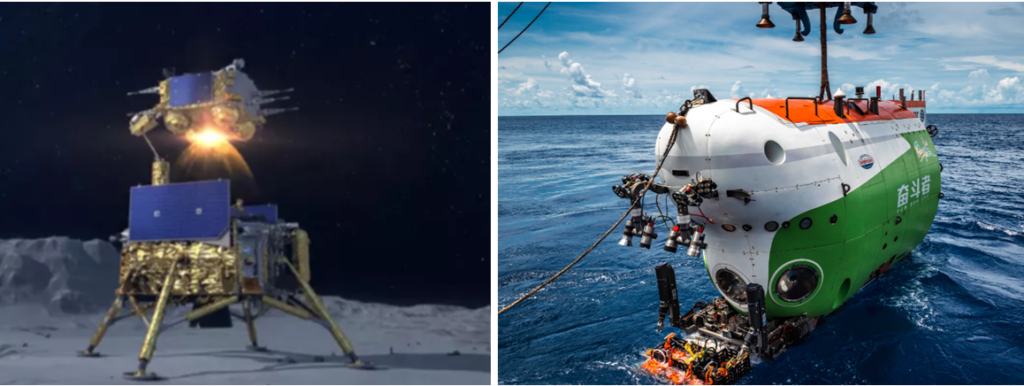
The past provides context. From deep space to the deep sea, Wuxi manufactured some of the most critical components for China’s 2020 lunar far-side sample return mission and built the Fendouzhe (“Striver”) manned submersible, which reached a depth of 10,909 m (close to the world record of 10,927 m). The city also hosts the National Supercomputing Center in Wuxi, home to the Sunway TaihuLight supercomputer, the world’s fastest from 2016 to 2018 and a milestone in China’s high-performance computing.
Strategic and market implications
The gala’s dramatic display, executed alongside major Chinese robotics peers, underscores intensifying global competition in humanoid robotics. While Western developers such as Tesla and Figure AI pursue general-purpose functional humanoids, Chinese firms are increasingly differentiating themselves through high-dynamic performance, multi-agent coordination, and ecosystem openness.
Public broadcasting exposure, combined with substantial regional development funds, illustrates how industrial policy and technological branding increasingly intersect. Humanoid robotics is emerging not only as a frontier technology platform, but also as a symbol of technological capability and a strategic pillar of advanced manufacturing.