Lunar New Year Special III: Soft Power, Hard Tech
From a seven-city European music tour to the world’s first large-scale perovskite “dragon-scale” concert hall roof, Wuxi is pairing cultural soft power with next-generation photovoltaic deployment to strengthen its global positioning.
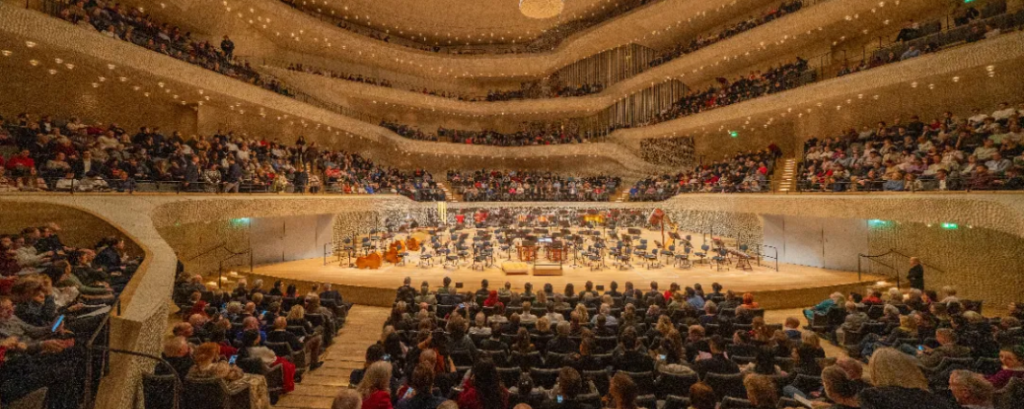
Wuxi began 2026 with two seemingly distinct milestones: a seven-stop European tour by its municipal folk orchestra and the commercial-scale debut of perovskite building-integrated photovoltaics (BIPV) at its new Symphony Concert Hall, a city landmark. Together, they illustrate a coordinated strategy that blends cultural diplomacy with industrial innovation, using music to amplify brand equity while rollout advanced solar technologies.
European tour: music heritage meets the global stage
On February 27, the Wuxi Chinese Orchestra concluded its 2026 “Spring of Chinese Music” European tour at the Palace of Arts in Budapest. The performance marked the seventh and final stop of a 15-day tour spanning four countries—Belgium, Germany, Austria, and Hungary—and seven major concert halls.
More than 80 musicians travelled in full ensemble formation, making it the orchestra’s largest overseas deployment to date. Venues included the Elbphilharmonie and the Wiener Konzerthaus, stages typically reserved for world-leading orchestras.
All tickets sold out well ahead of the performances. Audiences in Germany delivered four standing ovations; in multiple cities, the orchestra returned for up to six curtain calls.
Strategic context
The tour coincided with the Lunar New Year and served as an extension of Wuxi’s positioning as China’s only UNESCO-designated “City of Music.” For a city with a history dating back more than 3,000 years, cultural exports complement its well-established reputation in advanced manufacturing and photovoltaics.
The strategic value operates across three dimensions:
Brand amplification: Showcasing Jiangnan silk-and-bamboo music and Lake Tai heritage to European audiences strengthens Wuxi’s cultural identity.
Diplomatic alignment: Engagements received strong support from Chinese embassies and European local media, reinforcing bilateral cultural exchange.
Economic effects: Cultural visibility supports tourism, educational exchange, and international business linkages.
In value-chain terms, the orchestra functions as a “soft infrastructure” asset. Just as industrial clusters export modules and equipment, cultural institutions export narrative capital, shaping global perception and enabling broader commercial engagement.
Perovskite PVs: from lab to architectural deployment
“Architecture is frozen music.” – J. W. von Goethe (1749–1832)
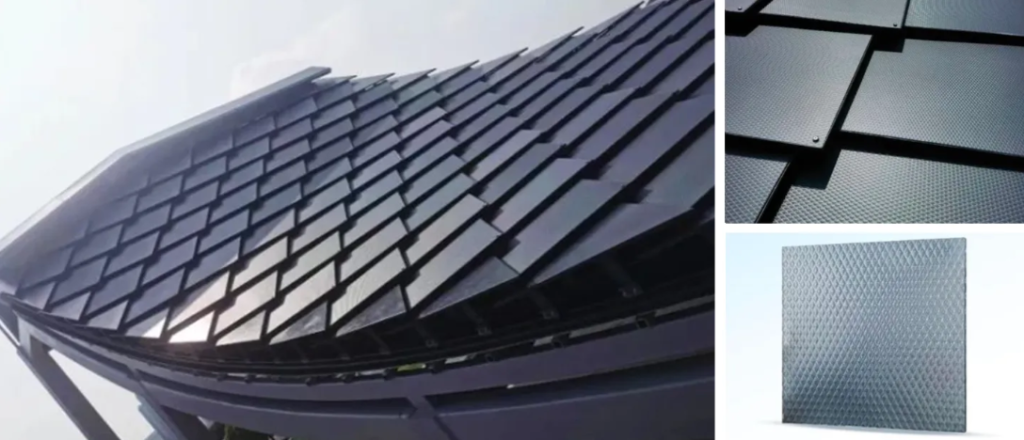
On January 1, 2026, the Wuxi Symphony Concert Hall opened, installed with more than 12,000 perovskite photovoltaic tiles integrated into its roof. The installation, developed by UtmoLight, covers 7,000 square meters in a distinctive “dragon-scale” overlapping layout.
The system has a total installed capacity of 1.24 MW and is expected to generate approximately 1.2 GWh annually, marking the first large-scale architectural application of perovskite BIPV roofing globally.
Technology and Specifications
Perovskite solar cells have rapidly transitioned from lab-scale demonstrations to pilot commercial deployment. In November 2024, UtmoLight’s GW-scale production line produced its first 2.8-square-meter single-junction perovskite module, achieving a power output of 450 W and a full-area efficiency of 16.1%. By July 2025, the 2.8-sqm modules had reached 490 W output and 17.44% full-area efficiency, a new industry record for modules of this size.
Globally, single-junction perovskite efficiencies now exceed 25% in research settings, narrowing the gap with crystalline silicon while offering advantages in weak-light performance and material flexibility.
The Symphony Hall’s roof integrates several technical innovations:
- Advanced perovskite material compositions optimized for durability and efficiency
- Perovskite quantum-dot enhancement, improving charge transport and spectral utilization
- Structured surface morphologies, increasing light trapping and conversion efficiency
- Building-grade polymer films that soften optical effects and reduce glare—critical for urban integration
- Overlapping “dragon-scale” geometry, enabling multi-angle sunlight capture and passive shading
Beyond energy generation, the design also helps regulate indoor temperature and humidity, enhancing overall building energy performance. All associated technologies are patented and represent a first-of-its-kind architectural deployment.
At 1.24 MW, the installation sits at the lower end of utility-scale solar but is highly significant in the BIPV segment. Compared with conventional rooftop silicon systems, perovskite tiles offer:
- Aesthetic integration suitable for landmark architecture
- Lower material intensity due to thin-film structures
- Improved weak-light performance, valuable in high-latitude or cloudy regions
- Design flexibility, enabling curved or patterned surfaces
Perovskite BIPV addresses a structural bottleneck in urban decarbonization: limited roof space and visual constraints. By embedding generation capacity directly into architectural surfaces, cities can expand distributed energy supply without altering skyline aesthetics.
From a cost perspective, perovskite modules remain in early-stage commercialization. However, their solution-based manufacturing processes, potentially compatible with roll-to-roll printing, offer a long-term pathway to lower capital expenditure compared with high-temperature silicon wafer production.
Ecosystem and value chain
Wuxi’s role in the global PV value chain provides the industrial foundation for this deployment. Since the mid-2000s, companies such as Suntech have built international supply chains from Wuxi, transforming the city into a global solar center for both R&D and manufacturing.
This industrial depth also underpins the rapid scaling and commercialization of advanced heterojunction (HJT) technologies. In 2024, Huasun Energy launched a 3.6 GW HJT cell facility in Wuxi, including the world’s first 210R HJT mass-production line. In November 2025, Huasun released its 770 W Himalaya HSN 212 B132 module, featuring:
- 132-cell bifacial double-glass architecture
- Dimensions of 2,384 × 1,303 × 33 mm
- Weight of 36.5 kg
- 23.5–24.8% efficiency under a 2,000 V system voltage
The shift to 2,000 V systems reduces balance-of-system costs by up to CNY 150/kW compared with 1,500 V systems, highlighting the cost-competitiveness drive across China’s advanced PV segment.
Perovskite BIPV complements, rather than replaces, silicon and HJT technologies. In portfolio terms:
- Crystalline silicon/HJT: High-efficiency, large-scale utility and industrial applications
- Perovskite BIPV: Design-centric urban integration and distributed generation
This dual-technology pathway diversifies risk and extends Wuxi’s reach across both conventional and next-generation PV markets.
Soft power and hard tech in parallel
Wuxi’s simultaneous European music tour and perovskite PV deployment illustrate a broader strategic pattern: pairing cultural diplomacy with technological leadership. Three implications stand out:
- City-level branding as a competitive advantage: Cultural recognition supports trade, investment, and talent attraction in high-tech sectors.
- Architectural decarbonization as a growth frontier: BIPV represents a high-margin niche within distributed solar, particularly in Europe, where building energy codes are tightening.
- Cluster resilience through technology diversification: By anchoring silicon, HJT, and perovskite technologies within one ecosystem, Wuxi strengthens supply-chain integration and inter-industry innovation synergies.
As poet Goethe said, “Architecture is frozen music.” In Wuxi, that metaphor has become literal: architecture generates clean power beyond borders, and ancient music journeys through Europe.
From concert halls along the Danube to a dragon-scale solar roof in the Yangtze River Delta, Wuxi is synchronizing cultural presence with clean-tech deployment – projecting both artistic heritage and industrial frontiers onto the global stage.