Breakthrough combines large-scale ammonia propulsion with digital control systems, signaling China’s emergence as a leader in zero-carbon marine power and reshaping fuel competition across global shipping value chains.
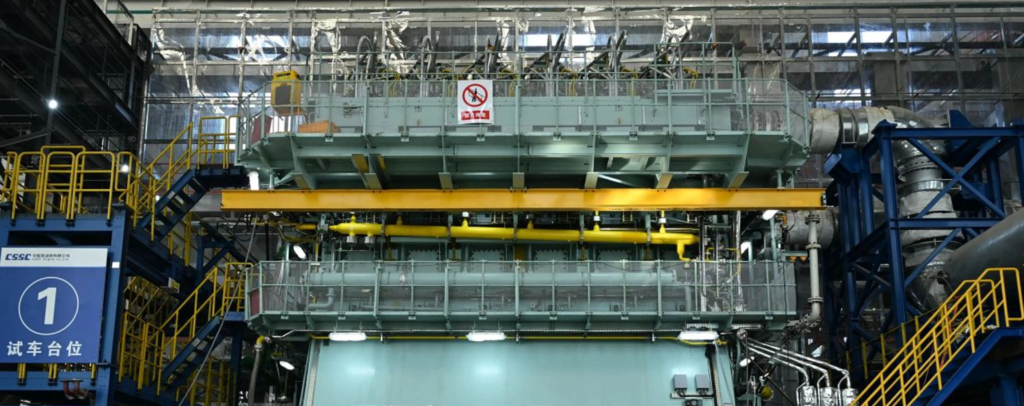
On March 16, CSSC Marine Engine Co., a subsidiary of China State Shipbuilding Corporation (CSSC), announced that its WinGD 6X72DF-A 1.0 ammonia-fuelled engine had successfully passed both Function Integration Testing (FIT) and Factory Acceptance Testing (FAT) before being delivered for installation.

The 14,400 kW engine will power a 210,000 deadweight ton (DWT) bulk carrier being built for Belgium-based CMB.TECH, one of Europe’s early movers in alternative marine fuels. The delivery represents China’s first commercial deployment of ammonia propulsion technology in shipping, closing a key gap in its zero-carbon marine power portfolio and intensifying competition with established engine makers in Europe and Japan.
From pilot to commercial deployment
The successful delivery signals a transition from prototype validation to commercial readiness for ammonia-fuelled engines in China. While ammonia has long been discussed as a zero-carbon fuel candidate, practical deployment has been limited by combustion challenges, safety concerns, and a lack of supply infrastructure.
CSSC’s latest milestone builds on rapid progress in alternative-fuel engines. Just one year earlier, in February 2025, the group delivered the world’s most powerful methanol dual-fuel engine, the WinGD 10X92DF-M-1.0, rated at 64,500 kW. That engine achieved over 95% methanol substitution and reduced CO₂ emissions by more than 7.5% compared with conventional diesel systems.
Together, these developments indicate a deliberate multi-fuel strategy: methanol as a near-term transitional fuel and ammonia as a longer-term zero-carbon solution.
Ammonia propulsion reaches industrial scale
The newly delivered 6X72DF-A 1.0 engine represents a significant technical step forward in ammonia combustion and system integration. Key specifications include:
- Rated power: 14,400 kW
- Maximum speed: 67 rpm
- Engine type: Low-speed, two-stroke ammonia-fuelled marine engine
- Emission control: High-pressure selective catalytic reduction (HPSCR)
The engine incorporates a suite of advanced subsystems designed to address ammonia’s unique properties, particularly its low flammability, toxicity, and nitrogen-based emissions profile. These include:
- Fuel valve unit (FVU) for precise ammonia injection
- Ammonia injection control and water system (AICWS) to stabilize combustion
- Ammonia fuel supply system (AFSS) to ensure consistent fuel delivery
- Ammonia ventilation and purging system (AVPS) for safety management
- Gas detection system (GDS) for real-time leak monitoring
At the core of the system is WinGD’s WiCE digital control platform, which enables real-time monitoring, diagnostics, and optimization of engine performance. Notably, the system can detect ammonia leakage both within the engine and across the test environment, an essential feature given ammonia’s toxicity and regulatory scrutiny.
From a thermodynamic perspective, ammonia combustion has lower energy density and slower flame speeds than conventional fuels. The integration of advanced control systems and after-treatment technologies such as SCR is therefore critical to maintaining efficiency while minimizing nitrogen oxide (NOx) emissions.
Scaling zero-carbon shipping solutions
Beyond technical validation, CSSC’s announcement underscores growing industrial readiness. The company has already established mass-production capacity, with:
- Four dedicated assembly and testing lines
- Annual output exceeding 20 ammonia-fuelled engines
This level of capacity suggests that ammonia propulsion is moving beyond niche demonstration projects toward scalable deployment, particularly in large vessel segments such as bulk carriers and tankers.
The choice of customers is also notable. CMB.TECH has been actively investing in hydrogen and ammonia fuel pathways, and its order signals increasing confidence among European shipowners in ammonia as a viable long-term fuel.
From a cost perspective, ammonia engines remain more expensive than conventional systems due to:
- Additional fuel handling and safety systems
- Lower fuel efficiency compared with diesel
- Limited fuel supply infrastructure
However, tightening emissions regulations, particularly from the International Maritime Organization (IMO), are shifting the economic calculus. Carbon pricing, fuel standards, and lifecycle emissions accounting are expected to narrow the cost gap over time.
Policy alignment and industrial positioning
The timing of the announcement aligns with broader policy momentum in China’s clean energy transition. In parallel, China is advancing its hydrogen and fuel cell strategy, with the first phase of fuel cell city-cluster demonstrations concluding in 2025 and a second phase launched in March 2026. The new policy will again select five city clusters, each with a four-year implementation period, reinforcing long-term commitment to hydrogen-based technologies.
Ammonia, produced from hydrogen, fits within this broader ecosystem as both an energy carrier and a maritime fuel. Its adoption in shipping could therefore stimulate upstream investment in green hydrogen production, storage, and transport infrastructure.
For CSSC, the ammonia engine milestone represents more than a product launch. It signals a shift from technological catch-up to global leadership. The company explicitly frames the achievement as a “historic leap” from following international peers to setting the pace in zero-carbon marine power.
Evolving maritime multi-fuel ecosystem
The emergence of commercially available ammonia engines adds a new dimension to the already complex landscape of alternative marine fuels, which includes:
- Liquefied natural gas (LNG): transitional, lower emissions but still fossil-based
- Methanol: scalable and easier to handle, but not inherently zero-carbon unless produced renewably
- Hydrogen: zero-carbon but limited by storage challenges
- Ammonia: zero-carbon at point of use, with easier storage than hydrogen but higher toxicity
Compared with methanol, ammonia offers a clearer pathway to zero-carbon compliance but at the cost of greater technical complexity. CSSC’s dual progress in both fuels suggests that shipowners may increasingly adopt portfolio strategies, selecting fuels based on route, vessel type, and regulatory exposure.
Globally, engine manufacturers such as Everllence (former MAN Energy Solutions) and Wärtsilä have also been developing ammonia-capable engines, but large-scale commercial deliveries remain limited. China’s early deployment could therefore shift competitive dynamics, particularly if domestic manufacturers leverage scale and cost advantages.
Fuel value chain: from production to vessel operations
The success of ammonia propulsion depends not only on engine technology but on the broader value chain, including:
- Green ammonia production (via renewable hydrogen and nitrogen synthesis)
- Storage and bunkering infrastructure at ports
- Safety standards and regulatory frameworks
- Vessel design adaptations for fuel handling
China’s integrated industrial ecosystem, spanning shipbuilding, energy, and heavy manufacturing, may provide an advantage in coordinating these elements at scale.
Outlook: from demonstration to deployment
The delivery of the 6X72DF-A 1.0 engine marks a critical inflection point for ammonia in shipping. While technical and economic challenges remain, the move from testing to commercial installation signals growing confidence across the industry.
If supported by policy incentives, carbon pricing, and infrastructure investment, ammonia could play a central role in achieving the IMO’s decarbonization targets—particularly for long-haul, energy-intensive segments where electrification is not viable.
For now, the industry appears to be entering a phase of parallel experimentation and early scaling, with multiple fuel pathways competing. China’s latest milestone ensures that it will be a central player in shaping that outcome.