Spring Special Report III: Orbital AI, Robotics & Orchestration
Breakthrough links natural language, orbital computing, and embodied AI, validating “compute-as-a-service in space” and opening new commercial pathways for robotics, satellite infrastructure, and distributed intelligence systems.
China has completed the world’s first technical demonstration of using space-based AI to control a ground robot via natural language commands, marking a significant step toward commercializing orbital computing and redefining how AI services are delivered across domains.
The experiment, conducted by the Guoxing Aerospace–Shanghai Jiao Tong University Space Computing Joint Laboratory, established a full closed-loop system: natural language input from a human operator was transmitted to an orbiting AI model, processed in space, and converted into executable commands for a ground-based humanoid robot.
The result is more than a technical milestone. It signals the emergence of “space computing as a service” (SCaaS), extending cloud-based AI capabilities beyond terrestrial infrastructure and into orbit.
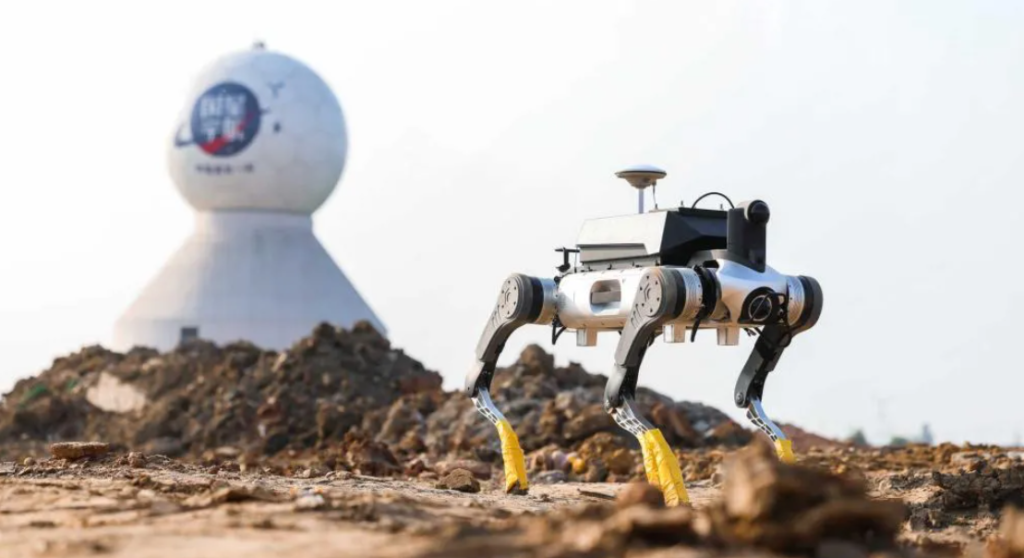
From concept to closed-loop validation
The demonstration is the first to integrate three previously separate domains into a single operational loop: natural language AI, satellite-based computing, and embodied robotics.
In the test, a human operator issued voice commands, which were captured by an open-source AI agent and transmitted to the “Star Computing” constellation’s in-orbit computing system. A large language model pre-deployed on the satellite performed inference in space, generating decision outputs that were sent back to Earth. The ground agent then translated these outputs into control signals, enabling the humanoid robot to execute the instructed actions.
This “natural language → space-based inference → robotic execution” chain validates the feasibility of delivering AI cognition services from orbit to silicon-based intelligent agents.
Crucially, the experiment also extended AI “token” processing, the fundamental unit of language model computation, into space, demonstrating that even fine-grained AI workloads can be offloaded beyond Earth.
Orbital inference meets embodied intelligence
At the heart of the system lies a distributed architecture that combines:
- Satellite-based AI inference engines running large language models in orbit
- Low-latency communication links connecting ground and space systems
- Open-source intelligent agents acting as intermediaries between human input and robotic execution
- Embodied AI platforms, including humanoid robots capable of interpreting and acting on high-level commands
Unlike traditional satellite systems focused on data transmission or remote sensing, the “Star Computing” platform introduces in-orbit processing capability at scale. This shifts satellites from passive data relays to active computational nodes.
The architecture supports a wide range of AI workloads, including:
- Real-time inference
- Distributed model training
- Data preprocessing and filtering
- Cross-domain decision-making
From a systems perspective, the key innovation lies in decoupling AI cognition from physical location. Instead of relying solely on terrestrial cloud infrastructure, intelligent agents can dynamically access compute resources in orbit, particularly valuable in environments where ground connectivity is limited or unreliable.
Scaling ambition: from pilot to global infrastructure
The experiment is part of China’s broader “Star Computing” initiative, a first-of-its-kind satellite constellation designed specifically for distributed AI workloads. The planned system includes:
- 2,800 computing satellites in total, including:
- 2,400 inference satellites
- 400 training satellites
- Target capacity:
- 100,000 petaFLOPS (PFLOPS) of inference computing power
- 1 million PFLOPS of training capacity
The roadmap outlines a phased rollout:
- By 2030: Deployment of a thousand-satellite network, with over 95% dedicated to inference, and initial commercial operations
- By 2035: Full constellation deployment, capable of serving hundreds of millions of intelligent agents across land, sea, air, and space
This scale positions the system as a potential counterpart, or complement, to terrestrial hyperscale cloud providers, but with unique advantages in global coverage, redundancy, and resilience.
By comparison, systems such as SpaceX’s Starlink focus primarily on broadband connectivity rather than in-orbit computation. Similarly, Amazon Web Services’ AWS Ground Station enables satellite data downlink and integration with cloud infrastructure, but relies on Earth-based data centers for processing. China’s “Star Computing” model, by contrast, pushes AI inference and training directly into orbit, representing a more vertically integrated approach to space-based digital infrastructure.
Unlocking new AI and robotics use cases
The implications for commercial applications are significant, particularly in sectors where connectivity constraints limit the deployment of advanced AI.
Robotics and autonomous systems are among the most immediate beneficiaries. Space-based AI could provide high-performance cognition for:
- Humanoid robots
- Quadruped robotic systems
- Autonomous vehicles
- Unmanned aerial vehicles (UAVs)
In scenarios such as remote mining, offshore operations, disaster response, and cross-border logistics, where terrestrial networks may be unavailable or unreliable, orbital computing could act as both a fallback and primary AI backbone.
In parallel, the system opens new opportunities in the low-altitude economy, a fast-growing sector encompassing drone logistics, aerial mobility, and urban air services. By upgrading remote sensing from 2D to real-time 3D navigation, the platform could enable precise flight guidance, collision avoidance, and airspace management.
Wuxi’s role: from pilot zone to industrial hub
The commercialization pathway is already taking shape in Wuxi, particularly in Liangxi District and Liangxi Science and Technology City, which have partnered with Guoxing Aerospace to localize the “Star Computing” constellation.
Key milestones include:
- Establishment of an AI satellite payload R&D center
- Creation of a global satellite internet operations hub
- Planned launch of the first 12 “Liangxi-made” computing satellites in 2026
Beyond infrastructure, Wuxi is positioning itself as a national testbed for space computing industrialization. The city has adopted a “cluster + specialized park” development model, anchored by the Wuxi (Liangxi) Space Information Industrial Park and Liangxi Aerospace Industrial Park.
This strategy has already delivered measurable scale:
- 109 companies across key subsectors, including satellite manufacturing, data services, and AI applications
- Recognition as a provincial pilot zone for future industries
- Inclusion of its aerospace sector among Jiangsu’s specialized SME industrial clusters
Notably, Wuxi is also advancing cross-sector integration. The “Star Computing” platform is being applied to:
- Low-altitude economy scenarios, including tourism, logistics, and urban services along the Grand Canal
- Embodied AI training environments, leveraging “communication + AI” integration
- Data-sharing ecosystems, enabling enterprises to co-develop applications based on satellite-derived datasets
This positions Wuxi not only as a manufacturing base, but as a full-stack innovation hub spanning hardware, data, and application layers.
Redefining the AI infrastructure stack
The shift toward space-based computing has broader implications for the global AI and cloud computing landscape.
First, it introduces a new layer in the compute hierarchy, complementing edge, on-device, and hyperscale cloud computing. Space-based nodes could act as intermediaries, balancing latency, coverage, and computational intensity.
Second, it enables true global AI coverage, including oceans, polar regions, and airspace—areas where terrestrial infrastructure is sparse or nonexistent.
Third, it reshapes the AI value chain, creating new roles for satellite operators, launch providers, and space-based service platforms alongside traditional cloud providers.
From a competitive standpoint, early deployment could allow China to define technical standards, capture first-mover advantages, and shape the governance of space-based digital infrastructure.
Toward “AI everywhere” via orbital infrastructure
The successful demonstration of space-based AI controlling ground robots represents a foundational step toward a more distributed and resilient AI ecosystem.
While challenges remain, including latency optimization, cost efficiency, orbital resource constraints, and regulatory frameworks, the direction of travel is clear: computing is no longer confined to Earth.
If scaled successfully, space computing could evolve into a critical enabler of next-generation applications, from autonomous systems to smart cities and beyond. In doing so, it may redefine not only where computation happens, but how intelligence is accessed, transforming AI from a location-dependent resource into a truly ubiquitous service.