China’s state energy giant outlines a multi-project, multi-region hydrogen roadmap combining electrolysis, synthetic fuels, and grid integration, positioning green hydrogen as a key pillar of energy security and industrial decarbonization.
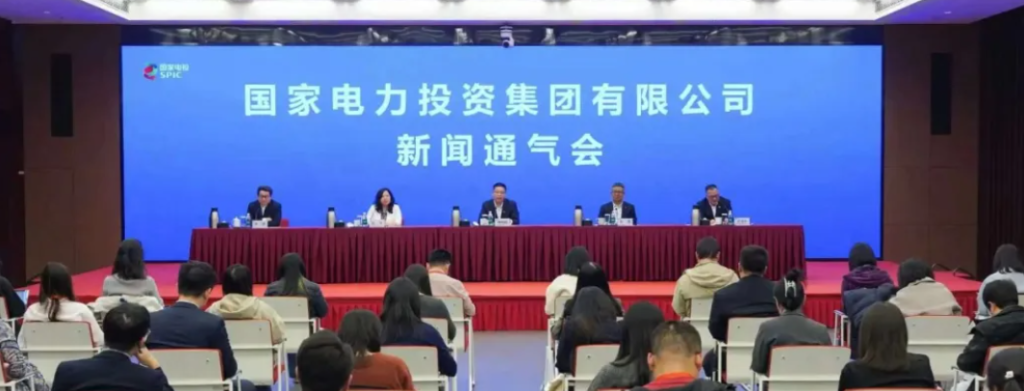
On March 23, at a press briefing in Beijing, the State Power Investment Corporation (SPIC) outlined its achievements under the 14th Five-Year Plan (2020–2025) and introduced its roadmap for the 15th Five-Year Plan (2026–2030). Hydrogen, alongside nuclear, solar, and wind, featured prominently as a pillar of technological innovation and long-term growth.
The 15th Five-Year Plan places a stronger emphasis on deep decarbonization, energy system flexibility, and strategic emerging industries, with hydrogen identified as a key vector for coupling renewable power with industrial demand. Within this framework, SPIC is positioning hydrogen not only as a technology pathway but as a system-level solution supporting a new-type power system.
With total assets reaching CNY 1.98 trillion (USD 270 billion), an increase of 57% over the past five years, and annual revenues exceeding CNY 400 billion, SPIC is leveraging its scale to accelerate the industrialization of hydrogen-based energy systems. The company reported total profits surpassing CNY 50 billion in the most recent fiscal year, underscoring its financial capacity to fund capital-intensive clean energy investments.
SPIC is one of China’s five largest state-owned power generation enterprises, alongside China Energy, Huaneng, Huadian, and Datang, and has the country’s largest installed renewable energy capacity. By 2025, its clean energy capacity exceeded 199 GW out of a total of 272 GW, accounting for about 73% of its portfolio.
Scaling green hydrogen in the 15th Five-Year Plan
During the 15th Five-Year Plan period, the centrepiece of SPIC’s hydrogen strategy is the consolidation and expansion of its green hydrogen business unit, SPIC Green Energy. Established in February 2026, the unit integrates upstream renewable generation, electrolysis-based hydrogen production, and downstream chemical conversion into ammonia, methanol, and sustainable aviation fuel (SAF).
This “power–hydrogen–chemicals” (P–H–C) model aligns with national policy priorities to enhance renewable energy consumption, improve grid flexibility, and develop green fuel alternatives. It also reflects a broader global shift toward Power-to-X (PtX) systems, in which surplus renewable electricity is converted into storable and transportable fuels.
Compared with standalone electrolysis projects, SPIC’s integrated approach aims to address intermittency challenges while improving overall system economics, an issue increasingly highlighted in China’s 15th Five-Year Plan discussions on balancing renewable expansion with system stability.
At the technical level, SPIC has developed a proprietary full-process flexible control system that dynamically balances intermittent wind and solar output with the steady-state requirements of ammonia synthesis. This addresses a key bottleneck in industrial-scale PtX deployment: while electrolyzers can ramp up and down, downstream Haber–Bosch processes typically require stable operating conditions.
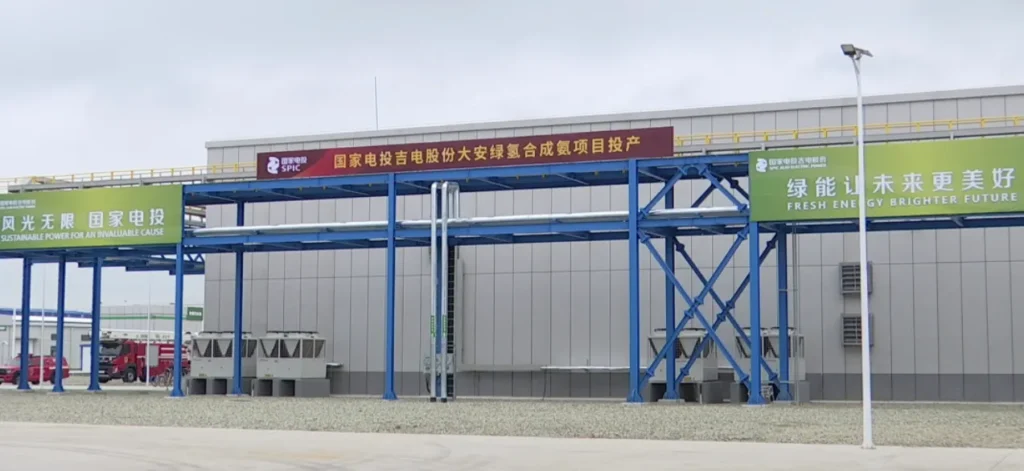
SPIC has resolved this mismatch through coordinated dispatch and cluster control technologies demonstrated in its Daan green ammonia project. The system enables real-time optimization across generation, hydrogen production, and synthesis units, effectively creating a “flexible industrial load” that can absorb renewable fluctuations, an increasingly important capability as renewable penetration rises across China.
Key projects and technical specifications
SPIC’s “3-3-3” hydrogen strategy under its 15th Five-Year Plan framework centres on three flagship projects:
- Daan green ammonia project: A large-scale pilot integrating wind and solar power with electrolysis and ammonia synthesis
- Lishu green methanol project: Targeting maritime fuel applications
- Lishu SAF project: Currently in the technical validation phase
These projects are intended to serve as industrial-scale demonstrations of green hydrogen-to-fuels pathways, supporting China’s broader push to decarbonize hard-to-abate sectors.
Each pathway targets specific end-use sectors:
- Ammonia: Fertilizers, coal power co-firing, and long-duration energy storage
- Methanol: Shipping fuel and chemical feedstock
- SAF: Aviation decarbonization
In parallel, SPIC is accelerating the development and industrialization of 300 MW-class F-grade gas turbines, which could provide flexible backup power and support grid stability—another priority under the 15th Five-Year Plan’s focus on system resilience.
Globally, green hydrogen costs remain in the range of $3–6/kg, depending on electricity prices and electrolyzer utilization. Integrated systems such as SPIC’s aim to improve utilization rates and reduce levelised costs, an explicit goal as China seeks to narrow the cost gap between green and fossil-based hydrogen during the 15th Five-Year Plan period.
Scale, markets, and policy alignment
SPIC’s hydrogen push is closely aligned with China’s dual objectives of energy security and carbon neutrality, both reinforced in the 15th Five-Year Plan. Green hydrogen reduces dependence on imported fossil fuels while enabling emissions reductions in sectors such as steel, chemicals, and aviation.
The company’s domestic deployment strategy is structured around a “two horizontal, one vertical” resource corridor:
- Northern region: Covering Heilongjiang, Jilin, Inner Mongolia, Xinjiang, and Gansu, this region accounts for the majority of China’s large-scale wind and solar bases, with GW-scale renewable projects and relatively low electricity costs, making it ideal for green hydrogen production.
- Yangtze River corridor: As China’s most industrialized region, this corridor concentrates steel, chemicals, and manufacturing demand, providing immediate offtake potential for hydrogen, ammonia, and methanol in high-emission sectors.
- Coastal regions: Provinces such as Liaoning, Jiangsu, Shanghai, and Guangdong serve as export hubs, with established port infrastructure that can support ammonia storage, methanol bunkering, and future hydrogen derivative exports.
This spatial strategy reflects the structural mismatch between resource supply and demand centres. By aligning project development with infrastructure planning, a key policy direction under the 15th Five-Year Plan, SPIC aims to improve asset utilization and reduce logistics costs.
Internationally, SPIC is targeting the Middle East, South America, and Southern Europe, consistent with China’s broader energy cooperation strategy. These regions offer strong renewable potential and access to future import markets, particularly in Europe, where demand for green fuels is expected to rise under tightening decarbonization mandates.
The commercial model prioritizes long-term offtake agreements for hydrogen derivatives such as ammonia and methanol, which are easier to transport and already embedded in global commodity markets.
Strategic implications for the hydrogen value chain
SPIC’s strategy reflects several structural shifts in the hydrogen economy, reinforced by 15th Five-Year Plan priorities:
Integration over fragmentation: The move toward vertically integrated systems supports greater efficiency, lower risk, and improved financing conditions for large-scale projects.
Derivatives as demand anchors: Ammonia, methanol, and SAF provide immediate market pathways, reducing reliance on still-developing hydrogen end-use markets.
Flexibility as a system requirement: As renewable penetration increases, the ability to synchronize power generation with industrial processes becomes critical.
Infrastructure as a strategic priority: Pipeline networks, port infrastructure, and storage systems are emerging as key enablers, and bottlenecks as well, of hydrogen scale-up.
Toward industrial-scale deployment
SPIC aims to complete its three flagship projects by 2030, achieving what it describes as “stable, long-cycle, high-load, and optimized” operations, a benchmark for industrial viability and a core objective of the 15th Five-Year Plan. If successful, the model could be replicated across China and expanded internationally, positioning SPIC as a global player in hydrogen-based energy systems.
SPIC’s strategy underscores a broader transition in China’s energy sector: from pilot-scale experimentation to system-level deployment of integrated renewable energy solutions. As the 15th Five-Year Plan period begins, the next phase of the hydrogen economy will be defined not by individual technologies, but by the ability to orchestrate entire value chains at scale and at low cost.