Policy clarity, automation advances, and integrated value-chain investments are converging to accelerate China’s transition from hydrogen pilot projects to GW-scale commercial deployment across energy, mobility, and storage sectors.
On March 25–27, the 5th China International Hydrogen Congress & Expo (CIHC 2026) took place in Beijing. As China’s largest hydrogen event, it attracted over 500 exhibiting companies. Anchored by major state-owned enterprises such as CHN Energy, State Grid, CRRC, CSSC and CASC, the event highlighted a coordinated push across the hydrogen value chain, from AEM materials breakthroughs and electrolyzer manufacturing to end-use applications.
A notable underpinning of this momentum is Wuxi LEAD Intelligent Equipment (LEAD), a globally leading supplier of intelligent manufacturing solutions across batteries, photovoltaics, and hydrogen. Often described as a “hidden champion,” the company plays a critical enabling role in scaling China’s hydrogen and new energy industries by delivering high-throughput, high-precision production lines that bridge laboratory innovation and mass manufacturing.
The exhibition coincided with the launch of China’s 15th Five-Year Plan (2026–2030), which positions hydrogen as a key “future industry,” with industry and policy sources projecting rapid expansion toward 100 GW-scale renewable hydrogen production capacity by 2030. This marks a critical shift from fragmented pilot projects toward system-level scale-up, with significant implications for global cost curves and supply chains.
Precision manufacturing meets GW ambitions
CIHC 2026 showcased the launch of domestic and global hydrogen technologies spanning materials, core components, and full-system equipment. A defining feature was the prominence of manufacturing enablers such as LEAD Intelligent, which presented a comprehensive suite of production equipment targeting bottlenecks in electrolyzer and fuel cell manufacturing.
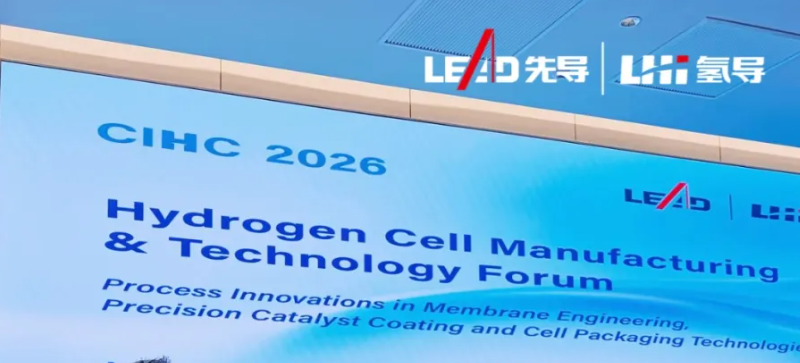
Focusing on precision engineering and scalable automation, LEAD Hydrogen Intelligence (LHI) is the hydrogen, fuel cell, and perovskite subsidiary of LEAD Intelligent. LHI positions itself not merely as an equipment supplier, but as a systems integrator enabling industrialization across the hydrogen and next-generation PV value chain.
As the industry pivots from pilot projects to large-scale deployment, manufacturing capability has emerged as a key differentiator. The technologies presented reflect a shift toward standardization, throughput optimization, and yield improvement – key levers for cost reduction at scale. In this context, LHI’s solutions illustrate how engineering precision translates directly into commercial viability.
Electrolyzer and fuel cell production
At the core of the LEAD exhibition was a new generation of automated manufacturing systems designed to unlock scale efficiencies:
- Fuel cell single-cell fabrication equipment achieves ±0.5 mm alignment precision at continuous speeds of 2.5 m/min, enabling packaging throughput of 6 PPM.
- PEM and AEM electrolyzer stack assembly systems demonstrate stacking precision of ±0.1 mm and annual production capacity of up to 2 GW per line, placing China at the forefront of GW-scale electrolyzer manufacturing.
Advanced coating technologies address one of the most technically challenging steps in membrane electrode assembly (MEA) production:
- Large-roll coaters deliver coating uniformity within ±5% and alignment below 0.5 mm at speeds up to 10 m/min.
- Ion membrane coating systems achieve thickness uniformity of ±1 μm and oven temperature control within ±2°C, critical for reducing defect rates in high-performance membranes.
Testing platforms improve gas analyzer response rates by 75%, enabling accurate simulation of intermittent renewable power inputs—a key requirement for integrating hydrogen production with wind and solar variability.
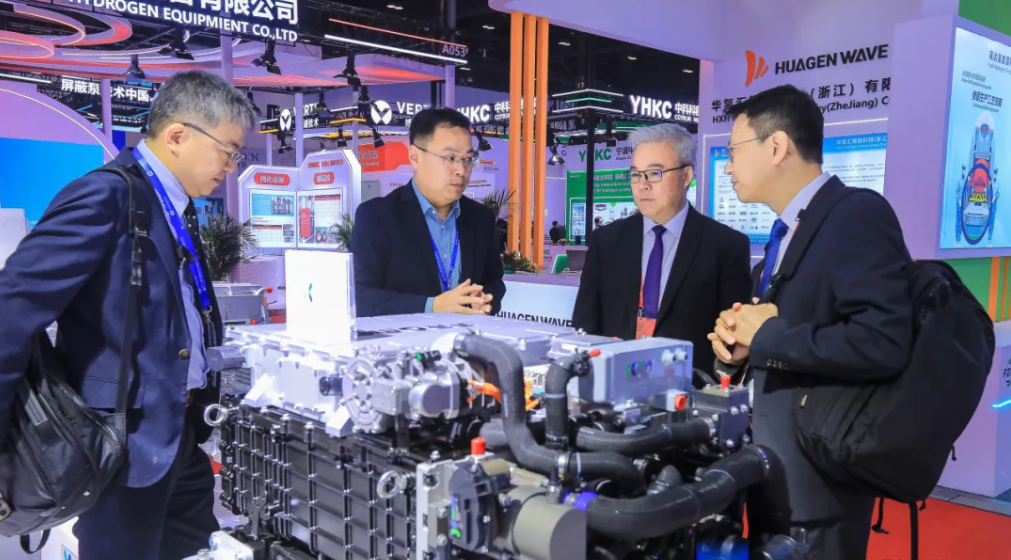
SHPT: 300 kW fuel cell systems for mobility
SHPT, a spinoff of SAIC, introduced its PROME M5H fuel cell stack and P5H system at CIHC 2026, targeting the 200–300 kW segment for heavy-duty transport. Compared with previous iterations, rated efficiency improved by approximately 15%, while volumetric power density and durability increased by nearly 50%, reaching internationally competitive performance levels.
With automated manufacturing equipment supplied by LEAD, the systems are scheduled for mass production in Q4 2026 and are designed for long-haul trucks, with potential expansion into rail, marine, and stationary power applications.
In parallel, SHPT’s smaller-format systems broaden hydrogen’s application scope:
- F-series (6 kW) fuel cell systems for drones achieve ≥630 W/kg power density, enabling longer endurance for inspection, logistics, and emergency response scenarios.
- R-series (300 W) systems for two-wheel vehicles offer over 100 km of range with a maximum speed of 25 km/h at vehicle weights below 55 kg, targeting urban mobility, shared transport, and last-mile delivery.
Energy storage manufacturing integration
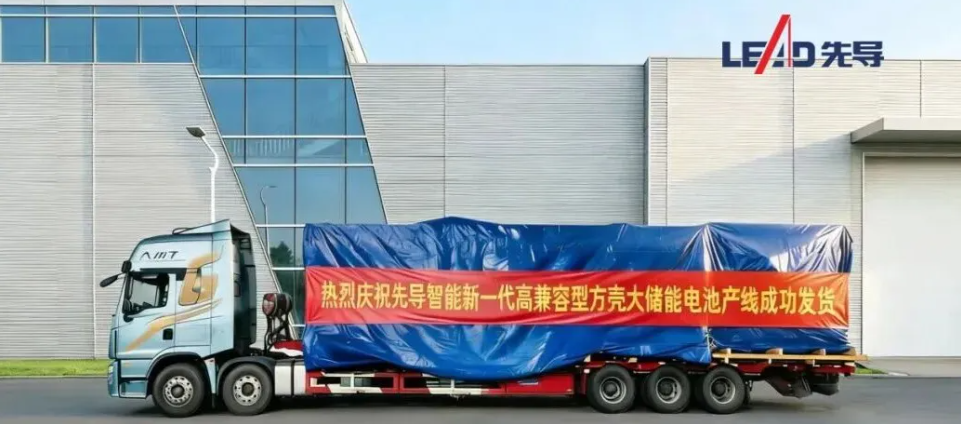
Earlier this month, LEAD Intelligent delivered a next-generation prismatic battery production line to a top green energy solutions developer, capable of handling 314 Ah to 600 Ah cells, with a design capacity of 17 PPM (pieces per minute). Key technical features include:
- Flexible manufacturing: model changeover time reduced by 58%, with line utilization exceeding 80%
- Footprint optimization: 40% reduction in floor space through a streamlined layout
- Energy efficiency: 30% electricity savings and 15% gas savings
Quality control advancements:
- CT resolution of 20 μm with <0.15% false detection rate
- 3D vision detecting weld defects as small as 0.2 mm with <0.05% false positives
- Overall yield exceeding 99%
These metrics position the line as a benchmark for 500 Ah+ “mega-cell” production, a segment increasingly critical for grid-scale energy storage.
Cost curves, capacity, and policy alignment
Overall, the technical advances displayed at CIHC 2026 directly address the three primary cost drivers in hydrogen deployment: capital expenditure (CAPEX), operational efficiency (OPEX), and system durability.
- Manufacturing scale and automation
The transition from semi-automated to fully automated intelligent production, evidenced by multi-GW electrolyzer lines and high-throughput MEA fabrication, could reduce equipment costs by 20–40% over the next five years, based on industry benchmarks. - Policy-driven demand visibility
The 100 GW renewable hydrogen projection provides a strong demand signal. By comparison, global installed electrolyzer capacity was about 10 GW at the end of 2025, implying a potential tenfold expansion within a single national market. - Integrated value chain economics
China’s approach—linking upstream equipment suppliers such as LEAD Intelligent with system integrators and end users—reduces transaction costs and accelerates industrial learning cycles. State-owned enterprises act as anchor scale-up drivers, de-risking capital investment. - Mobility and distributed energy expansion
The emergence of standardized fuel cell systems across a wide power range (300 W to 300 kW) suggests a modular commercialization pathway, enabling faster adoption across micromobility, UAVs, logistics, public transport, and industrial mobility.
Global competition and industrial policy
As China’s hydrogen ecosystem matures, its implications extend beyond domestic deployment to global market dynamics. The combination of policy support and manufacturing depth is beginning to reshape competitive benchmarks and cost expectations.
I. Cost leadership in hydrogen equipment
The convergence of high-precision manufacturing and scale economics positions China to replicate its photovoltaic trajectory in hydrogen. If electrolyzer costs fall below $300/kW, compared with current global averages of $500–1,000/kW, Chinese suppliers could gain a decisive export advantage.
II. Acceleration of hydrogen corridors
Improved heavy-duty fuel cell performance aligns with China’s push to develop long-haul hydrogen transport corridors, with enhanced durability and efficiency directly lowering the total cost of ownership.
III. Convergence of hydrogen and storage ecosystems
Parallel advances in battery manufacturing highlight a dual-track strategy: hydrogen for long-duration and industrial applications, and batteries for short-duration grid balancing—reinforcing the strategic role of LEAD Intelligent.
IV. Technology standardization and global benchmarks
Precision metrics such as ±0.1 mm stack alignment or 20 μm defect detection signal a maturing industry moving toward standardized manufacturing tolerances, accelerating certification and interoperability.
V. Competitive pressure on Western OEMs
European and Japanese manufacturers, historically dominant in hydrogen and FCEV technologies, may face pressure as Chinese firms close performance gaps while leveraging lower production costs and faster scaling capabilities.