On November 16, China Central Television (CCTV) premiered the documentary Great Views of Industrial Technology. Its first episode featured UtmoLight and the world’s first GW-scale perovskite PV manufacturing facility in Wuxi – a major hub of China’s solar industry.
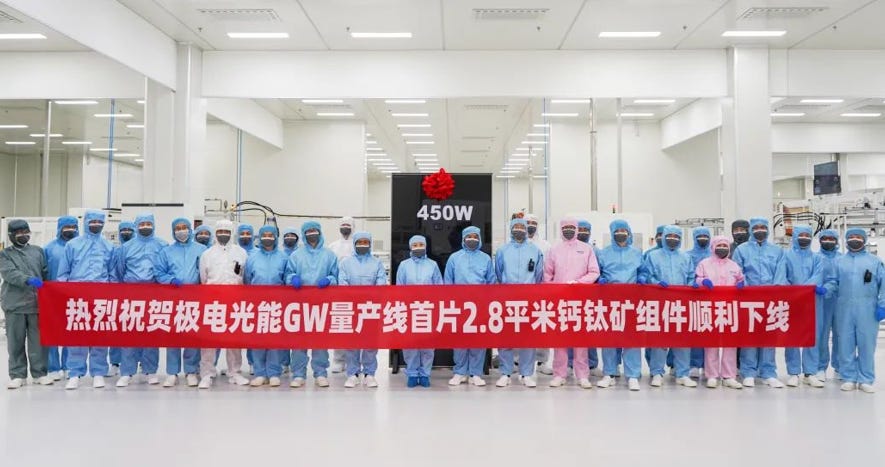
The GW-scale line produced its first 2.8-sqm single-junction perovskite module in November 2024 (photo above), achieving a power output of 450 W and a full-area efficiency of 16.1%. This marked a major step for perovskite modules, advancing the technology from pilot-scale demonstrations to industrial production and early commercialization.
In summer 2025, the 2.81-sqm modules achieved further gains, reaching 490 W output and 17.44% full-area efficiency – a new industry record. For comparison, current 2.0-sqm high-efficiency residential silicon PV modules typically deliver 400–430 W with 19–21% full-area efficiency.
From the establishment of its first R&D center in 2020 to the commissioning of its first 100 MW-scale perovskite production line in 2023 and the launch of its GW-scale production line in 2024, UtmoLight has achieved major technological breakthroughs almost every year. It pioneered flash-evaporation deposition equipment and high-stability, multi-source composite crystallization systems that enable uniform, defect-controlled films at industrial throughput, breaking world records for perovskite module efficiency nine times.
R&D and Manufacturing Showcase
UtmoLight’s R&D and manufacturing center in Wuxi is a showcase of the latest perovskite innovation. Its perimeter wall, spanning hundreds of meters, is built from more than 3,000 perovskite PV panels, with a total installed capacity of 256 kW and an annual energy output of 168 MWh.
Key Technologies
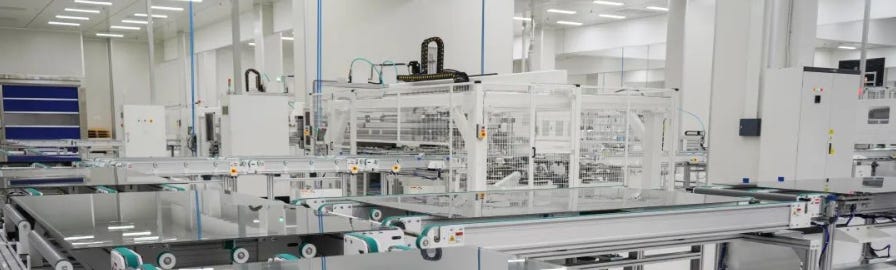
UtmoLight’s perovskite modules are produced using its proprietary Jichuang+ system, employing a no-crack, integrated film-deposition process. The main features include:
- Ultra-thin active layer: Perovskite films are deposited at 0.5 μm (about 1/200th the thickness of an A4 sheet), maximizing material efficiency without compromising performance.
- In-situ solid-film crystallization: Ensures uniform large-area perovskite layers with high grain quality and minimal defects, enabling industrial-scale production.
- Advanced material formulation: Methylamine-free perovskite compositions combined with interface passivation reduce degradation and improve consistency.
- Optimized transport layers: Dense electron and hole transport layers enhance conductivity, protect the perovskite absorber from degradation, and improve module efficiency and long-term stability.
- Scalable module design: Modules up to 2.8 sqm are manufactured at GW-scale production lines, bridging the gap between lab breakthroughs and commercial deployment.
Technical Features
- Energy efficiency: 2.81-sqm modules deliver 490 W output at 17.44% full-area efficiency, setting a new benchmark for large-format perovskite modules.
- Low carbon footprint: Production temperatures remain below 150 °C, consuming only one-quarter of the energy required for crystalline silicon.
- Weak-light performance: The modules generate additional energy under low irradiance compared with conventional crystalline-silicon modules, making them ideal for urban or partially shaded environments.
- Design flexibility: Modules can be transparent, flexible, or custom-shaped for façades, canopies, and multifunctional PV systems.
- Certifications: TÜV Rheinland IEC, RoHS, and JPAC certifications cover the entire product lifecycle from production to recycling.
Commercial Relevance
UtmoLight demonstrates that perovskite technology can scale to GW-level production without compromising efficiency, stability, or environmental compliance, addressing major commercialization barriers.
Scale and market potential: Its GW-scale production line represents a leap from 100 MW-scale pilot operations to full industrial capacity, enabling rapid deployment. The integrated production architecture significantly reduces supply-chain complexity and operating costs.
Cost competitiveness: Estimated per-kW production costs for single-junction perovskite modules are CNY 160–200 lower than crystalline silicon. Continued advances in deposition control, yield management, and intelligent manufacturing are expected to further reduce costs.
Efficiency outlook: Current 2.81‑sqm modules achieve 17.44% efficiency, with projections to reach 22–23% within two years and long-term potential of 25%, surpassing crystalline silicon.
BIPV integration: Perovskite panels at UtmoLight’s R&D and Manufacturing Center generate 14 MWh per month, meeting approximately 8% of the building’s energy needs. Integrated into the building envelope, these building-integrated photovoltaics (BIPV) combine aesthetic design with high-efficiency power generation.
Global market access: Large single-junction perovskite modules have obtained IEC 61215 performance-and-reliability and IEC 61730 safety certifications, enabling exports and driving global adoption of Chinese perovskite technology. Its 150 MW pilot line has run continuously for nearly three years, and the GW-scale production line is now fully operational, producing 0.72‑sqm and 2.81‑sqm modules with TÜV, CQC, CCC, cTÜVus (U.S. & Canada), and EU RoHS certifications.
Durability: The Key Challenge
Longevity is critical for perovskite commercialization. UtmoLight’s single-junction modules have undergone 1–2 years of outdoor field testing across various climatic regions in China, demonstrating preliminary commercial viability.
After extensive research into degradation mechanisms, UtmoLight has developed targeted mitigation strategies, with a particular focus on ion migration (especially iodide migration), implemented through a four-pronged stability approach:
- Control – Reduce defect density and suppress ion generation through interface passivation and additive engineering.
- Block – Inhibit ion migration by passivating defect sites and substantially increasing the activation energy required for ion transport.
- Seal – Confine ion migration within the perovskite film or its grains using passivation layers or highly dense charge-transport layers.
- Extract – Accelerate carrier extraction via interface passivation, preventing the formation of a “microscopic chemical environment” that gives rise to mobile ions or other defects.
UtmoLight is actively accelerating aging tests, IEC/ISOS reliability protocols, and outdoor demonstrations to validate long-term performance and commercial viability, complementing its efforts in large-scale field deployments.
In August 2025, China Huaneng commissioned the world’s first 5 MW perovskite demonstration project (see the link) at a site about 3,000 m above sea level in Qinghai Province, northwest China, to test the performance and durability of perovskite panels under intense UV and high-irradiation conditions. UtmoLight is one of the perovskite module suppliers for the project, alongside GCL Optoelectronic, Microquanta, and Renshine Solar.
Strategic Location: Wuxi, China’s Solar Hub
Globally, perovskite PV is transitioning from the lab to pilot deployment. It is rapidly narrowing the efficiency gap with crystalline silicon while offering distinct advantages in cost, weak-light performance, and design flexibility. UtmoLight is driving market deployment with scalable BIPV solutions that integrate seamlessly into architectural and urban energy systems.

One notable example is Wuxi Symphony Concert Hall, set to open on January 1, 2026, where more than 12,000 perovskite PV tiles form a “dragon-scale” roof – marking the first major application of perovskite BIPV roofing in the architectural sector. This project demonstrates the technology’s adaptability, durability, and aesthetic potential in real-world environments.
“Architecture is frozen music.” – J. W. von Goethe (1749–1832)
Wuxi’s relationship with music stretches back over 2,500 years, beginning in the Spring and Autumn Period (770–476 BC), when Wuxi natives celebrated a variety of musical styles. As China’s only “City of Music,” designated by UNESCO, Wuxi today is building global connections through music and architecture. The Symphony Hall stands as a testament to how modern sustainable technologies can weave together functionality, artistry, and the timeless rhythm of cultural heritage.
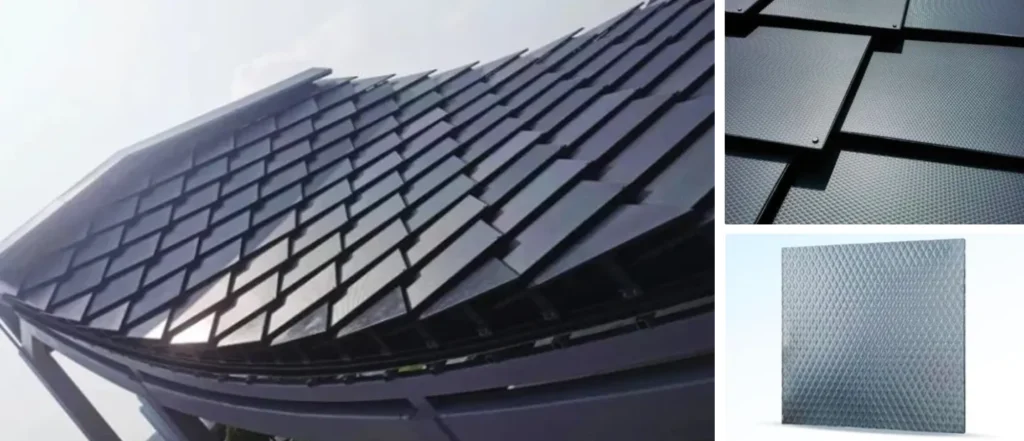
The hall roof combines high-performance photovoltaics with aesthetic design. Its perovskite PV tiles feature innovative material compositions, structures, and surface morphologies. Building-grade polymer films soften optical effects, while structured surface patterns enhance light trapping, increasing conversion efficiency and reducing glare. Advanced perovskite quantum-dot technology further maximizes power generation.
Covering 7,000 sqm, the roof has a total installed capacity of 1.24 MW and is expected to generate 1.2 GWh annually. The dragon-scale overlapping layout captures sunlight from all angles, provides shading, and helps regulate indoor temperature and humidity. All related technologies are patented, marking their first application in the architectural sector.
Located in the center of the Yangtze River Delta, Wuxi is a major hub of China’s next-generation PV industry, with a well-established ecosystem fully integrated into high-end domestic and international supply chains for precursor materials, cells, modules, encapsulation technologies, and intelligent manufacturing equipment.
Major manufacturers, including Suntech Power, have developed global PV supply chains from Wuxi since the mid-2000s. In 2024, Huasun Energy launched a 3.6 GW heterojunction (HJT) cell factory, the world’s first 210R HJT mass-production line, further solidifying Wuxi’s position as a center of advanced solar manufacturing.
In November 2025, Huasun released its 770 W HJT solar module, the Himalaya HSN‑212‑B132, featuring a 132‑cell bifacial double-glass design measuring 2,384 × 1,303 × 33 mm and weighing 36.5 kg, with 23.5–24.8 % efficiency under an ultra-high 2,000 V system voltage. Durability and high-voltage reliability are ensured by a perforation-free butyl edge seal and split-cell design, while the 2,000 V system lowers balance-of-system costs, saving up to CNY 150/kW compared with 1,500 V systems.
Toward a Green Energy Future
Globally, perovskite PV are emerging as a transformative complement to established solar technologies. Countries across Asia, Europe, and North America are accelerating investment in research, pilot lines, and industrial partnerships.
UtmoLight’s GW-scale perovskite production line marks a milestone for global solar technology. By combining defect-controlled precision film deposition and interface engineering with AI-driven manufacturing, the company demonstrates that perovskite PV is both technically robust and commercially viable. With efficiencies approaching those of crystalline silicon, significantly lower production costs, and effective control of durability challenges, perovskite PV is poised to reshape solar economics.
For China, perovskites represent new export and industrial growth opportunities. For global solar, solar-storage, and real estate project developers, they offer a new class of high-performance, low-cost modules that deliver higher energy yields, greater design flexibility, and faster project payback.
Investors and policymakers will be closely watching how GW-scale perovskite production impacts cost curves, supply chain integration, and global competitiveness.