A new tender led by China’s top market regulator aims to establish the country’s first mandatory national safety standards for liquid hydrogen (LH2) storage and transport equipment, accelerating commercialization while tightening oversight of high-risk hydrogen infrastructure.
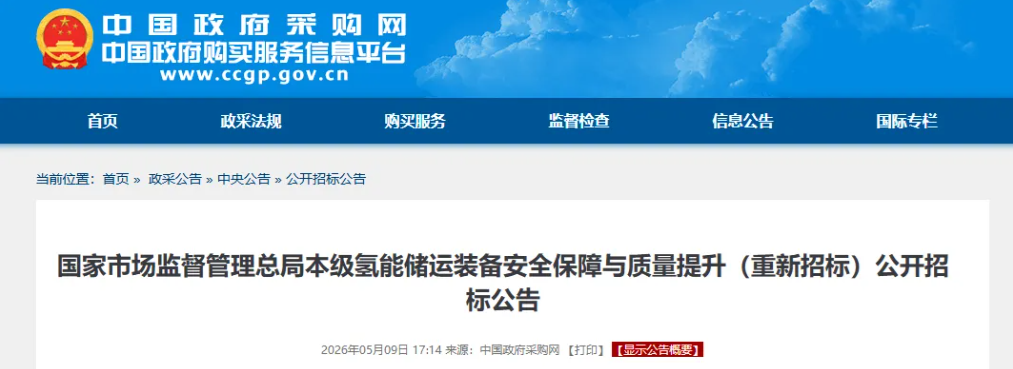
On May 9, the China Government Procurement Network announced a re-tender for a national hydrogen equipment safety and quality improvement project led by the State Administration for Market Regulation (SAMR), China’s principal regulator for special equipment safety.
The project covers the development of five core national standards for saturated liquid hydrogen cylinders, cylinder valves for LH2 service, high-pressure spherical hydrogen storage vessels, steel-strip wound stationary high-pressure hydrogen containers, and hydrogen liquefaction heat exchangers.
The tender has a total budget of CNY 2.45 million (USD 340,000) and must be completed by December 31, 2026 — an unusually compressed schedule for a multi-standard national regulatory program involving complex cryogenic and pressure-vessel technologies.
The procurement was first launched on April 17, 2026, but was cancelled after fewer than three bidders passed qualification review, underscoring the technical barriers and limited number of domestic institutions capable of undertaking advanced hydrogen-equipment standardization work. The re-tender closes on June 1.
From recommended guidance to mandatory regulation
The significance of the project lies less in its monetary value than in its regulatory status.
China already maintains several recommended national standards for liquid hydrogen, including:
- GB/T 40045-2021, covering LH2 fuel specifications for fuel cell vehicles
- GB/T 40060-2021, governing LH2 storage and transport requirements
- GB/T 40061-2021, defining technical specifications for LH2 production systems
However, these are advisory rather than mandatory standards.
The newly tendered framework is materially different. Because it is being led directly through SAMR’s special-equipment regulatory system, the standards will sit within China’s mandatory industrial safety regime governing pressure vessels and hazardous equipment.
In practical terms, this elevates the standards from technical guidance documents to what industry participants describe as “special-equipment access-level” regulations, creating compulsory technical and safety thresholds for future hydrogen infrastructure deployment.
The initiative marks China’s first coordinated effort to establish a mandatory national safety standard system specifically targeting LH2 storage and transport hardware, including pressure vessels, cylinders, valves, and cryogenic heat exchangers.
For the hydrogen industry, the move represents a broader transition from fragmented engineering practices toward formalized industrial governance and nationally unified compliance requirements.
Standardization aimed at accelerating deployment
The timing aligns closely with China’s broader hydrogen commercialization strategy.
Over the past three years, local governments and state-owned enterprises have accelerated investment in hydrogen production hubs, refueling networks, fuel cell vehicle fleets, and integrated renewable hydrogen projects. Yet deployment of LH2 infrastructure has lagged behind policy ambition.
One of the sector’s primary constraints has been the absence of unified mandatory safety standards for critical equipment. Without nationally recognized compliance benchmarks, local regulators and project approval authorities have often relied on project-specific engineering reviews, extending permitting timelines and increasing uncertainty for developers and investors.
Industry executives say the new standards could materially reduce regulatory friction.
A formalized national framework would provide clearer technical benchmarks for equipment manufacturers, EPC contractors, hydrogen operators, insurers, and local safety regulators. It could also create a more predictable approval pathway for large-scale hydrogen infrastructure projects.
That is particularly important for liquid hydrogen production bases, bulk transport systems, import terminals, and future hydrogen corridor networks, all of which require high-capital, long-duration investments that are highly sensitive to regulatory uncertainty and safety compliance risk.
The compressed execution timeline further reflects policymakers’ urgency.
Winning bidders must complete the full standards-development cycle — including technical research, drafting, consultation, validation, industry review, and regulatory submission — in less than eight months.
Such schedules are aggressive even by industrial standardization norms, especially given the technical complexity of cryogenic hydrogen systems and China’s still-limited operational experience in large-scale LH2 deployment.
Strategic implications extend beyond safety
Beyond risk management, the tender also carries broader industrial-policy implications.
China is increasingly seeking to localize critical hydrogen technologies while reducing dependence on foreign engineering standards and imported high-end equipment.
Companies and engineering groups in Japan, Europe, and the United States have historically dominated key segments of the LH2 value chain, including cryogenic storage systems, hydrogen liquefaction technologies, and ultra-low-temperature transport engineering.
By codifying its own mandatory standards, China could accelerate domestic supply-chain maturation, support local equipment manufacturers, and strengthen the competitiveness of local hydrogen technologies in future global markets.
The tender’s explicit acceptance of consortium bids is also notable. The provision suggests regulators expect collaboration among research institutes, equipment manufacturers, testing organizations, certification bodies, and engineering firms — reflecting the multidisciplinary nature of hydrogen safety engineering and the limited concentration of expertise within any single organization.
More broadly, the initiative signals that China’s hydrogen strategy is entering a new phase: moving beyond demonstration projects toward industrial-scale deployment supported by a formal regulatory and safety framework.