Shanghai’s subsea facility combines offshore wind generation, seawater cooling, and ultra-low-PUE computing infrastructure, offering a potential blueprint for energy-intensive AI and cloud workloads.
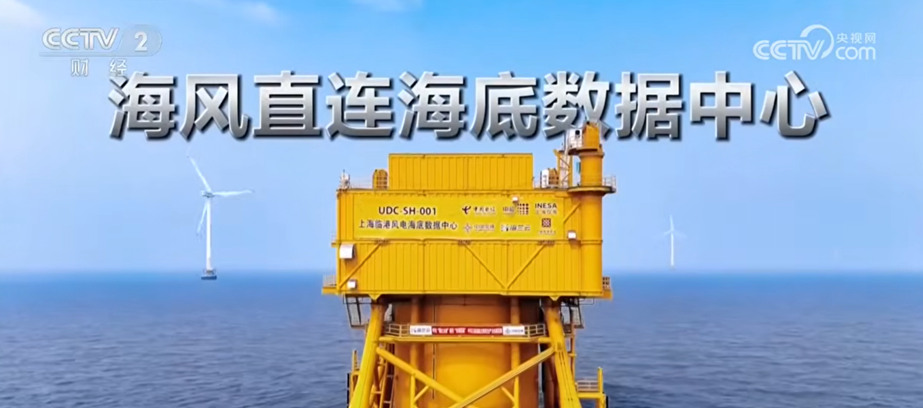
China has taken a significant step toward integrating renewable energy directly with digital infrastructure through the commercial deployment of the world’s first operational undersea data centre powered primarily by offshore wind energy.
Located in the East China Sea off Shanghai Lingang, the project represents one of the clearest examples of China’s emerging “compute-power coordination” strategy – an industrial and policy framework aimed at aligning fast-growing computing demand with low-carbon electricity supply.
Developed in waters 10 metres deep, the project combines subsea computing infrastructure with a nearby 200 MW offshore wind farm. Total planned investment stands at CNY 1.6 billion (USD 220 million). The full development is designed for 24 MW of computing capacity, while the first commercial demonstration phase has deployed 2.3 MW.
The facility highlights how China is attempting to address a growing structural challenge facing global AI and cloud markets: rapidly rising compute demand colliding with increasingly constrained power availability, land resources, and cooling capacity.
A new model for AI-era data centres
The Lingang project differs fundamentally from conventional terrestrial hyperscale data centres. Rather than transmitting renewable electricity inland to power server campuses, the model colocates computing infrastructure directly alongside offshore generation assets.
The undersea data centre sits roughly 500 metres from an offshore wind farm comprising more than 50 turbines. The wind installation generates more than 500 GWh annually, with over 95% of the data centre’s electricity supplied directly through integrated photoelectric composite subsea cables.
The architecture reduces transmission losses while improving renewable-energy utilisation rates, effectively turning offshore wind generation into a dedicated power source for digital infrastructure.
The first-phase facility contains four rack layers, each covering about 160 square metres. The subsea chamber houses 192 server racks operating at roughly 12 kW per rack, with thousands of servers running continuously beneath the sea to support cloud services, internet applications, and increasingly AI-oriented workloads.
At current configurations, rack density already exceeds that of many conventional enterprise data centres in Asia, reflecting the industry-wide shift toward higher-density AI computing infrastructure.
Thermal management is central to the project’s technical proposition. The facility uses a passive refrigerant circulation system that leverages seawater as the primary heat sink, eliminating freshwater consumption for cooling. According to project operators, the facility achieves a power usage effectiveness (PUE) below 1.15, placing it within the efficiency range targeted by leading global hyperscale operators.
For AI-focused infrastructure, cooling efficiency is becoming increasingly critical. High-performance GPU clusters can consume several times more power per rack than traditional enterprise servers, intensifying pressure on both electrical and thermal management systems. The Lingang model attempts to address both simultaneously through integrated energy and cooling design.
Commercial expansion beyond pilot phase
Project operators are now moving beyond proof-of-concept toward industrial-scale deployment.
Following the commercial validation of the 2.3 MW Lingang Phase I, design and operations teams are preparing standardized subsea modules ranging from 5 MW to 7 MW per unit. Future deployments are expected to involve multiple interconnected subsea chambers operating in parallel.
Planned expansion targets several of China’s major coastal economic regions, including the Yangtze River Delta, Pearl River Delta, and Bohai Rim – areas that combine strong AI-driven compute demand with growing renewable-energy integration requirements.
From a business-model perspective, the architecture could establish a new value chain linking offshore wind developers, telecom infrastructure providers, cloud-computing operators, and AI-service companies. The model also offers a potential pathway for offshore wind projects to secure higher-value electricity demand amid increasing grid congestion and renewable curtailment pressures.
Implications for China’s energy and digital strategy
“Compute-power coordination” has become an increasingly prominent policy framework in China’s digital-economy planning, as policymakers seek to geographically align computing infrastructure with renewable-energy resources.
Historically, China pursued this strategy through large inland data-centre clusters in western provinces rich in wind, solar, and hydro resources. The offshore model extends the same logic to coastal regions where latency-sensitive applications, industrial demand, and digital-economy activity are concentrated.
The project also places China at the forefront of an emerging segment within green digital infrastructure. Experimental underwater data-centre concepts have previously been explored by companies including Microsoft through Project Natick, as well as by projects such as Subsea Cloud. However, Lingang appears to represent the first fully commercialized offshore wind-connected subsea deployment operating at a meaningful scale.
Significant challenges remain. Long-term subsea maintenance, corrosion control, equipment replacement logistics, and operational reliability will ultimately determine whether the model can achieve broad commercial competitiveness.
Nevertheless, the project points toward a future in which offshore renewable energy, subsea infrastructure, and AI computing evolve together. As demand for high-density computing rises, coastal and offshore environments could become strategic hubs for next-generation digital infrastructure, combining clean power, seawater cooling, and scalable modular deployment.