On December 8, Qingling Motors delivered 500 units of 49-ton hydrogen fuel cell trucks in Hami, Xinjiang. Equipped with Bosch’s 300 kW fuel cell engines, the fleet will serve long-distance heavy-haul routes in support of China’s national “Xinjiang coal-to-east” energy strategy.
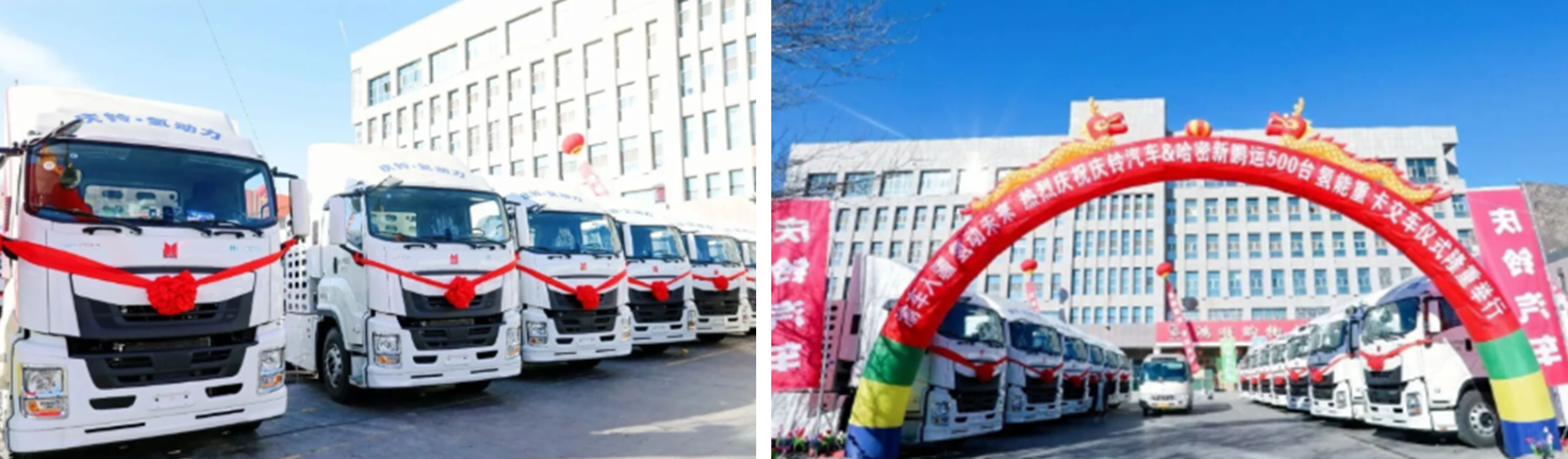
The 500-unit fleet will operate along a cross-provincial hydrogen logistics corridor connecting the Naomaohu mining area in Xinjiang with Guazhou in Gansu. This route is a critical energy artery transporting coal and coal-chemical products from western production bases to central and eastern China.
Before this delivery, a pilot fleet of 65 hydrogen heavy-duty trucks had already been operating for an extended period in the Naomaohu area under some of the world’s most demanding logistics conditions. The large-scale rollout now places the region among the most advanced nationwide in fuel cell truck deployment. Looking ahead, Qingling plans to deploy an additional 1,500 hydrogen heavy-duty trucks in Xinjiang by 2026.
Powertrain and Vehicle Platform
In 2021, with an investment of CNY 2.98 billion, Bosch Hydrogen Powertrain Systems (Chongqing) was established. The company is a 60:40 joint venture between Bosch China and Qingling Motors, focused on fuel cell powertrain R&D and manufacturing. Key components, such as fuel cell stacks and air compressors, are supplied by Bosch’s production facilities in Wuxi.
To meet the stringent logistics requirements of the Naomaohu–Guazhou corridor, Bosch and Qingling jointly developed a highly robust fuel cell powertrain and vehicle platform for extreme operating conditions. The system was specifically tailored to Xinjiang’s environment, capable of handling elevations up to 2,300 meters, sustained uphill gradients of 241 kilometres, and temperatures as low as –43 °C.
1. Fuel-cell system performance
Powered by Bosch’s 300 kW PEM fuel cell engine, the trucks’ key performance metrics include:
- 63% peak efficiency, placing it among the highest-performing heavy-duty PEM systems globally – well above the typical 50–55% of previous-generation stacks.
- Real-world range over 500 km at full 49-ton gross vehicle weight, enabled by high-pressure hydrogen storage and advanced thermal management.
- Cold-start capability to –40 °C, critical for winter operations in the Tianshan region, where temperatures routinely fall below –30 °C.
- Four-speed e-drive axle optimized for steep grades such as the Tianshan crossing.
The 300 kW module has undergone extensive field trials across urban logistics, mining, and long-haul operations. Bosch’s full product categories (76 kW, 134 kW, 190 kW, and 300 kW) cover applications from light trucks to Class-8 equivalents.
2. Qingling’s vehicle architecture
Since 2020, Qingling has invested heavily in commercial FCVs, establishing integrated R&D, manufacturing, and quality-control systems. The company has secured more than 100 patents related to hydrogen powertrains and vehicle integration. Its vehicle architecture provides high power density, outstanding safety and reliability, and advanced thermal management, key advantages for Xinjiang’s extreme temperature fluctuations and harsh road conditions.
Notably, its 49-ton model is the only hydrogen truck capable of traversing the Tianshan Mountains while meeting Xinjiang’s heavy-load coal-transport requirements.
In February 2025, Qingling’s hydrogen heavy-duty truck completed a 900-kilometre Tianshan crossing in 13 hours under extreme conditions, becoming the first and only hydrogen heavy-duty truck in China to conquer the Tianshan route.
One month later, the truck completed a 2,600-kilometre round trip along West China’s Hydrogen Corridor Route, carrying a 49.6-ton payload in just 35 hours. It achieved hydrogen consumption as low as 1.9 g per ton-kilometre, setting a new benchmark for high-payload, high-speed, low-consumption hydrogen trucking.
3. Bosch–Weifu partnership
Bosch’s fuel cell facility in Wuxi, its first fuel cell R&D center outside Germany, plays a critical role in supplying fuel cell stacks for China’s growing FCV market. The center began small-scale production in 2021 and now operates a dedicated stack production line.
Bosch has also expanded its long-standing partnership with Weifu High-Technology Group (Weifu), a leading Chinese automotive components supplier, into the fuel cell sector. Under a 2023 strategic cooperation agreement with the Wuxi National Hi-Tech Industrial Development Zone, Bosch and Weifu committed to localizing and commercializing hydrogen fuel cell systems and electrified powertrains.
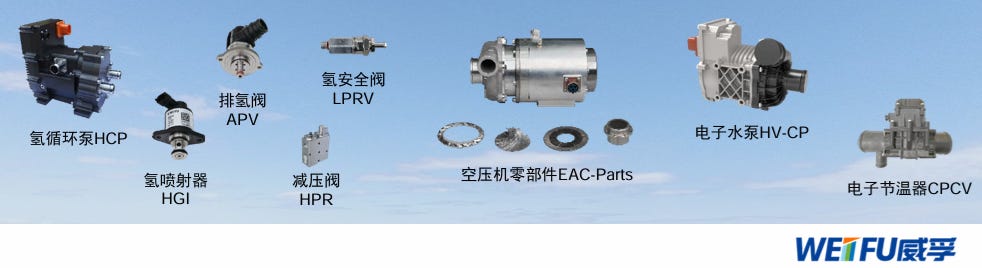
Weifu has since established a production base in Wuxi capable of manufacturing millions of bipolar plates, MEAs, and BOP components – core building blocks for Bosch’s fuel cell stacks and systems.
Together with other Wuxi-based hydrogen players, including Wuxi LEAD, Envision, LONGi Hydrogen, Shuangliang, Triumph Gases, and FAWDE, this Bosch–Weifu partnership has helped transform Wuxi into a world-class hydrogen manufacturing hub, significantly strengthening China’s capabilities in advanced fuel cell systems and hydrogen technologies.
Building on this momentum, Weifu further strengthened its position in June 2024 through a partnership with Germany-based Voith HySTech GmbH to establish two joint ventures: a global JV led by Voith and a China-focused JV in Wuxi, in which Weifu holds a 51% stake. The China JV will develop, manufacture, and commercialize high-pressure hydrogen storage systems for mobility and energy applications, leveraging Weifu’s local manufacturing expertise and extensive industrial network.
Building a National-Level Hydrogen Freight Corridor
The Naomaohu–Guazhou (Hami-Gansu) corridor is positioned to become one of China’s first fully commercial, cross-provincial hydrogen trucking routes. The rollout has already set several industry “firsts” – including the world’s largest single-OEM hydrogen heavy-truck fleet and the most concentrated hydrogen-logistics application scenario (coal transport).
This reflects three structural shifts as China’s FCV market transitions from CapEx-heavy pilots to OpEx-optimized fleets:
- OEM–supplier alignment: Localization of stacks, system integration, and vehicle manufacturing, such as the Bosch-Qingling collaboration, reduces costs and shortens delivery cycles.
- Fleet-operator partnerships: Mining and logistics operators provide stable, high-mileage duty cycles essential for vehicle utilization and cost amortization.
- Regional infrastructure investment: Local governments and energy providers fund upstream capital expenditures (renewables, hydrogen production, refuelling stations), enabling fleet operators to focus on low-cost operations and high utilization to improve bankability.
This mirrors the rollout model that accelerated electric-bus adoption in China a decade ago, indicating hydrogen freight may follow a similar scale-up trajectory.
From Demonstration to a Replicable National Model
Advancing from the early pilot, the 500-truck deployment reveals three patterns:
- Application scenario matters: Heavy-duty, long-distance, high-utilization freight in cold climates represents the ideal early market for fuel cell trucks.
- Ecosystem integration outweighs isolated innovation: Low-cost hydrogen, stable freight demand, and supportive policy must align to achieve commercial viability.
- Scale drives cost reduction: As hydrogen production grows and utilization rises, total cost of ownership is expected to decline further, enabling adoption beyond demonstration zones and potentially in global markets.
Bosch’s hydrogen journey in China, from early fuel cell R&D in Wuxi to supplying engines for what is now the world’s largest hydrogen heavy-truck fleet, reflects the rapid progression of China’s hydrogen FCV sector. For Bosch and its partners, the 500-unit rollout reinforces their position as global leaders in high-efficiency fuel cell manufacturing.
As the Naomaohu-Guazhou hydrogen corridor moves toward full-scale operation, it is set to become China’s first major commercial cross-provincial hydrogen heavy-haul route – and a testament to the success of a German automotive giant’s deep localization in China.