New “multi-user” green electricity direct connection rules could reshape renewable energy consumption, lower hydrogen production costs, and strengthen China’s influence over emerging global carbon-accounting standards.
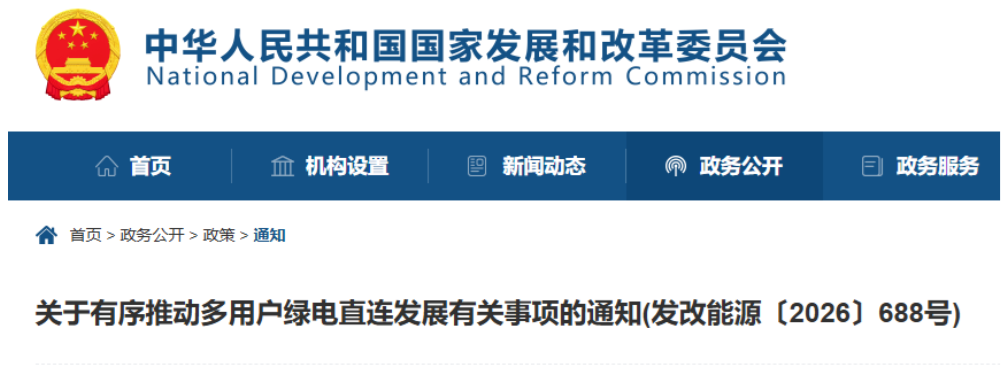
On May 20, China significantly expanded its green electricity direct connection framework through the release of the Notice on the Orderly Promotion of Multi-User Green Power Direct Connection Development (No. 688 of the NDRC Energy Affairs Division [2026]) by NDRC and NEA. The policy extends renewable power direct connection models from single-user projects to multi-user industrial ecosystems, enabling one or more renewable energy sources to supply electricity directly to multiple industrial consumers.
The reform addresses rising pressures from renewable energy curtailment while supporting industrial decarbonization, zero-carbon industrial parks, and emerging sectors, including green hydrogen, green ammonia, green methanol, and AI-driven data centers. Beyond domestic energy reform, the initiative also positions China to strengthen its influence over future international standards for green electricity traceability and carbon accounting.
A new phase in China’s renewable energy reform
Notice 688 marks another significant step in China’s restructuring of its renewable power system. By expanding green electricity direct connection from bilateral arrangements to multi-user industrial networks, China is attempting to address a growing mismatch between renewable capacity expansion and grid absorption capability.
Under the new framework, renewable energy generators — including offshore wind farms and utility-scale desert solar projects — can deliver electricity directly to clusters of industrial users through dedicated transmission infrastructure, partially bypassing the conventional public grid.
In practice, factories, industrial parks, data centers, and hydrogen production facilities can now procure physically traceable green electricity through localized “source-to-load” systems rather than relying solely on centralized grid distribution.
The policy builds on the Notice 650 released by NDRC and NEA in 2025, which for the first time legalized one-to-one renewable power direct connection. Notice 688 expands the concept into a scalable industrial energy platform capable of supporting broader regional decarbonization.
The significance of Notice 688
At its core, Notice 688 is designed to address one of China’s most pressing energy transition challenges: renewable generation is expanding faster than the grid’s ability to absorb and redistribute it efficiently. The policy therefore represents both an energy-system reform and an industrial competitiveness strategy.
By encouraging localized renewable consumption, China aims to reduce curtailment, improve renewable utilization rates, lower industrial electricity costs, and strengthen the commercial foundation of low-carbon manufacturing.
I. Renewable expansion is outpacing grid absorption
The policy arrives as China faces increasing pressure to integrate rapidly growing renewable generation capacity.
During the first two months of 2026:
- National solar utilization fell to 90.8%, down 3.1% year-on-year
- Wind utilization declined to 91.5%, down 2.3% year-on-year
- Both indicators moved close to the NEA’s 90% minimum threshold
Several provinces are already experiencing more acute pressure:
- Hebei’s wind utilization dropped to 84.4%
- Xinjiang recorded 88.7%
At the same time, renewable deployment continues to accelerate aggressively.
By the end of the first quarter of 2026:
- China’s cumulative solar capacity reached 1.24 TW
- Wind capacity climbed to 660 GW
- Annual growth rates reached 31.3% for solar and 22.4% for wind
China’s total solar and wind energy capacity now exceeds 1.9 TW and could rise to 3.6 TW by 2035 under the country’s updated climate targets.
The result is a growing structural imbalance: renewable generation capacity is expanding faster than the transmission system’s ability to absorb and distribute electricity efficiently across regions. Traditional solutions, particularly long-distance ultra-high-voltage transmission corridors, are becoming increasingly capital intensive, resource constrained, and operationally complex.
Notice 688 reflects a broader strategic shift in China’s energy policy: instead of relying solely on transmitting renewable electricity across provinces, policymakers are increasingly encouraging industrial demand centers to move closer to renewable generation sources and consume power locally.
II. From centralized transmission to localized energy ecosystems
Green power direct connection refers to a model in which renewable electricity bypasses portions of the traditional public grid and is delivered directly to end users through dedicated infrastructure.
Instead of routing electricity through long-distance transmission corridors and multiple grid dispatch layers, renewable generators and industrial consumers are physically linked through what policymakers increasingly describe as “source-load coordination.”
The model offers several structural advantages:
- Lower electricity costs: Reduced or bypassed transmission and distribution charges can materially lower delivered electricity prices.
- Improved renewable consumption: Localized balancing enables renewable electricity to be consumed closer to generation sources, reducing curtailment risks.
- Physical green power traceability: Direct delivery allows physical verification of renewable electricity consumption, increasingly important for exporters facing carbon disclosure requirements.
- Enhanced energy security: Industrial clusters gain more predictable access to renewable electricity supplies and lower exposure to grid volatility.
The core innovations of Notice 688
Notice 688 expands the direct connection framework not only technically, but institutionally and commercially. The policy introduces new governance mechanisms, broader eligibility rules, and stricter operational standards intended to transform green power direct connection into a scalable industrial infrastructure model.
I. Expansion from “one-to-one” to “one-to-many”
The most significant breakthrough is the transition from single-user projects to multi-user participation.
Under the earlier Notice 650 framework, projects were largely limited to bilateral arrangements between one generator and one industrial user. Notice 688 now supports:
- Industrial parks
- Zero-carbon industrial zones
- Incremental distribution networks
- Multi-enterprise manufacturing clusters
- Data centers
- Emerging green fuel industries
The expansion substantially broadens market accessibility, particularly for small and medium-sized enterprises that previously lacked sufficient electricity demand to justify standalone infrastructure investment.
The policy also removes earlier restrictions that largely limited participation to export-oriented enterprises. Under the new framework, any qualified user within an industrial park with demand for renewable electricity may participate.
II. Creation of a new governance structure
Multi-user systems introduce significantly greater ownership and operational complexity. To address this, the policy establishes a new “project principal entity” framework.
The principal entity may include:
- Joint ventures between generators and consumers
- Independent infrastructure investors
- Industrial park authorities
- Third-party operating companies
Public grid operators are excluded from assuming this role.
The framework effectively creates a single coordination interface for external grid interaction while preserving commercial flexibility among participating users.
The governance model also addresses a key operational challenge of multi-user systems: balancing multiple ownership structures, investment responsibilities, and electricity consumption profiles within a single integrated project.
III. Strict self-consumption and grid interaction rules
The policy also introduces quantitative operating requirements intended to ensure projects function primarily as localized balancing systems rather than speculative electricity trading platforms.
Key thresholds include:
- At least 60% of annual renewable generation must be self-consumed
- Direct green electricity must account for at least 30% of total electricity demand
- The ratio must rise to 35% before 2030
- Grid-connected projects generally cannot export more than 20% of annual generation
- Projects cannot feed electricity back into the public grid during periods of renewable oversupply
The policy therefore prioritizes localized balancing and system stability over arbitrage opportunities.
The underlying regulatory logic is clear: green power direct connection projects are intended to function first as “self-balancing energy units” and only secondarily as participants in broader electricity market transactions.
IV. Strategic importance for zero-carbon industrial parks
Industrial parks account for more than 66% of China’s total energy consumption and are becoming central to China’s industrial decarbonization strategy.
In December 2025, China approved its first batch of 52 national zero-carbon industrial park pilots, each requiring renewable electricity to supply at least 50% of total power demand.
Notice 688 addresses one of the sector’s major implementation bottlenecks.
Under previous frameworks, companies often needed to build separate direct connection infrastructure, creating duplication, high capital expenditure, and operational inefficiencies.
The multi-user model allows industrial parks to:
- Share transmission infrastructure
- Coordinate electricity demand across multiple users
- Improve renewable utilization rates
- Reduce overall system costs
- Simplify carbon accounting
The policy effectively transforms green electricity from a niche procurement mechanism into shared industrial infrastructure.
For export-oriented manufacturers, the implications are particularly significant. Physical renewable power delivery is generally viewed internationally as more credible than certificate-only systems, potentially strengthening the competitiveness of Chinese exports facing carbon-related trade barriers.
Global commercial implications
The significance of Notice 688 extends well beyond China’s domestic power market. The policy could materially reshape the economics of hydrogen production, industrial electrification, and low-carbon exports while strengthening China’s influence in emerging global carbon-governance systems.
I. Improved electricity economics for green hydrogen
The hydrogen sector may emerge as one of the largest long-term beneficiaries, as electricity currently represents 60–70% of green hydrogen production costs.
Traditional renewable procurement through the public grid often includes transmission and distribution charges accounting for 30–40% of delivered electricity prices. Direct renewable connection changes the economics materially.
Industry estimates suggest that direct connection projects can reduce electricity costs for hydrogen production by more than 40%. For example, in pilot projects in Xinjiang:
- Electricity costs reportedly fell from CNY 0.35/kWh to below CNY 0.25/kWh
- Green hydrogen production costs declined by approximately CNY 5.6/kg
These reductions could significantly improve the competitiveness of green ammonia, green methanol, sustainable aviation fuel (SAF), and low-carbon chemical production.
The policy also aligns with China’s broader push to integrate renewable electricity with strategic emerging industries. Notice 688 explicitly prioritizes sectors including computing infrastructure and green hydrogen-ammonia-methanol value chains, reinforcing China’s wider “source-grid-load-storage” industrial strategy.
II. International trade and carbon policy implications
One of the policy’s most strategically important dimensions is renewable electricity traceability. Notice 688 explicitly calls for time-based metering systems linked to green certificates and carbon accounting frameworks.
This has direct relevance for:
- EU Carbon Border Adjustment Mechanism (CBAM)
- EU Battery Regulation
- Global supply chain emissions disclosure requirements
By pioneering multi-user traceable renewable power systems, China could gain an early-mover advantage in shaping future international standards governing low-carbon manufacturing verification and renewable electricity accounting.
This could become increasingly important for exporters in sectors such as batteries, steel, chemicals, aluminum, and clean technology manufacturing.
III. Investment economics and infrastructure efficiency
The economics of multi-user infrastructure are materially stronger than isolated bilateral projects.
Dedicated 110kV transmission infrastructure can cost more than CNY1 million per kilometre, creating significant barriers for individual industrial users.
Shared infrastructure lowers costs through:
- Joint capital expenditure
- Shared maintenance
- Higher transmission utilization
- Diversified electricity demand profiles
The model also improves long-term investment resilience.
Wind projects typically operate for around 20 years and solar installations for approximately 25 years. By contrast, the average operating lifespan of large and medium-sized Chinese enterprises is only seven to eight years.
Multi-user participation therefore diversifies counterparty risk and improves long-term project bankability while reducing the risk that a single industrial user’s exit could destabilize an entire project.
IV. Remaining challenges
Despite the policy’s ambition, implementation risks remain substantial. Key issues include:
- Standardization of renewable traceability systems
- Alignment with international carbon accounting frameworks
- Coordination between local governments and grid operators
- Commercial pricing mechanisms
- Integration of energy storage and flexible demand management
China’s success will depend not only on policy design, but also on execution across provincial governments, industrial parks, renewable developers, and electricity market regulators.
The next phase of policy evolution will likely focus on technical standards, carbon verification methodologies, and interoperability with international reporting systems.
From niche experiment to industrial energy platform
Notice 688 represents more than a technical adjustment to renewable energy policy. It reflects a broader shift in China’s industrial and energy strategy toward localized, integrated energy ecosystems.
China is increasingly moving beyond a purely centralized electricity model toward industrial systems combining:
- Renewable generation
- Smart grid coordination
- Energy storage
- Industrial electrification
- Carbon accounting
- Digital infrastructure
The transition from “one-to-one” to “one-to-many” renewable direct connection systems could become a foundational mechanism for China’s next phase of industrial decarbonization.
If successfully implemented, the policy may not only help China absorb unprecedented volumes of renewable electricity domestically, but also provide a potential model for future global frameworks governing low-carbon industrial production and green trade competitiveness.