On December 7, China Oil and Gas Pipeline Network Corporation (PipeChina), in collaboration with the China Academy of Safety Science and Technology (CASST), completed a comprehensive test campaign at the Hami rupture-control field in Xinjiang. The trial used a full-scale pipeline system with a pure-hydrogen storage volume of 12,000 cubic metres, designed to replicate conditions in commercial transmission networks.
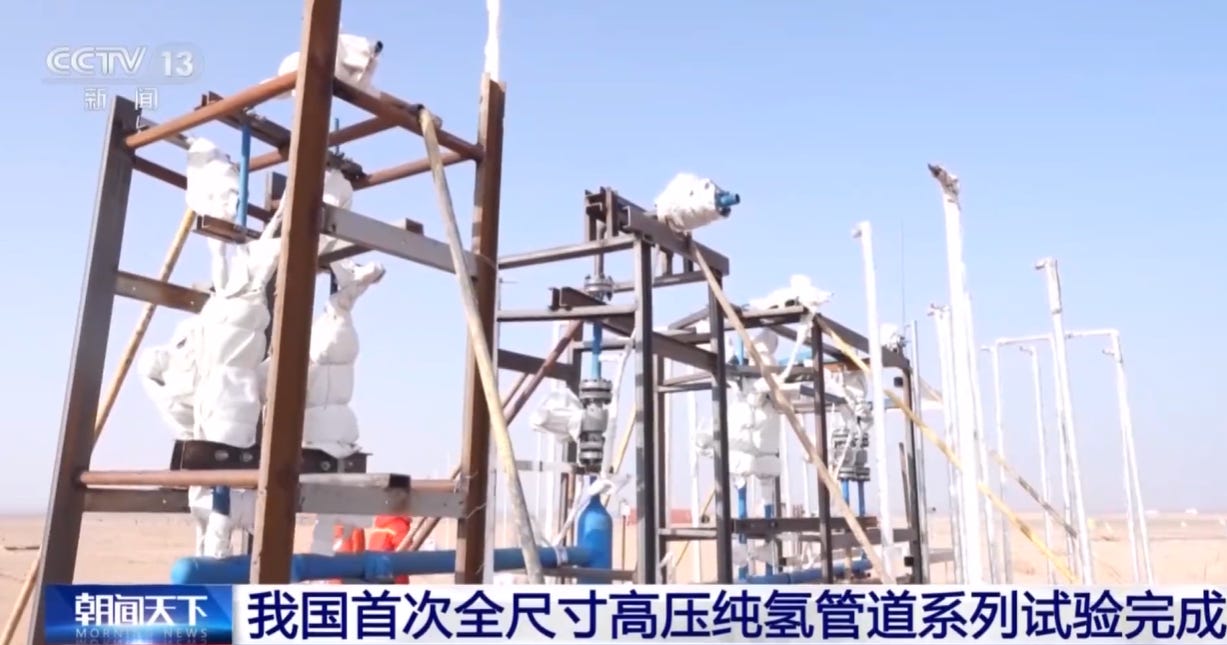
As the world’s third full-scale pipeline explosion-testing site (after the UK and Italy) and Asia’s only one, the facility is capable of conducting high-intensity burst and failure tests on high-grade steels, large-diameter pipelines, and multiple transport media including hydrogen.
From Nov. 11 to Dec. 7, the team conducted 33 hydrogen leak and jet-fire scenarios, combining
- Four leak-hole diameters: 5 mm, 10 mm, 25 mm, 50 mm
- Three pressure levels: 3.4 MPa, 6.3 MPa, 10 MPa
- Three jet orientations: horizontal, 45° inclined, vertical
As China’s first full-scale, high-pressure pure-hydrogen leak–jet-fire experiment, the campaign generated critical empirical data for developing hydrogen-specific pipeline safety standards.
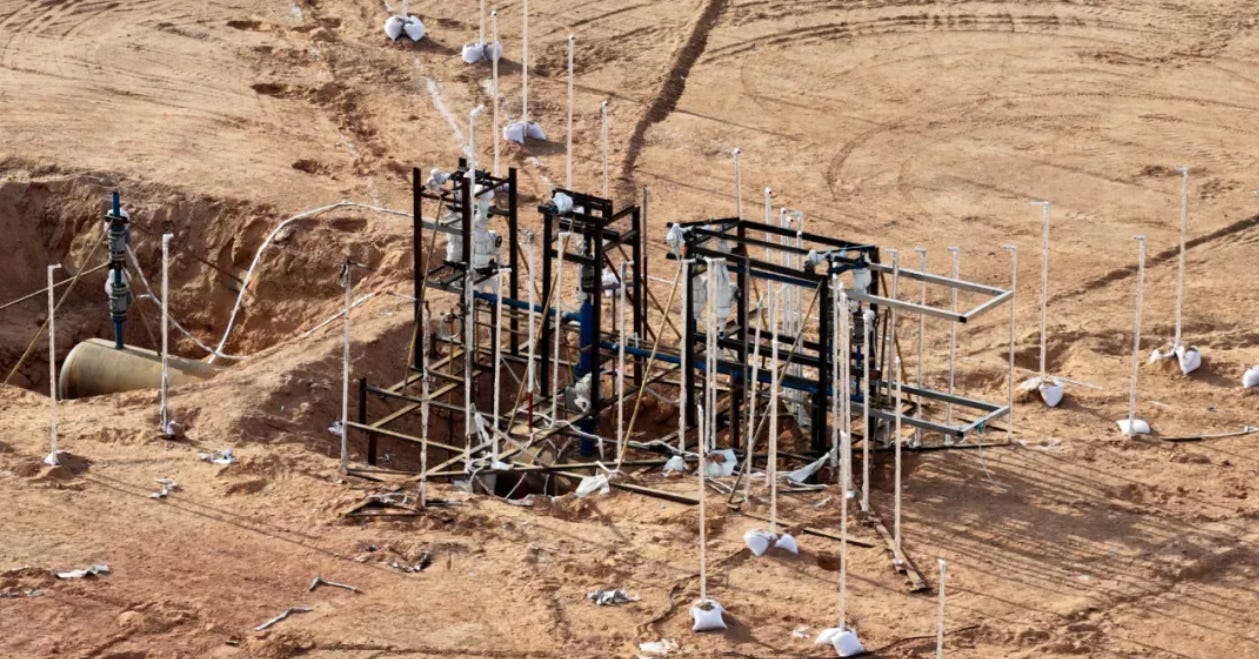
The test series reproduced a broad range of failure modes that hydrogen pipelines may encounter during operation from micro-leaks to catastrophic ruptures, generating critical empirical data on flame behaviour, jet directionality, thermal radiation, and combustion-plume evolution that will directly support the creation of China’s first hydrogen-specific pipeline safety standards.
The dataset provides a multidimensional view of high-pressure hydrogen behaviour and will inform safety-spacing rules, fire-risk models, and design benchmarks for pure-hydrogen pipelines. During the trial, drones enabled remote and safe ignition under diverse environmental and operational conditions. High-precision optical, thermal, and acoustic sensors captured flame morphology and radiative heat flux, allowing reconstruction of “the most realistic pipeline failure contexts possible.”
Experimental Design
The purpose of the Hami experiment is to generate a critical dataset, bridging the gap between theoretical risk models and real-world hydrogen pipeline safety requirements.
1. Full-scale high-pressure pure-hydrogen system
Hydrogen possesses unique combustion and dispersion characteristics – high diffusivity, a wide flammability range (4–75%), low ignition energy, and fast flame speeds – which make small leaks potentially dangerous while large ruptures can generate extensive thermal footprints. Until now, almost all global hydrogen jet-fire data came from small-scale tanks (10–50 m³) or short pipe sections, limiting the accuracy of models for real transmission pipelines.
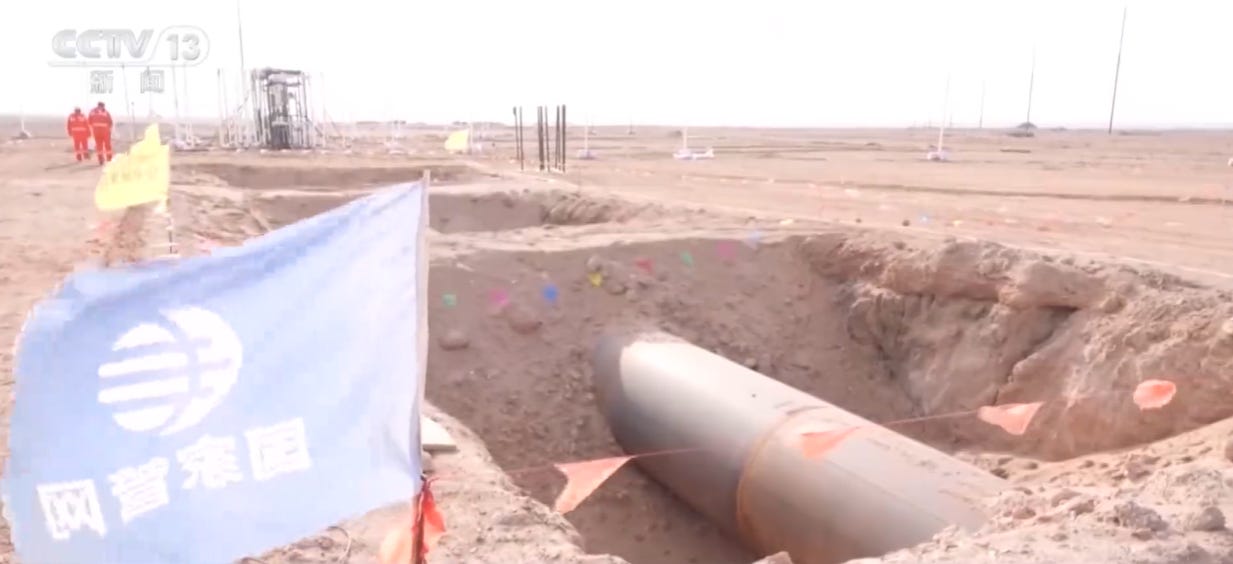
To overcome this constraint, the Hami campaign employed a full-scale hydrogen pipeline system with a 12,000-m³ storage capacity, enabling continuous leakage and flame monitoring under realistic operating conditions. This scale is comparable to actual long-distance transmission segments and represents a major step forward in China’s hydrogen-safety research.
The test platform consisted of a hydrogen main pipeline, jet-fire branch lines, autonomous ignition systems, and an extensive sensor and data-acquisition suite.
2. Controlled leak-jet-fire simulation
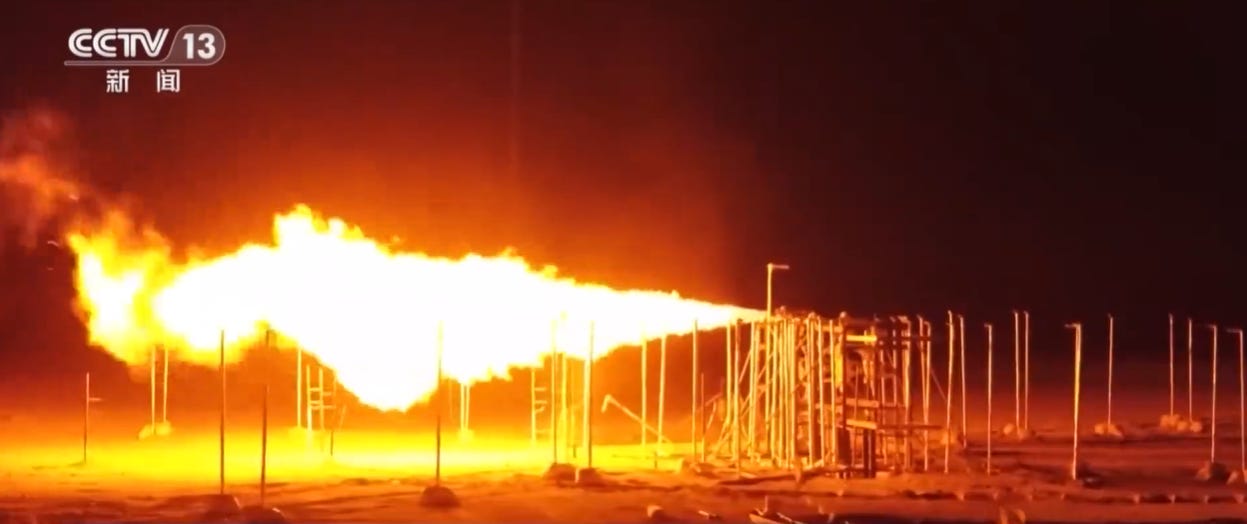
Each of the 33 cases paired a leak aperture with a specific pressure condition and jet orientation. Pressures were selected to reflect the upper bounds expected in high-pressure hydrogen transport, where flow dynamics differ significantly from those of natural gas.
The leak-hole sizes captured multiple combustion regimes:
- Small leaks: high-velocity, often low-visibility jets
- Medium leaks: flames dominated by stabilization effects
- Large ruptures: turbulent combustion with wide thermal footprints
Varying the jet direction (horizontal, inclined, vertical) enabled researchers to characterize how gravity, buoyancy, and momentum interact in hydrogen flames, information essential for evaluating hazard distances.
3. High-precision sensor suite and data acquisition
To ensure comprehensive data collection and capture multi-dimensional flame behaviour, the test team deployed:
- Infrared and optical cameras for flame morphology
- High-speed imaging to capture flame acceleration and detachment
- Thermocouple arrays and radiometers to measure temperature fields and heat flux
- Pressure transducers to record transient flow dynamics
These instruments captured the evolution of hydrogen jet flames, plume structure, radiative intensity, and hazard radii – parameters essential for computational fluid dynamics (CFD) modelling, emergency-response planning, and safety-spacing calculations.
Initial expert analysis indicates that the dataset is complete, valid, and suitable for determining national hydrogen-pipeline safety thresholds.
4. Key empirical outputs relevant to pipeline design
The trial generated a wide range of design-relevant outputs, including:
- Thermal-radiation contours and damage thresholds
- Flame length and penetration distance as functions of pressure, orientation, and aperture
- Ignition probability and flame stability across leak regimes
- Radiative hazard radii for personnel, equipment, and infrastructure
These measurements will directly inform the calculation of minimum safety distances, wall-thickness requirements, emergency shutoff spacing, leak-detection thresholds, and thermal-protection design.
Relevance to China’s Hydrogen-Pipeline Strategy
China is accelerating the development of hydrogen infrastructure, with major pipeline projects under construction or in planning in Xinjiang, Inner Mongolia, Hebei, and coastal regions.
Before the Hami experiment, China relied heavily on natural-gas data and small-scale hydrogen tests. With the completion of the Hami trial, China now has:
- A hydrogen-specific empirical foundation for pipeline design
- The basis for dedicated GB/T hydrogen-pipeline codes (rather than adapting natural-gas standards)
- Reduced reliance on conservative assumptions that inflate capital expenditure
- A clearer permitting and regulatory framework for hydrogen infrastructure
Hydrogen pipelines often require thicker walls due to permeation and embrittlement, larger safety setbacks, advanced monitoring systems, and higher-grade steels (X70/X80) or composite liners.
The Hami results may allow recalibration of these design choices using empirical evidence. Even modest refinements, such as reducing a setback from 50 to 30 metres, can significantly lower land-acquisition costs and shorten project timelines.
From Safety Validation to Industry Acceleration
Before the Hami trial, full-scale empirical data for pure hydrogen were largely unavailable. Safety requirements for spacing, wall thickness, leak detection, and emergency response were mainly borrowed from natural-gas codes (GB/T, EN, ASME) or extrapolated from limited datasets.
The Hami dataset reduces reliance on precautionary assumptions and supports evidence-based design. PipeChina and CASST will use it to refine hydrogen leak and jet-fire thermal-radiation models, supporting the development of a comprehensive national safety standard system for hydrogen transmission. This will benefit multiple segments of the hydrogen value chain:
- Transmission pipelines: High-pressure trunk lines (10 MPa) will benefit immediately from evidence-based safety models that reduce over-design.
- Industrial-park networks: Hydrogen-intensive sectors (steel, chemicals, ammonia, refining) will gain greater regulatory certainty and lower fire-protection costs.
- Storage and buffer systems: The 12,000 m³ test volume closely mirrors buffer-tank systems used for pressure balancing, making the findings directly applicable.
- Regulatory alignment: Reduced uncertainty across provincial permitting and insurance processes.
As China advances toward large-scale hydrogen adoption and its dual-carbon goals, the availability of full-scale empirical safety data will provide the technical foundation needed to design, approve, and deploy hydrogen-pipeline infrastructure with greater confidence.
Support for Large-scale Transmission Corridors
China’s hydrogen strategy increasingly mirrors natural-gas transmission models: regional production hubs connected to industrial demand centres through long-distance pipelines. Hydrogen production in Xinjiang and Inner Mongolia already exceeds local consumption, creating a need for trunk-line transport eastward.
Although the full Hami datasets have not yet been published, the test structure suggests insights that will inform setback calculations, material-selection criteria, leak-detection thresholds, valve-spacing design, and thermal-protection strategies.
Given China’s focus on “clean energy + industrial hydrogen + infrastructure integration,” this new evidence base is expected to accelerate pipeline construction, particularly in the northwest and northern regions where large-scale electrolysis projects are underway.
From Proof-of-Safety to Infrastructure Build-Out
Safety standards play a central role in moving pipeline projects from design to construction. With the Hami experiment complete, PipeChina and other operators now have the empirical foundation needed to develop hydrogen-specific codes (the forthcoming GB/T hydrogen-pipeline series) and accelerate project deployment.
By generating full-scale, high-pressure pure-hydrogen fire-behaviour data, PipeChina is closing a critical engineering gap that has long constrained pipeline design. In commercial terms, this shortens project timelines, strengthens investor confidence, and positions China alongside the world’s most advanced hydrogen-infrastructure markets.