Carbon-neutral infrastructure financing and expanding European and North American logistics links highlight how Wuxi is leveraging capital markets and supply chain assets to drive industrial growth, green mobility, and international trade.
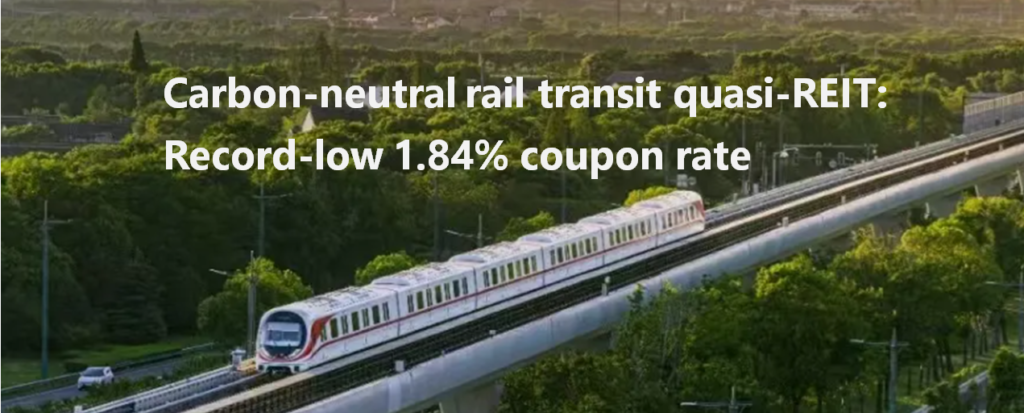
On June 2, Wuxi achieved a national first with the issuance of China’s first approved carbon-neutral rail transit quasi-REITs product, securing a record-low coupon rate of 1.84%. One day later, on June 3, the city’s upgraded international cargo route to Chicago commenced operations using Boeing 777 freighters, expanding high-value export capacity between the Yangtze River Delta and North America.
Taken together, the developments illustrate how Chinese cities are increasingly combining innovative financing mechanisms with logistics investments to unlock capital, improve infrastructure efficiency, and enhance global trade competitiveness.
Turning rail transit assets into investable capital
The rail transit financing transaction, formally known as the CITIC Securities Investment–Wuxi Metro Carbon-Neutral Green Asset-Backed Special Plan, reflects the increasing sophistication of China’s infrastructure securitization market.
Structured as a quasi-REITs vehicle based on asset-backed securities (ABS), the product resembles international REIT models while remaining privately placed rather than publicly listed. The structure enables investors to gain exposure to stable infrastructure cash flows while allowing asset owners to monetize future revenue streams without relinquishing operational control.
For urban rail operators, the model addresses a longstanding challenge. Metro systems require substantial upfront capital investment, yet fare revenue and station-based commercial income are often insufficient to cover operating and financing costs.
By securitizing a portion of future revenue rights from its metro operations, Wuxi Metro can recycle capital tied up in mature infrastructure assets and redirect proceeds toward network expansion, new projects, and system upgrades.
The transaction achieved a coupon rate of just 1.84%, reportedly the lowest ever recorded among comparable rail transit quasi-REITs issuances in China. The yield approaches that of China’s 10-year government bond (1.72% for the May 2036 maturity), representing an exceptionally low financing cost for a capital-intensive infrastructure asset class.
The rate reflects strong investor confidence in Wuxi Metro’s operational performance, asset quality, and the city’s broader credit profile. Compared with similar rail transit financing transactions elsewhere in China, where coupon rates typically exceed 2%, the deal materially reduces financing costs while enhancing future refinancing flexibility.
Carbon-neutral finance moves into urban infrastructure
The transaction also carries a carbon-neutral certification, highlighting the growing convergence of infrastructure finance and climate policy.
According to third-party assessments, the project is expected to support annual reductions of approximately 1,182 tonnes of carbon dioxide emissions and save around 2,605 tonnes of standard coal equivalent by encouraging greater investment in low-carbon urban mobility.
While the direct emissions impact is relatively modest, the broader significance lies in establishing a scalable financing model capable of attracting private capital into sustainable transport infrastructure.
As China expands the use of green bonds, REITs, and asset-backed securities to support decarbonization objectives, Wuxi’s transaction demonstrates how municipal transit operators can improve balance-sheet efficiency while aligning infrastructure funding with national carbon-neutrality goals.
Future financing initiatives could extend beyond rail construction to support smart operations and maintenance systems, transit-oriented development (TOD), and integrated urban mobility projects, creating a broader ecosystem for rail-led urban development.
Building a multi-modal international logistics network
The financing transaction coincides with a broader effort by Wuxi to strengthen its position within global supply chains through both maritime and air logistics infrastructure.
In March 2026, the city launched a direct container shipping service linking Jiangyin Port and Antwerp, creating a new logistics corridor between one of China’s most important manufacturing regions and Europe’s largest integrated port hub. The service reduces reliance on transshipment routes, shortens logistics cycles, and provides exporters with more direct access to European markets.
The launch reflects a wider strategy to enhance Wuxi’s international connectivity across multiple transport modes. While maritime freight remains the backbone of global trade, air cargo plays a critical role for time-sensitive, high-value goods. Against this backdrop, the upgraded Chicago air cargo service represents the next phase of Wuxi’s logistics expansion strategy.
Upgraded Chicago air cargo route strengthens export connectivity
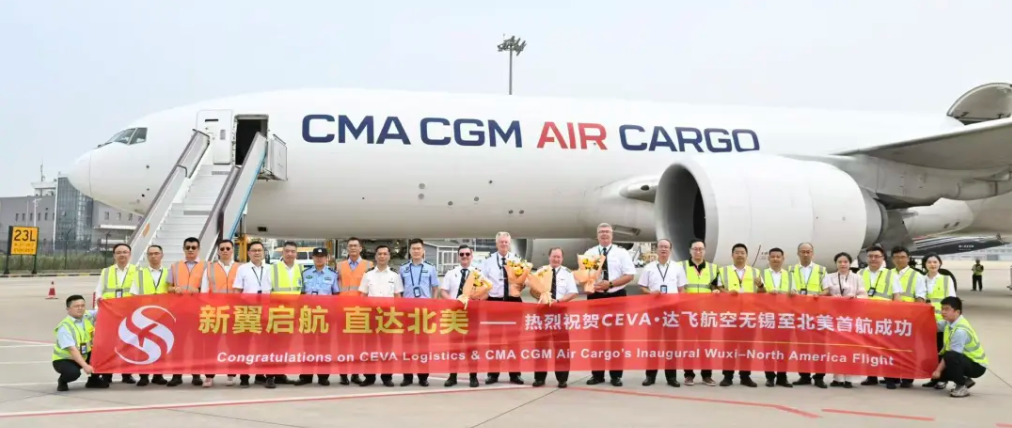
On June 3, Wuxi further reinforced its role in global trade networks by upgrading its Wuxi–Chicago cargo route. The service is jointly operated by CMA CGM Air Cargo, CEVA Logistics, and Wuxi Airport Group. Both CMA CGM Air Cargo and CEVA Logistics are subsidiaries of France-based CMA CGM Group, one of the world’s largest integrated shipping and logistics companies.
The upgraded route operates twice weekly using Boeing 777 freighters, among the most capable long-haul cargo aircraft in commercial service. The B777F platform combines high payload capacity, intercontinental range, and operational reliability, making it particularly well suited for time-sensitive and high-value freight.
Initial shipments consisted primarily of cross-border e-commerce cargo, including consumer electronics and machinery components. These cargo categories closely align with Wuxi’s industrial profile and the broader southern Jiangsu manufacturing cluster, where advanced manufacturing, electronics production, and export-oriented supply chains are key economic drivers.
The upgraded Chicago connection builds on an established logistics corridor. Since its launch in 2018, the route has become an important air freight gateway linking Wuxi and the wider Yangtze River Delta region with North American markets.
A dual strategy for growth
Viewed together, Wuxi’s experience reveals a coherent infrastructure strategy centred on improving asset productivity and economic competitiveness.
The quasi-REITs issuance unlocks capital embedded in mature infrastructure assets, while expanded international logistics links strengthen the physical movement of goods and improve access to global markets.
Both initiatives are designed to generate multiplier effects. Financial innovation lowers the cost of infrastructure development and accelerates capital recycling, while enhanced logistics connectivity supports export growth, industrial upgrading, and foreign trade resilience.
The results are increasingly visible. Wuxi Airport handled more than 190,000 tonnes of cargo in 2025, a record high that elevated its national cargo ranking to 21st place. At the same time, the city’s ability to secure record-low infrastructure financing costs highlights growing sophistication in capital markets engagement.
For China’s broader rail transit and logistics sectors, Wuxi’s experience provides a potential blueprint for combining financial innovation, green infrastructure funding, and global connectivity to support long-term urban and industrial development.
Wuxi’s “465+X” Modern Industrial Cluster Strategy
Wuxi is implementing its “465+X” Modern Industrial Cluster Strategy, which comprises four landmark industrial clusters, six competitive industrial clusters, five future industries, and a group of emerging strategic sectors represented by the “X.”
I. Four Landmark Industrial Clusters (2025 Revenue Targets)
- Internet of Things (IoT): CNY 500 billion
- Integrated Circuits: CNY 200 billion
- Software and IT Services: CNY 200 billion
- Biomedicine: CNY 200 billion
II. Six Competitive Industrial Clusters (2025 Revenue Targets)
- New Materials: CNY 300 billion
- Automotive and Auto Parts: CNY 300 billion
- High-End Equipment: CNY 200 billion
- New Energy: CNY 200 billion
- Energy Conservation and Environmental Protection: CNY 150 billion
- High-End Textiles: CNY 150 billion
III. Five Future Industries
- AI and the Metaverse
- Quantum Technologies
- Third-Generation Semiconductors
- Hydrogen and Energy Storage
- Deep-Sea Equipment
All five future-industry sectors are targeted to achieve annual growth rates of over 15%.
IV. Expanded “X” Industries
The strategy also includes a number of emerging industries under the “X” category, including:
- Low-Altitude Economy
- Humanoid Robots
- Commercial Space
- Synthetic Biology
- High-End Membrane Materials
To support the “465+X” strategy, Wuxi has developed more than 50 specialized industrial parks, including five dedicated to the new-energy sector.