China is stepping into a new era of hydrogen infrastructure. In July 2025, its first cross-province, long-distance green hydrogen pipeline, the 1,132‑km Ulanqab–Beijing–Tianjin–Hebei (BTH) line, received government approval for construction, advancing the country’s plans for a national hydrogen backbone.
This follows a series of major project announcements, including the 190 km Damao Banner–Baotou line, the 1,038 km Kangbao–Caofeidian pipeline, and Inner Mongolia’s plan for 14 green hydrogen, ammonia, and methanol pipelines totalling 4,400 km.
In June 2025, the National Energy Administration (NEA) issued a notice promoting hydrogen pipeline pilots to be at least 100 km in length, explicitly targeting long-distance, cross-regional transmission. This set the stage for the current surge in pipeline development, aligning national policy with the needs of industrial-scale infrastructure.
Meanwhile, Chinese steel manufacturers have achieved breakthroughs in hydrogen-compatible pipeline steels and flexible composite materials. Baosteel and Shougang are advancing high-strength, hydrogen-embrittlement-resistant steels toward industrial validation, while Zhongyou Baoshishun Pipe (Qinhuangdao) delivered the first 50 pipes for the Ulanqab–BTH project in July.
Industry Spotlight
China Oil & Gas Pipeline Network Corporation (PipeChina)
Established in December 2019, PipeChina is the state-owned enterprise overseeing the investment, construction, and unified operation of China’s national oil and gas trunk pipelines, intended to build a “one-net” infrastructure. In the hydrogen sector, it has pioneered transmission by operating a high-pressure pure hydrogen pipeline as part of its R&D on large-scale, cost-effective transport.
China Petroleum Pipeline Engineering Co., Ltd. (CPP/CNPC)
Founded in 1973, CPP is an EPC subsidiary of China National Petroleum Corporation (CNPC). As China’s leading pipeline engineering and construction company, it provides design, survey, EPC contracting, and integrity management services for oil, gas, and increasingly hydrogen pipelines.
To address critical regulatory gaps, CPP and PipeChina co-led the drafting of China’s industrial standard “Hydrogen Transmission Pipeline Integrity Management Specification (T/CAS 847-2024)”, which covers lifecycle integrity management from design and construction to operation, maintenance, and decommissioning.
CNPC Zhongyou Baoshishun Pipe (Qinhuangdao)
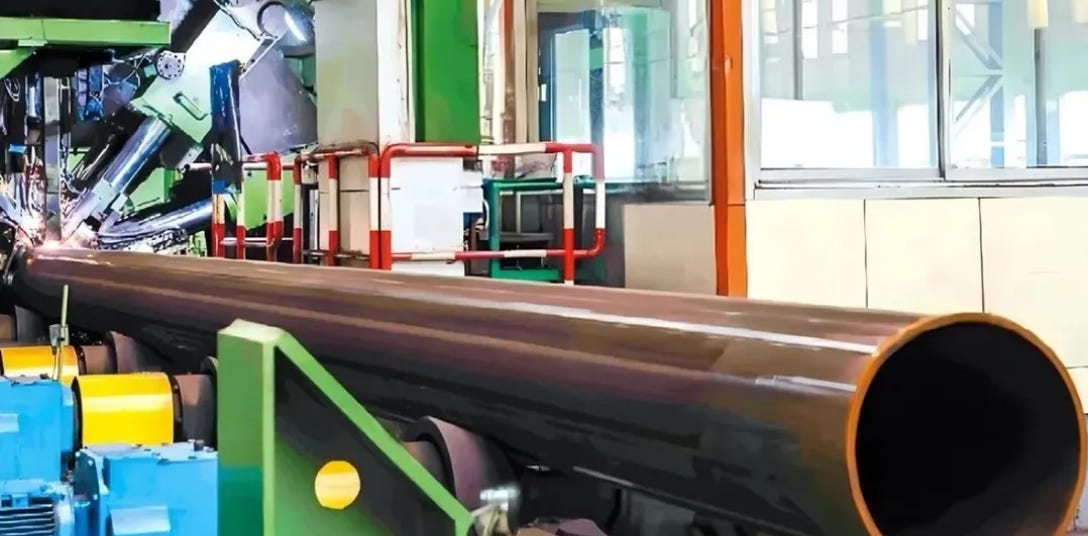
Founded in 2006, Zhongyou Baoshishun Pipe (Qinhuangdao), a CNPC equipment subsidiary, is a leading manufacturer of high-end welded pipes in China, with an annual output of over 400,000 tonnes. It operates advanced JCOE straight-seam submerged-arc and spiral submerged-arc welding lines, producing pipes ranging from Ø323.9 mm to Ø1,626 mm.
In July 2023, Baoshishun developed the world’s first 18.3-meter dual-process (straight + spiral seam) line for new-energy pipes, completed in just 14 months and supported by MIIT. Compared with conventional 12-meter pipes, the 18.3-meter variant reduces weld joints by 31%, increases construction efficiency by 33%, and lowers overall project costs. Its flexibility enables deployment across both traditional oil and gas as well as emerging hydrogen and CO₂ transmission markets.
Baoshishun has supplied pipes for more than 200 major projects, including the West–East Natural Gas Transmission, the China–Russia East Line, and the Mongolia–Western gas pipelines. Its entry into pure hydrogen transmission, highlighted by the delivery of 50 submerged-arc welded pipes for the Ulanqab–BTH line in July 2025, underscores its growing role in building China’s hydrogen backbone.
China’s Hydrogen Pipelines: 2025 as a Pivotal Year
China’s advances in steel manufacturing and infrastructure, coupled with supportive policies, make 2025 a pivotal year for hydrogen pipelines. With multiple projects over 1,000 km either approved or under development, and new steel grades and flexible materials entering field trials, the country is moving from pilot demonstrations toward a cross-region hydrogen transmission network.
Key Areas to Observe
Two long-distance projects are already underway: the 1,038 km Kangbao–Caofeidian line (7.2 MPa, 1.55 Mt/yr throughput) and the 1,132 km Ulanqab–BTH line, expected to transport more than 1 Mt/yr of green hydrogen. Together, they represent the world’s first high-capacity hydrogen trunklines under construction.
By contrast, the U.S. currently operates about 2,570 km of hydrogen pipelines, mostly legacy lines serving refineries and chemical plants along the Gulf Coast rather than purpose-built networks for clean hydrogen. These pipelines typically operate at ~7 MPa and are constructed primarily from API 5L X52 or lower grades of conventional carbon steel.
To support these large-scale projects, China’s materials and manufacturing sectors are advancing rapidly, focusing on steels, welding techniques, and flexible pipelines capable of withstanding hydrogen’s demanding conditions.
Technology Advances
- Baoshishun (Qinhuangdao): Trial-produced X52MH/X60MH steels; pipe sizes up to D610×14.3 mm; submerged-arc welding with ultra-fine grains to mitigate hydrogen embrittlement. Its 18.3-meter dual-process line reduces weld joints and cuts construction costs.
- Shougang Jingtang: Developed steel matrix grades (B, X42–X65MH) addressing embrittlement and low-temperature toughness, validated by third parties.
- Baosteel: Developing X80 and X100 steels resistant to hydrogen embrittlement, targeting 10 MPa-class pipelines by 2026.
- SPIC R&D Institute: Demonstrated DN150, 10 MPa non-metallic flexible hydrogen pipeline—stable for 30 days, suitable for saline, humid, and coastal environments.
These technological breakthroughs are not only addressing technical bottlenecks but also reshaping the commercial landscape, where coordinated efforts across the value chain will ultimately determine the pace of deployment.
Commercial Relevance
- Integrated Value Chain: Building on the success of the “west-to-east” oil & gas model, China’s hydrogen transmission is integrating state-owned operators, steelmakers, and R&D institutes across materials, manufacturing, engineering, and digital monitoring systems.
- Industrial Demand: Pipelines will connect Inner Mongolia’s 100+ GW renewable base with steel, refining, and chemical industries in Beijing, Tianjin, and Hebei.
- Cost Competitiveness: Long-distance pipelines reduce hydrogen transport costs by 30–40% compared with trucking or tube trailers.
- Export Potential: Baosteel has secured its first overseas hydrogen pipeline order in Australia, alongside casing deliveries for a large-scale hydrogen storage project in deep salt caverns in Asia. These developments suggest Chinese steelmakers’ role in supporting international hydrogen infrastructure and advancing the global clean-energy transition.
As these drivers converge, investors should closely watch which players capture the most value—and how risks around technology, regulation, and financing will be managed.
Investment Outlook
- Beneficiaries: Pipeline operators, steelmakers, TIC (Testing, Inspection, and Certification) service providers, and integrated hydrogen developers. Early movers in pipeline technologies, certified materials, and digital monitoring systems could gain outsized advantages over the next three to five years.
- Risks: Material durability under pure hydrogen, regulatory harmonization, and financing for 1,000+ km projects. Delays in permitting or technology adoption could slow returns and disrupt project economics.
2025 marks a turning point for the hydrogen pipeline sector in China, shifting from pilot-scale to regional rollout in northern China. With multiple pipelines over 1,000 km advancing, new steel technologies scaling, and flexible pipelines validated, the country is laying the groundwork for a national hydrogen backbone. As costs decline and the industry expands, China’s “infrastructure-first” strategy could set the pace for global hydrogen transport and reshape competitive dynamics in green fuels and exports.