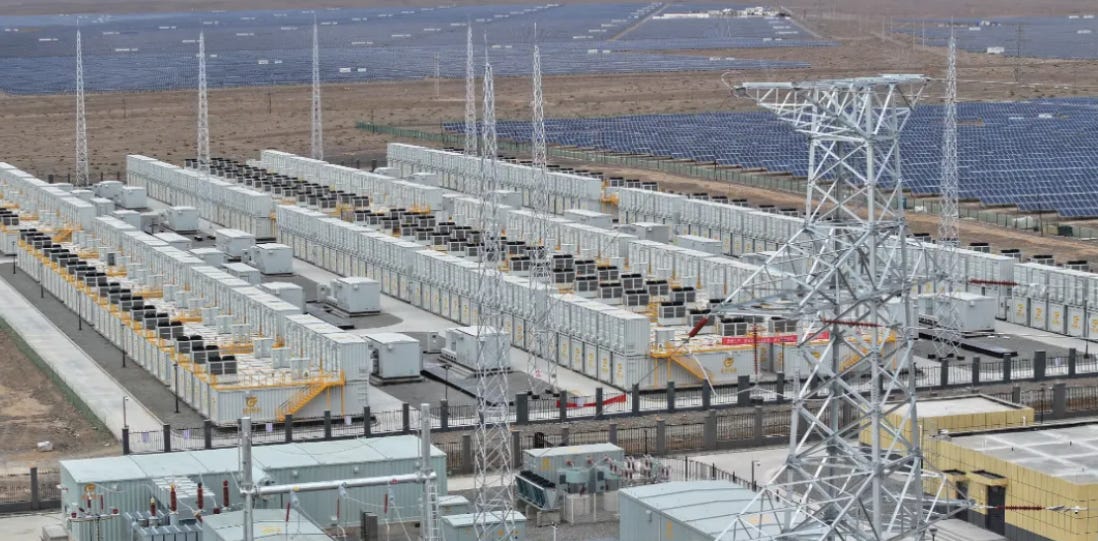
On August 6, Hami Energy Group’s 100 MW/400 MWh vanadium redox flow battery (VRFB) project was officially connected to the grid, making Hami the third city in China, after Dalian in Liaoning and Songyuan in Jilin Province, to deploy a hundred-MW-class standalone VRFB system at full scale. This marks a major step forward in long-duration storage and grid flexibility.
Technical configuration and performance
The facility provides 400 MWh of usable storage capacity, enough to supply about 80,000 households for one day. It features an outdoor prefabricated modular design and an intelligent control system capable of millisecond-level response. The system stores surplus renewable energy during periods of oversupply and discharges precisely during peak load periods.
The storage technology, supplied by Rongke Power (RKP), offers high intrinsic safety, stable capacity over its service life, and long cycle durability. Supporting infrastructure includes a 110-kV step-up substation for seamless integration with the main grid. The vanadium pentoxide–based electrolyte was provided by Dalian Borong New Materials (BNM), the world’s largest producer of vanadium chemicals and vanadium electrolyte, with an annual output of 25,000 tons of high-purity vanadium chemicals (as V₂O₅) and 150,000 cubic meters of vanadium electrolyte.
The facility is designed for 40 MWh of charging and 27 MWh of discharging per day, a ratio reflecting a round-trip efficiency (RTE) of 68% and its load-management strategy. Its 400-MWh capacity smooths renewable generation fluctuations at scale and strengthens both grid stability and the electricity transmission corridor.
Commercial and strategic significance
Hami has abundant wind and solar resources. The VRFB facility’s annual operations are expected to raise Hami’s renewable utilization rate by 8%. This translates into 3.6 TWh of additional green power consumption per year, reducing approximately 300,000 tonnes of CO₂ emissions. It plays a dual role: enabling higher wind and solar utilization while improving transmission reliability and economic efficiency.
Hami operates 18 storage facilities with a combined 1.03 GW/3.8 GWh capacity. With this addition, total installed storage capacity now exceeds 1.13 GW, consolidating Hami’s position as a leading energy storage hub in China.
The commissioning of the VRFB facility occurred six months after the release of China’s Document No.136 (2025), a landmark policy issued by the NDRC and NEA in February 2025 that transformed the country’s renewable and energy storage landscape. The document ended the mandatory requirement (enforced since 2017) for renewables to pair with energy storage as a precondition for grid connection, while transitioning renewable electricity pricing to a fully market-based system. This reform shifts energy storage from being “policy-driven” to “market-driven.”
Situated in eastern Xinjiang, Hami is a key hub for the “Xinjiang Power Transmission” corridors, which have already completed three ultra-high-voltage direct current (UHVDC) projects: Hami South–Zhengzhou (1st corridor), Zhundong–Southern Anhui (2nd corridor), and Hami–Chongqing (3rd corridor). The fourth corridor, Southern Xinjiang–Sichuan/Chongqing, is now in the late stages of feasibility study.
Industrial integration and outlook
From groundbreaking to commissioning, the VRFB project was completed in just 148 days. It was developed alongside a VRFB equipment manufacturing plant, jointly invested by Hami Energy and Rongke Power. This co-location strategy mitigates supply chain risks, reduces transportation costs for electrolyte and system components, and speeds up the rollout of future projects.
The Hami VRFB deployment demonstrates that commercial-scale, hundred-MW VRFBs are now viable in China. Its scale, rapid construction, and regional manufacturing integration could serve as a replicable model for renewable-heavy areas seeking long-duration storage to stabilize grids and transmission corridors.