China’s latest national energy blueprint sets quantified hydrogen production targets, expands green fuel infrastructure, and integrates industrial decarbonization with regional energy development to strengthen long-term competitiveness.
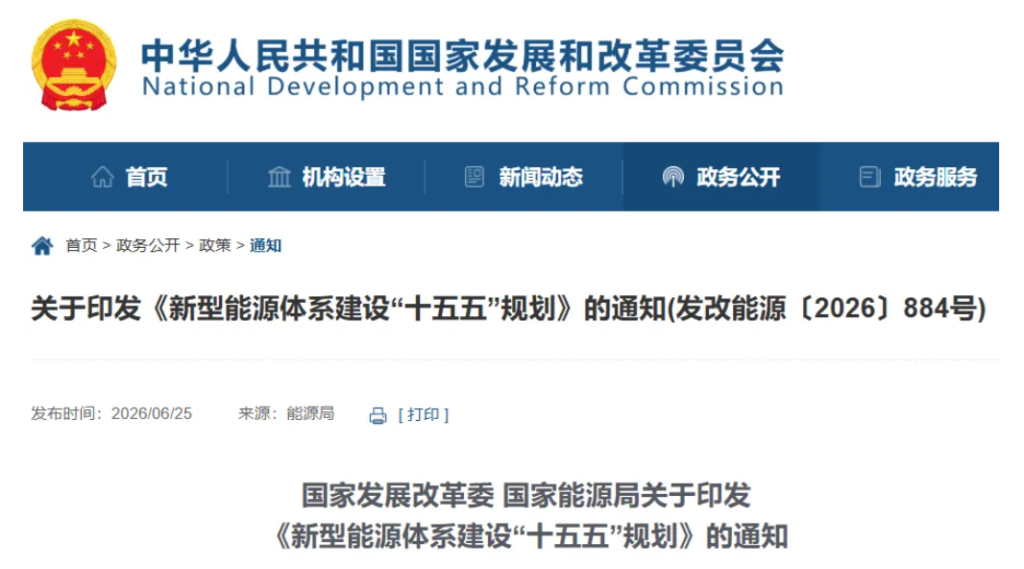
On June 25, the National Development and Reform Commission (NDRC) and the National Energy Administration (NEA) jointly released the 15th Five-Year Plan for the Construction of a New Energy System (NDRC Energy [2026] No. 884), positioning hydrogen and green fuels at the centre of China’s next phase of energy transition. More than a clean energy technology, hydrogen is framed as a strategic industrial platform linking renewable power, advanced manufacturing, transport, chemicals and energy security.
Among its headline targets, the plan calls for renewable hydrogen production to reach 2 million tonnes annually by 2030, while accelerating development of an integrated hydrogen value chain spanning production, storage, transportation, distribution, utilization, certification and infrastructure. It also outlines major strategic projects—including cross-provincial hydrogen pipelines, green methanol logistics corridors and internationally oriented marine fuel hubs—underscoring China’s ambition to scale hydrogen as a national industry rather than through isolated demonstration projects.
From pilots to scale: a national hydrogen ecosystem
The plan marks a clear shift from supporting individual hydrogen projects to developing a fully integrated hydrogen economy.
It promotes renewable hydrogen production through both grid-connected renewable electricity and off-grid renewable energy systems, while expanding purification and utilization of industrial by-product hydrogen. This dual-track approach enables China to increase low-carbon hydrogen supply in both renewable-rich western provinces and established industrial clusters where by-product hydrogen is readily available.
Beyond production, the plan gives unprecedented attention to midstream infrastructure, one of the sector’s key bottlenecks. It calls for coordinated planning of national hydrogen pipeline networks and explores repurposing underutilized oil and gas pipelines for large-scale transportation of green methanol. The message is clear: future market growth will depend as much on transport and logistics infrastructure as on electrolyzer deployment.
Another significant development is the proposed establishment of a national sustainability certification system for green fuels. As global markets increasingly require verified lifecycle carbon accounting, certification is becoming a strategic commercial asset rather than simply a regulatory requirement. A nationally recognized certification framework could enhance the competitiveness of Chinese-produced hydrogen, green ammonia and green methanol in both domestic and international markets.
Technical framework for hydrogen and green fuels
The plan provides one of China’s most comprehensive technical blueprints for hydrogen deployment to date.
On the production side, priority technologies include renewable-powered electrolysis integrated with large-scale wind and solar resources, direct renewable electricity-to-hydrogen systems, and off-grid hydrogen production at remote renewable energy bases. The government also encourages integrated “wind-solar-biomass” projects to maximize renewable resource utilization and improve system flexibility.
Hydrogen applications extend far beyond mobility. Priority sectors include power generation, heavy-duty transport, shipping, chemicals, metallurgy, and long-duration energy storage. The plan also promotes hydrogen blending into natural gas networks and increased adoption of green electricity and green hydrogen across refining and petrochemical industries.
Infrastructure development is equally ambitious. Major green hydrogen, ammonia and methanol production bases will be established in Northeast China, the Yellow River “Great Bend” region, northern North China, and the northern foothills of the Tianshan Mountains, areas with abundant wind and solar resources. Planned projects include the Ulanqab–Beijing-Tianjin-Hebei hydrogen pipeline, additional cross-provincial pipelines linking Ordos, Yulin, Bayannur and Ningdong, and feasibility studies for a dedicated green methanol pipeline connecting Xing’an League, Songyuan and Dalian.
The strategy also envisions integrated energy stations combining electricity, natural gas, heat and hydrogen, creating multi-energy service platforms capable of supporting industrial users, heavy-duty transport and future distributed energy systems.
Value creation beyond hydrogen production
While the 2-million-tonne renewable hydrogen target has attracted considerable attention, the plan’s broader commercial significance lies in embedding hydrogen across China’s wider industrial strategy.
Hydrogen is positioned alongside advanced manufacturing, digital infrastructure, heavy industry and regional economic development. Resource-rich western provinces are encouraged not only to export renewable electricity but also to convert it locally into higher-value products such as hydrogen, ammonia and methanol, capturing more value while reducing transmission constraints.
The plan also seeks to stimulate downstream demand. Green ammonia, green methanol, sustainable aviation fuel (SAF), biofuels and renewable natural gas are all incorporated into a broader green fuels strategy. Storage, transportation and refuelling infrastructure will be expanded along major freight corridors and inland waterways, supporting large-scale deployment of hydrogen-powered heavy trucks, green shipping and low-carbon industrial applications.
Shanghai receives particular strategic emphasis as a future international green marine fuel bunkering and trading hub. Recent market activity demonstrates how policy is already translating into commercial deployment. On June 23, China Marine Bunker signed a record domestic agreement to purchase 6,000 tonnes of green methanol from Shenergy Group, the country’s largest single green methanol procurement for marine fuel. Backed by Shenergy’s annual local production capacity of 100,000 tonnes, the project establishes a complete “produced in Shanghai, bunkered in Shanghai” supply chain while laying the foundation for nationwide green methanol distribution.
Chinese companies are also expanding internationally. In June, Sinopec Ningbo Engineering signed front-end engineering design (FEED) and detailed engineering contracts for Uzbekistan’s integrated sustainable aviation fuel complex. The USD 6.1 billion project combines biomass processing, renewable hydrogen, e-SAF, SAF and green diesel production, with an annual SAF capacity of 400,000 tonnes. It highlights the growing export of Chinese engineering expertise alongside domestic clean fuel deployment.
Hydrogen strategy anchored in renewable scale
China’s hydrogen ambitions are underpinned by the world’s largest and fastest-growing renewable power system.
By May 2026, China’s installed power generation capacity had reached 4.01 TW, up 11% year on year. Total installed capacity now exceeds the combined generating capacity of the US, EU, India, Japan, and Russia.
The country’s power mix has also undergone a profound structural transformation. Coal’s share of installed capacity has fallen from 61% in 2010 to 32% in May 2026, while non-fossil sources have risen from 25% to 62%. Renewable energy alone now accounts for 61% of installed capacity, and 73% of all new generating capacity added since 2010 has come from renewable sources.
The 15th FYP builds directly on this expanding renewable resource base. It targets renewable electricity accounting for 30% of total power generation by 2030, while aiming to double non-power renewable energy utilization. Hydrogen and green fuels are expected to play a pivotal role in converting surplus renewable electricity into transportable, storable and internationally tradable energy products.
Global hydrogen market implications
The new energy plan positions hydrogen not as a niche decarbonization technology but as a strategic industrial platform with long-term economic and geopolitical significance.
Three structural characteristics distinguish China’s approach. First, hydrogen development is closely integrated with industrial competitiveness, allowing renewable electricity, manufacturing, chemicals and logistics to evolve as a coordinated ecosystem. Second, infrastructure, including pipelines, ports, integrated energy stations and sustainability certification, is given nearly equal priority to production capacity, reflecting a more mature understanding of market development. Third, green fuels are increasingly viewed as globally tradable commodities capable of supporting both domestic decarbonization and international energy trade.
Rather than announcing a series of standalone projects, the 15th Five-Year Plan establishes the institutional and infrastructure framework for scaling hydrogen and green fuels into nationally integrated industries. As implementation gathers pace, the strategy is likely to influence not only China’s energy transition but also global supply chains, engineering markets, certification standards and the future competitiveness of low-carbon fuels.