The record 3,750-tonne shipment highlights the emergence of internationally certified green ammonia supply chains, reinforcing China’s growing role in low-carbon fuels, industrial decarbonization and cross-border energy trade.
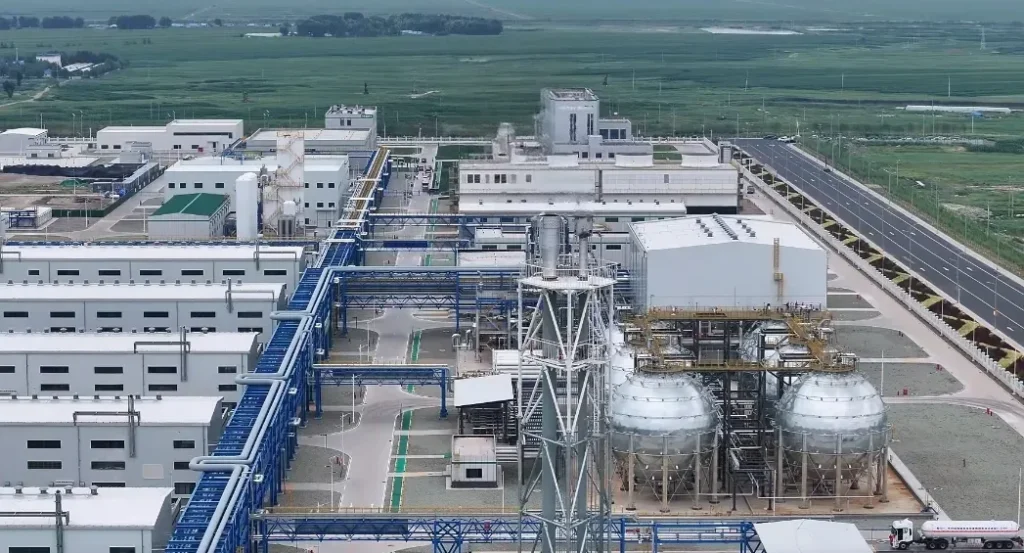
China has completed the world’s largest single-batch export of green ammonia, shipping 3,750 tonnes from the eastern port of Lianyungang, Jiangsu, to South Korea in a milestone that signals the country’s transition from pilot-scale green ammonia projects to commercial international deliveries.
The cargo, which departed on July 28, originated from State Power Investment Corporation’s (SPIC) Daan Green Ammonia Demonstration Project in Jilin Province. While modest compared with global conventional ammonia trade, the shipment represents an important milestone for the green ammonia economy, demonstrating an integrated renewable-powered production chain capable of meeting international certification standards and export requirements.
The transaction also reflects rising demand across Northeast Asia for low-carbon fuels as utilities and industrial users seek alternatives to fossil-derived ammonia and hydrogen.
From demonstration to commercial delivery
The export marks a significant step in China’s hydrogen strategy. Although hundreds of green hydrogen and ammonia projects have been announced globally, relatively few have progressed beyond demonstration to sustained commercial operation serving international customers.
Commissioned in July 2025 after 26 months of construction, the Daan project is among China’s first large-scale facilities to integrate renewable electricity generation, water electrolysis, ammonia synthesis, storage and export logistics within a single industrial complex.
Following a year of commissioning, optimization and operational ramp-up, the successful shipment demonstrates that the project’s entire value chain, from renewable power generation and hydrogen production to flexible ammonia synthesis and international export logistics, has reached commercial readiness.
The project’s operational performance further underscores its maturity. Since entering service, the facility has operated safely and continuously for more than 300 days while maintaining industry-leading zero- and low-carbon performance. Its proprietary “green electricity–hydrogen–ammonia” flexible control system optimizes operations despite fluctuating wind and solar generation, solving the challenge of integrating variable renewable power with continuous ammonia production. The innovation was named one of China’s Top Ten Energy Technology Innovation Achievements for 2025 by the National Energy Administration.
Equally important is the project’s certification. In October 2025, Daan became the world’s first facility to receive certification for Renewable Fuels of Non-Biological Origin (RFNBO) ammonia, providing internationally recognized verification of lifecycle carbon reductions. The certification, awarded under the ISCC EU framework and verified by Bureau Veritas, confirms compliance with the EU’s Renewable Energy Directive (RED III). It covers the entire supply chain and enables full traceability of every green ammonia shipment from renewable power generation to the delivery port.
Such certification is increasingly becoming a prerequisite for accessing premium low-carbon fuel markets, particularly in Europe and parts of Asia, where lifecycle carbon accounting requirements are becoming more stringent.
Integrated renewable production at industrial scale
The Daan project is one of the world’s largest integrated renewable ammonia developments. Its electrolyzers were supplied by SPIC Hydrogen, Sungrow Hydrogen, and LONGi Hydrogen, while its intelligent control systems were provided by the State Nuclear Power Automation System Engineering Company (SNPAS), a wholly owned second-tier subsidiary of SPIC.
With a total investment of CNY 6.3 billion, the complex comprises:
- 800 MW of onshore wind generation
- 200 MW of solar photovoltaic capacity
- Water electrolysis facilities producing 32,000 tonnes of green hydrogen annually
- An ammonia synthesis plant with an annual production capacity of 180,000 tonnes
Unlike conventional ammonia production, the Daan facility uses renewable electricity to produce hydrogen, which is subsequently combined with nitrogen extracted from the air through the Haber-Bosch process to produce ammonia without fossil-derived feedstocks.
One of the project’s principal engineering challenges is integrating intermittent wind and solar generation with continuous industrial processes. Flexible production systems enable the plant to respond to variable renewable power output while maintaining stable ammonia synthesis, an increasingly important capability as renewable penetration increases across power systems.
Power generation drives commercial demand
The shipment highlights the rapidly expanding role of green ammonia beyond its traditional use in fertilizer production.
The South Korean buyer is a consortium comprising Korea Electric Power Corporation (KEPCO), Doosan Enerbility and Lotte Fine Chemical. Earlier this year, the consortium launched the world’s first demonstration project for power generation using pure ammonia and hydrogen-ammonia co-firing, creating long-term demand for certified green ammonia supplies.
Ammonia is increasingly viewed as both an efficient hydrogen carrier and a low-carbon fuel. Compared with hydrogen, it benefits from established global transport and storage infrastructure, reducing many of the logistical challenges associated with hydrogen distribution. At the point of use, ammonia can either be combusted directly in suitably adapted turbines or cracked back into hydrogen for industrial and energy applications.
For import-dependent economies such as South Korea and Japan, where renewable energy resources are constrained but decarbonization targets are ambitious, green ammonia is emerging as a strategically important energy vector.
The transaction therefore represents more than a commodity export; it reflects the emergence of regional low-carbon energy supply chains linking renewable resource-rich production centres with industrial demand hubs.
Implications for global hydrogen markets
Although a single shipment does not establish a mature export market, it provides an important proof point for the commercialization of green ammonia.
Globally, many announced hydrogen projects continue to face challenges, including high production costs, financing constraints, certification requirements and the need to secure long-term offtake agreements. The Daan project demonstrates that these barriers can be overcome through integrated project development, internationally recognized certification, proprietary process innovation and committed downstream customers.
For China, the shipment reinforces its position not only as a manufacturer of renewable energy technologies but also as a prospective exporter of low-carbon energy carriers. Sustained competitiveness, however, will depend on maintaining cost leadership, expanding certified production capacity and securing long-term international demand.
More broadly, the export illustrates how green ammonia is evolving from technology demonstration to industrial deployment. As production scales, certification frameworks mature and cross-border supply chains deepen, green ammonia is poised to become an increasingly important internationally traded commodity in the emerging market for low-carbon fuels.