The project signals a new stage in the commercialization of perovskite PVs, demonstrating progress in manufacturing scale, building integration and low-carbon industrial energy systems.
China’s perovskite solar industry has reached a significant commercial milestone after UtmoLight connected a 6.7MW rooftop distributed photovoltaic project to the grid at its Wanshan Lake industrial campus in Wuxi, Jiangsu Province. Commissioned on July 31, the installation is currently the world’s largest single commercial rooftop PV project based on perovskite technology, marking an important step in the transition of next-generation solar cells from pilot projects to large-scale commercial deployment.
Beyond its record capacity, the project illustrates how advanced PV technologies are becoming integrated into manufacturing operations, building design and industrial energy systems. Operating under a “self-consumption with surplus electricity exported to the grid” model, it combines renewable power generation with on-site industrial demand while serving as a showcase for building-integrated photovoltaics (BIPV) and zero-carbon industrial development.
Scaling perovskite PV beyond demonstration
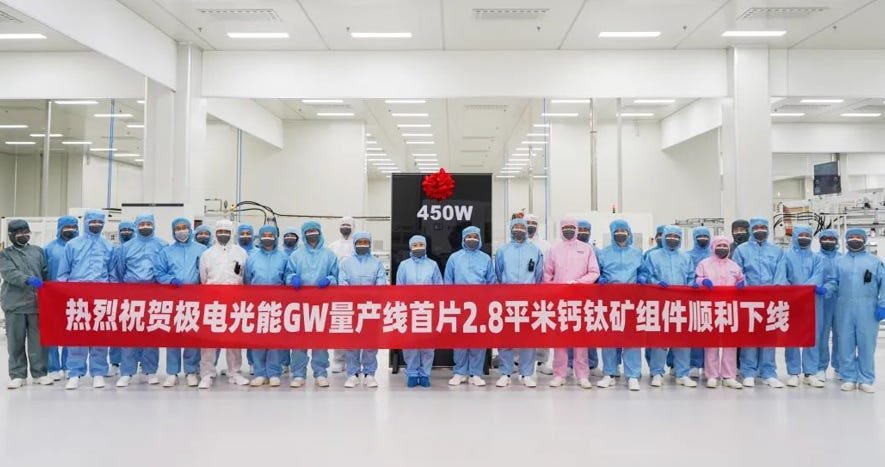
The installation comprises approximately 15,000 perovskite modules, each measuring 2.81 square metres, deployed across the rooftops of UtmoLight’s manufacturing facilities. The system has been designed to maximize rooftop utilization through optimized module layout and integrated energy management.
According to the company, the project is expected to generate more than 6.56 GWh of electricity annually. Most of the electricity will be consumed on site, lowering grid demand and reducing operating emissions, while surplus generation will be fed into the public grid.
Although crystalline silicon remains the dominant photovoltaic technology, perovskite solar cells have attracted growing industry interest because of their high efficiency potential, lower material consumption, and compatibility with lower-temperature manufacturing processes. Commercial scalability and long-term operational stability have long been regarded as the principal barriers to widespread adoption. Projects at this scale therefore represent an important validation of both manufacturing capability and technology maturity.
The Wuxi installation demonstrates that perovskite photovoltaics are moving beyond laboratory research and demonstration projects toward mainstream distributed generation applications.
Manufacturing and architecture converge
The rooftop project forms part of UtmoLight’s broader vision of developing a zero-carbon industrial campus in which photovoltaic generation is embedded throughout the built environment rather than confined to rooftops.
Across the Wanshan Lake campus, perovskite products have been integrated into façades, elevated walkways, perimeter walls and photovoltaic carports, illustrating the expanding role of BIPV. Instead of treating solar panels as stand-alone infrastructure, the approach incorporates electricity generation directly into architectural elements, improving land utilization while enhancing design flexibility.
The strategy extends to the company’s Perovskite Solar Cell Innovation R&D Center, which has been designated a Jiangsu provincial demonstration project for ultra-low-energy and near-zero-energy buildings. Covering 13,240 square metres, the facility integrates perovskite photovoltaic products into curtain walls, roofs and connecting structures.
According to project data, the building achieves an overall energy-saving rate of 86.18%, demonstrating how photovoltaic materials can function as structural building components while reducing operational energy demand. Such integrated solutions are increasingly viewed as an important pathway for decarbonizing commercial buildings, particularly in dense urban environments where rooftop space is limited.
Advantages in challenging operating conditions
Perovskite photovoltaics may offer particular advantages in regions such as the Yangtze River Delta, where climatic conditions can reduce the performance of conventional silicon modules.
Summer rooftop temperatures in Wuxi can reach around 70°C. While crystalline silicon modules experience measurable power losses as operating temperatures rise, perovskite cells exhibit lower temperature sensitivity. They also maintain stronger performance under diffuse and low-light conditions, including during the region’s prolonged rainy season.
According to local energy authorities, these characteristics enable perovskite installations in Wuxi to generate approximately 8% more electricity annually than crystalline silicon systems with the same installed capacity.
Early operating results appear to support that assessment. UtmoLight’s rooftop perovskite installation at Wuxi MixC, commissioned in late June, has recorded 8% higher electricity generation than conventional crystalline silicon modules during its first month of operation. The project is expected to generate around 680 MWh annually.
Higher energy yields under high-temperature and low-irradiance conditions could significantly improve the economics of distributed solar generation across humid subtropical regions in China and elsewhere in East and Southeast Asia.
Building a broader commercial ecosystem
UtmoLight’s strategy extends beyond module manufacturing toward integrated renewable energy solutions for industrial and commercial customers.
Its product portfolio includes standard perovskite modules in 0.72-square-metre and 2.81-square-metre formats, alongside BIPV products such as photovoltaic roof tiles, electricity-generating stone panels and photovoltaic curtain walls. Together, these products support customized deployment across rooftops, façades, fencing systems and parking structures, broadening the range of buildings capable of generating electricity.
The business model reflects a broader evolution across the photovoltaic value chain. Rather than competing solely on module efficiency or manufacturing cost, developers of next-generation PV technologies are increasingly integrating product design, engineering, construction and energy management into comprehensive low-carbon building solutions.
As distributed energy systems become a larger component of China’s energy transition, this integrated approach could become an increasingly important source of competitive differentiation.
Urban renewal opens a larger market
While new industrial developments provide an important early market, the greater long-term opportunity may lie in retrofitting existing buildings.
Local energy planners view urban renewal as one of the largest potential markets for perovskite photovoltaics. Demonstration projects are already exploring the installation of semi-transparent perovskite modules on office windows, allowing buildings to reduce solar heat gain while simultaneously generating electricity.
This illustrates one of perovskite technology’s distinctive advantages over crystalline silicon. Because perovskite materials can be manufactured with varying degrees of transparency, they enable photovoltaic windows and façades that preserve daylight while contributing to a building’s energy supply.
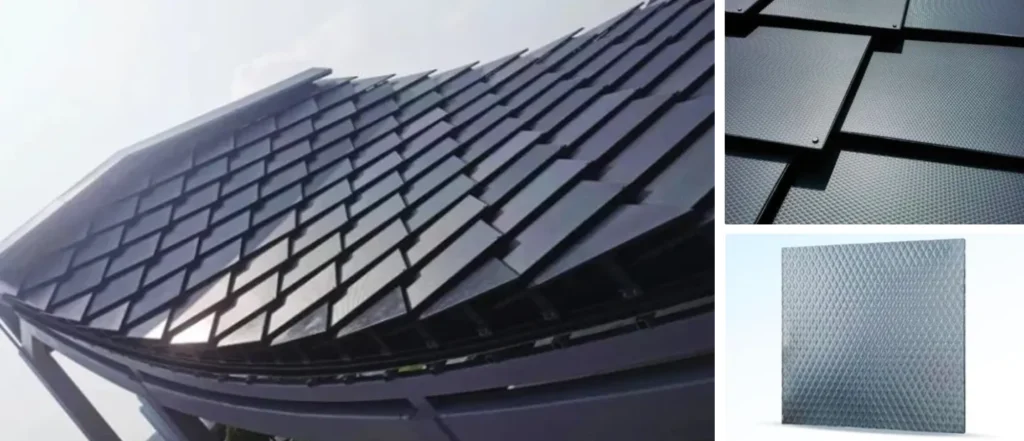
Several landmark projects across Wuxi demonstrate the technology’s expanding application. More than 10,000 perovskite photovoltaic roof tiles cover the 9,800-square-metre dome of the Wuxi Symphony Hall, generating approximately 1,200 MWh annually. Elsewhere, semi-transparent perovskite curtain walls have been incorporated into Liangxi Science City, where façade elements simultaneously provide daylight, weather protection and electricity generation.
According to Wuxi Energy Group, projects based on perovskite photovoltaics now account for more than 90% of the city’s investment in this emerging technology, positioning Wuxi as one of China’s leading testbeds for commercializing next-generation solar technologies.
Strategic implications for the global solar industry
The significance of UtmoLight’s 6.7MW project extends well beyond its record-setting capacity. It provides tangible evidence that perovskite photovoltaics are entering a new stage characterized by scalable manufacturing, diversified applications and commercially relevant operating performance.
For China, the project aligns with broader industrial policies supporting advanced manufacturing, next-generation energy technologies and carbon neutrality objectives. For the global photovoltaic industry, successful commercial deployments help address long-standing questions surrounding scalability, reliability and bankability, factors that will ultimately determine whether perovskite technology complements or competes with crystalline silicon over the coming decade.
As manufacturing capacity expands and long-term operational data accumulate, competitive advantage is likely to depend not only on laboratory efficiency records but also on manufacturing scale, supply chain maturity, system integration and lifecycle economics. The Wuxi project suggests that the next phase of photovoltaic competition may be shaped as much by architecture, industrial engineering and urban redevelopment as by advances in solar cell chemistry.