The new Qualified Foreign Limited Partnership fund strengthens Wuxi’s cross-border investment platform while highlighting the growing role of secondary private equity in financing China’s advanced manufacturing and technology sectors.
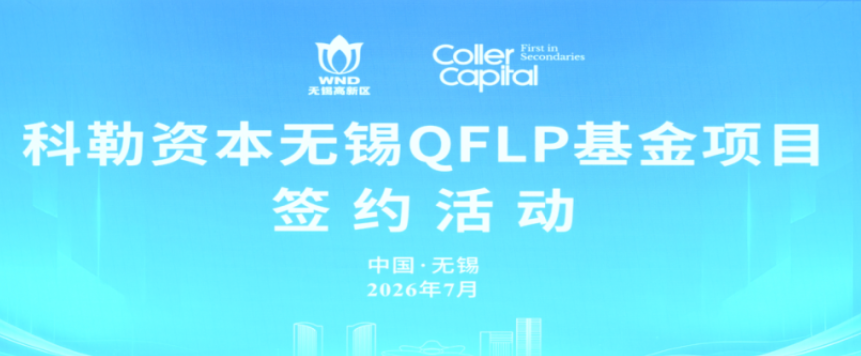
On July 17, Coller Capital and Wuxi National High-tech Zone (WND) signed an agreement to establish a CNY 700 million (USD 97 million) Qualified Foreign Limited Partnership (QFLP) fund, reinforcing Wuxi’s ambition to become a leading hub for cross-border private equity investment and technology finance in China.
The transaction represents the latest milestone in a long-term partnership between Coller Capital, one of the world’s leading specialists in the private equity secondary market, and Wuxi’s rapidly developing investment ecosystem. It also reflects a broader trend: Chinese local governments are increasingly leveraging QFLP programs to attract overseas institutional capital into strategic industries amid a more complex global investment environment.
For Coller Capital, the new fund expands its onshore renminbi investment platform and strengthens its access to China’s innovation economy. For Wuxi, the partnership demonstrates how local governments are combining industrial policy with financial infrastructure to channel international capital towards high-growth technology sectors.
The new fund builds on an established relationship between the two parties. In 2023, with the support of WND, Coller Capital launched its first onshore CNY secondary fund in the city. The fund, with CNY 1.2 billion in committed capital, has since been fully funded and focuses on acquiring secondary interests in private equity funds and investment portfolios, providing liquidity solutions for China’s increasingly mature private capital market.
QFLP as a strategic investment gateway
China’s QFLP framework enables qualified overseas investors and fund managers to establish or participate in onshore private equity and venture capital funds investing directly in Chinese companies.
Rather than relying solely on offshore structures, QFLP provides a regulated channel for deploying foreign capital through CNY-denominated funds. Since Shanghai launched China’s first QFLP pilot in 2011, the framework has evolved from a regulatory experiment into an important gateway for international institutional investors seeking access to China’s private equity and venture capital markets.
Its appeal extends beyond market entry. QFLP structures typically provide greater flexibility in foreign exchange conversion, streamlined investment procedures, clearer tax arrangements, and more efficient exit mechanisms. These advantages have made QFLP an increasingly important policy tool for local governments seeking to attract long-term institutional capital while supporting innovation and industrial upgrading.
For fund managers, QFLP offers an efficient structure for deploying overseas capital into China’s domestic market. Compared with many traditional CNY funds, these vehicles are often supported by longer-duration institutional capital, enabling managers to pursue patient investment strategies and apply global operational expertise.
For local governments and state-backed investment platforms, QFLP funds serve a broader strategic purpose. Beyond financing individual companies, they help attract diversified international capital, strengthen regional innovation ecosystems, and support industrial development. Increasingly, QFLP vehicles operate alongside government guidance funds, fund-of-funds platforms, and industrial M&A initiatives to create integrated capital ecosystems.
Wuxi builds a leading QFLP ecosystem
Wuxi has become one of China’s most active centres for QFLP development, using the program as a bridge between global institutional investors and the city’s technology-driven industrial economy.
In June 2021, Wuxi became the first city in Jiangsu Province to launch a city-wide QFLP program, extending the scheme across its entire administrative area (including its five districts and the two county-level cities of Jiangyin and Yixing), rather than limiting it to a single pilot zone. The city further strengthened the framework in 2024 by introducing Version 3.0 of its QFLP regulations, improving operational efficiency and investor accessibility.
Under the updated framework, Wuxi has adopted a selective approach to attracting fund managers, prioritizing institutions whose investment strategies and sector expertise align with the city’s industrial priorities. The objective is not simply to attract capital but to ensure that financial resources reinforce long-term economic development goals.
The strategy has produced significant results. By the end of 2025, Wuxi had approved 57 QFLP funds with combined target commitments exceeding USD 5.8 billion, the highest number and fundraising scale in Jiangsu Province, placing the city among China’s leading centres for cross-border private equity investment.
The program supports flexible fund structures that combine domestic and foreign capital under international or local managers. Eligible investments cover private equity, venture capital, and strategic emerging industries aligned with Wuxi’s economic priorities.
Building a tech-focused capital ecosystem
The latest agreement with Coller Capital forms part of WND’s broader strategy to develop its “6+2+X” industrial cluster model while strengthening Wuxi Fund PARK (尚贤湖基金) as a nationally recognized technology investment hub.
Local authorities are positioning the district as an international financial platform connecting overseas institutional investors with China’s advanced manufacturing economy. Priority sectors include AI, biopharmaceuticals, renewable energy, advanced materials, high-end equipment manufacturing, and digital technologies.
Wuxi Fund PARK has become a key pillar of this strategy. To date, it has attracted more than 30 leading investment institutions, including China Chengtong Holdings, IDG Capital, HOPU Investment Management, CDH Investments, GGV Capital, and China Merchants Capital. Together, these institutions have helped establish a multi-layered investment ecosystem spanning angel investment, venture capital, private equity, and secondary funds.
Since its establishment in 2021, the park has accumulated more than CNY 260 billion in private fund assets under management, strengthening its position as one of China’s leading hubs for technology-focused investment capital.
Secondary private equity gains momentum
The transaction is notable not only for its size but also for Coller Capital’s specialist focus on private equity secondaries.
Unlike traditional buyout or venture capital funds that invest directly in companies, secondary funds acquire existing interests in private equity funds or portfolios of underlying assets. This approach provides liquidity to existing investors while allowing buyers to access more mature assets with greater visibility into operating performance.
As China’s private equity market matures and more funds approach the end of their investment cycles, demand for secondary liquidity solutions has increased. Secondary strategies are becoming an increasingly important component of China’s private capital ecosystem, supporting more efficient capital recycling and enabling continued investment in innovation-driven companies.
EQT acquisition strengthens global reach
The investment comes as Coller Capital prepares to become Sweden-based EQT Group’s dedicated global secondary private equity platform following an acquisition agreement announced in January 2026. The transaction, expected to close in the third quarter, will connect Coller Capital with Europe’s largest alternative investment platforms by assets under management and private markets capital raised.
EQT is among the international private equity firms that have actively utilized China’s QFLP and broader cross-border investment frameworks. The firm applies an “all-weather” investment approach in China, targeting both high-growth companies and established businesses in resilient sectors.
For Wuxi, the combination could further expand access to global institutional capital, sector expertise, and international industrial networks. For overseas investors, it may provide additional opportunities to participate in China’s innovation economy through professionally managed, onshore investment structures.
Capital aligned with industrial strategy
The latest fund demonstrates how Chinese local governments are increasingly integrating financial policy with industrial development. Rather than focusing solely on fundraising, cities such as Wuxi are building investment ecosystems designed to attract capital, expertise, and strategic resources.
Wuxi’s QFLP framework prioritizes industries aligned with both local development plans and national strategic priorities, including advanced information technology, intelligent manufacturing, biomedicine, renewable energy, and advanced new materials. By directing international capital towards these sectors, policymakers aim to strengthen corporate financing while enhancing long-term industrial competitiveness.
More broadly, the model connects overseas institutional investors, professional fund managers, government-backed investors, and technology companies within a single value chain. Beyond capital provision, it facilitates knowledge exchange, international networks, and operational expertise to accelerate innovation and industrial upgrading.
The Coller Capital transaction therefore represents more than a regional fundraising announcement. It illustrates the evolution of QFLP from a regulatory innovation into a mature investment platform linking global institutional capital with China’s technology economy. As competition among Chinese cities for high-quality foreign investment intensifies, jurisdictions capable of combining industrial strength with sophisticated financial infrastructure are likely to gain a lasting advantage in attracting long-term technology investment.