China’s solid-state battery industry is accelerating toward commercialization, with multiple manufacturers unveiling pilot production lines, new materials platforms, and vehicle integration timelines for 2026–2027. Backed by policy momentum and demand from electric vehicles and high-end applications such as eVTOL aircraft and robotics, the sector is converging on sulfide-based chemistries and >400 Wh/kg energy density targets, while addressing cost, interface, and manufacturing challenges.
Growing Momentum
Leading Chinese battery makers and suppliers have shifted the narrative from lab breakthroughs to pilot-scale deployment, with notable developments including:
- Gotion High-Tech has completed a 0.2 GWh full solid-state battery (SSB) pilot line, among the largest currently operational in China.
- Farasis Energy expects to complete its full SSB pilot line by the end of 2025, targeting verification of 60 Ah-class products.
- Ronbay Technology, a global cathode leader, has developed 8- and 9-series high-nickel cathodes optimized for sulfide SSBs, with expected cost parity to incumbent chemistries.
- Hive Energy will begin trial production of its first-generation semi-solid cells (140 Ah) on a 2.3 GWh line in Q4 2025, aiming for large-scale OEM supply in 2027.
Specifications and Commercial Relevance
Solid-state batteries are classified by their residual liquid electrolyte mass fraction: liquid (~25%), semi-solid (5–10%), quasi-solid (0–5%), and full solid-state (0%). The industry is transitioning from semi-solid toward full solid-state, with sulfide-based electrolytes emerging as the dominant choice due to high ionic conductivity (~10⁻³ S/cm) and favorable interface properties compared with oxides and polymers.
I. Performance Targets
- Energy density: ≥400 Wh/kg for auto-grade cells by 2026–2027
- Cycle life: ≥1,000 cycles to 80% capacity retention
- Fast charging: Comparable to current liquid lithium-ion cells
- Safety: Elimination of flammable liquid electrolytes reduces thermal runaway risk
II. Application-Specific Designs
- eVTOL: Farasis’ 2nd-gen semi-solid eVTOL cell (320 Wh/kg), optimized for high C-rate takeoff/landing cycles and long service life
- Humanoid robots: High-silicon anode + SSB configuration for high volumetric energy density in space-constrained designs
III. Scale and Timelines
- 2024–2025: Pilot line construction and 60–140 Ah-class product validation
- 2026: OEM integration testing; small-batch automotive deployments
- 2027: Initial large-scale automotive rollouts; niche adoption in eVTOL and robotics
- 2030: Full-scale deployment in premium EV segments
IV. Cost Competitiveness
While sulfide SSB materials are nearing cost parity at the cathode level, system-level costs remain 20–50% higher than high-end NCM811 liquid cells due to dry-room processing requirements, interface coating complexity, and high-purity precursor costs. Policy incentives under China’s 14th Five-Year Plan and provincial subsidies for advanced battery manufacturing are expected to narrow this gap.
Strategic and Market Implications
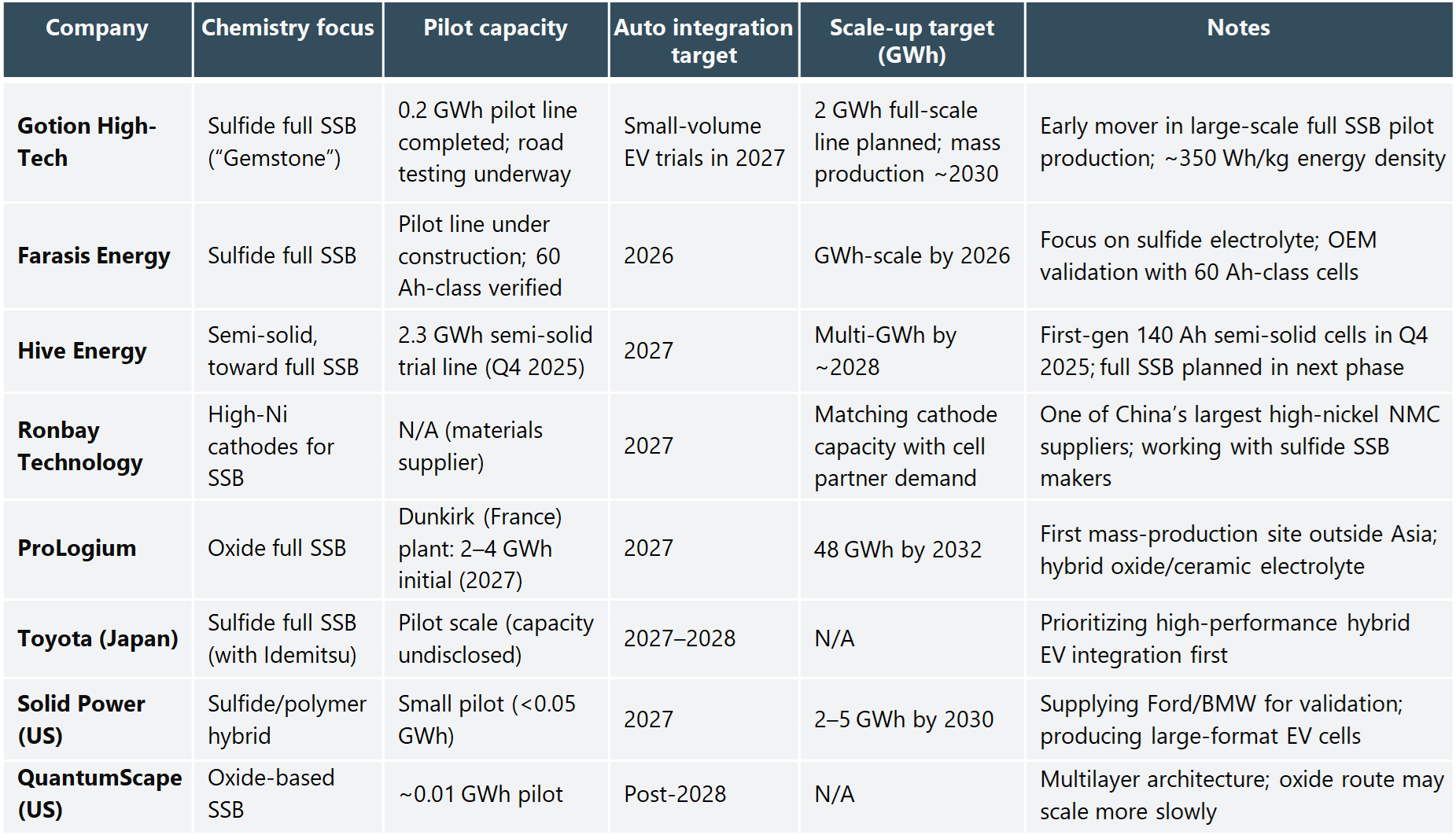
Chinese SSB leaders are building pilot lines at 0.2–2.3 GWh scale, outpacing most international peers in 2024 in installed pilot capacity. Materials integration, such as Ronbay’s cathode readiness, positions Chinese midstream players for rapid GWh-scale expansion once manufacturing bottlenecks are resolved.
China’s early scaling advantage positions it to lead the 2026–2027 commercialization window, while Japanese and US developers remain in lower-throughput phases. The advantage is shaping the nascent industry, where rapid integration and scalable production may trump incremental performance gains. At the same time, the move to SSBs is transforming the battery value chain:
- Upstream: Materials suppliers (Ronbay, Jiayuan) securing contracts for cathodes and copper foils tailored to SSB needs.
- Midstream: Cell makers scaling pilot capacity ahead of confirmed OEM orders.
- Downstream: Automakers (Changan, GAC) aligning product roadmaps with SSB readiness, particularly for high-margin EV lines.
It also shapes market segmentation, with product performance and cost structures steering adoption toward high-value niches in the early commercialization stage.
- High-end EVs: Premium sedans/SUVs prioritizing range and safety
- Aerospace: eVTOL and UAV markets with stringent weight and safety requirements
- Advanced robotics: Compact, thermally stable, high-energy-density packs
Outlook
The commercial race for full solid-state batteries is shifting from R&D-led competition to a scale-up contest, where integrated supply chains, manufacturability, and cost control will define market leadership. While liquid and semi-solid chemistries will coexist for years, China’s current pace suggests it could secure the first mass-market foothold in full SSBs, with automotive-grade 400 Wh/kg cells on the road by 2027.