In August 2025, Sinoscience Clean Energy Technology closed a hundred-million-CNY Series A round. Backed by state-owned investors and industrial partners, the funding will accelerate expansion into liquid hydrogen (LH2) equipment, fusion cryogenics, and deep refrigeration systems for quantum computing.
Founded in 2022 by China General Nuclear Group, the Energy Institute of the Hefei Comprehensive National Science Center, and Henan Investment Group, the startup has already achieved a number of Chinese technical firsts. In 2023, it unveiled China’s first 1 TPD hydrogen liquefier, followed by a 5 TPD unit in December 2024, which immediately entered commercialization.
In March 2025, its liquefaction technology supported the Changzheng-8 (Long March 8) rocket at the Hainan International Commercial Space Launch Center, demonstrating reliability in mission-critical applications. In May, it signed its first export contract with CMMZE Group for a 2 TPD liquefaction system.
LH2 and Market Significance
At the core of Sinoscience Clean Energy’s strategy is liquid hydrogen (LH2), enabling cost-effective storage and long-distance transport at –253 °C. Key milestones include:
- 1 TPD H2 liquefier (2023): First domestically built system to achieve continuous long-duration operation; validated cryogenic compressors, expanders, and helium refrigeration.
- 5 TPD H2 liquefier (2024): Benchmarked against international standards; advanced directly from R&D to commercialization; designed for hydrogen hubs, including coke plant integration in Henan.
- 30 TPD H2 liquefier (target 2027): Planned for deployment in Inner Mongolia or Northeast China; aims to reduce LH2 liquefaction and delivery costs to CNY 30–33/kg (US$4–5/kg) within a 2,500 km transport range.
Globally, hydrogen liquefaction remains a bottleneck: less than 5% of hydrogen trade is in liquid form (IEA). With modular systems from 1–30 TPD, Sinoscience Clean Energy is targeting a market estimated at US$15–20 billion by 2030, driven by projects in Australia, MENA, and Latin America.
To achieve cost competitiveness, the company plans:
- Phase 1 (Henan): 5 TPD unit targeting CNY 38–42/kg (US$5–6/kg) within a 1,000 km transport range.
- Phase 2 (Inner Mongolia): 30 TPD unit targeting CNY 30–33/kg (US$4–5/kg) within a 2,500 km transport range.
For comparison, LH2 liquefaction and delivery in Japan (2025) costs US$7–8/kg, while Air Liquide’s 30 TPD Nevada unit, operational since 2022, still costs over US$6/kg. If realized, Sinoscience Clean Energy’s targets would position China as a global low-cost liquefaction supplier.
From Hydrogen to Fusion & Quantum
Beyond hydrogen, Sinoscience Clean Energy is advancing in other cryogenic domains. In fusion, it has contracted with the Institute of Plasma Physics (IPP), CAS, to supply a 3 kW@4.5 K helium refrigeration system, the largest commercial fusion cryogenic unit in China, and is developing a 20 kW Tokamak system under the national fusion program.
In quantum computing, it has built a third-generation deep cryogenic sensing system, stable under 9 T magnetic fields, representing China’s first engineering-ready platform for superconducting quantum computers, planned for release in 2026.
Value Chain and Outlook
Current global LH2 benchmarks are set by Air Liquide (30 TPD, Nevada, operational since 2022, primarily serving mobility and space) and Linde (5–15 TPD units worldwide, known for high efficiency but with capital costs often exceeding US$100 million per plant). In the US, Air Products is a leading industrial gases player, while Plug Power is emerging in green hydrogen with modular, scalable liquefaction.
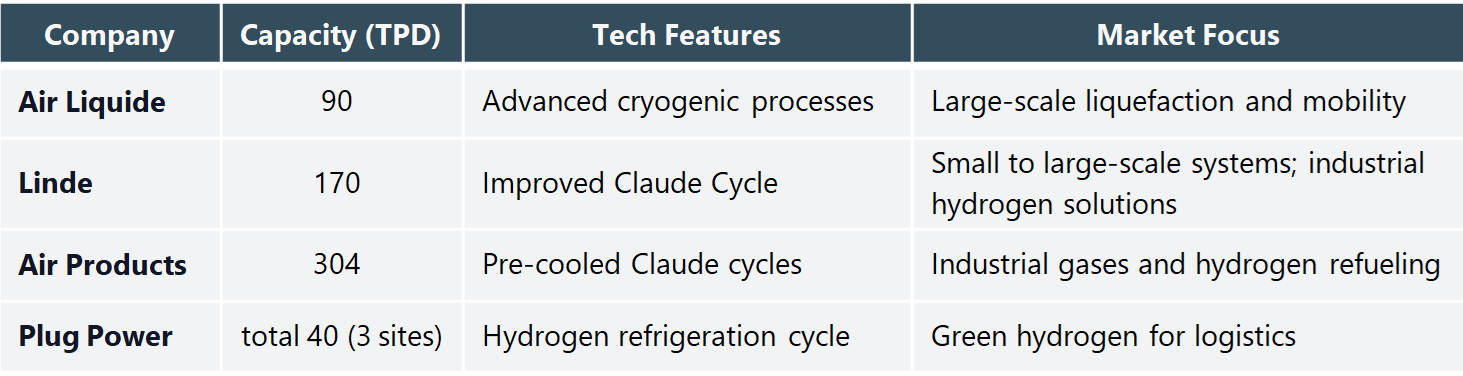
In China, major LH2 sites are listed in the table below. Amid significant market potential, Sinoscience Clean Energy seeks to establish a cost-effective domestic value chain to scale up LH2 equipment, production, and deployment.
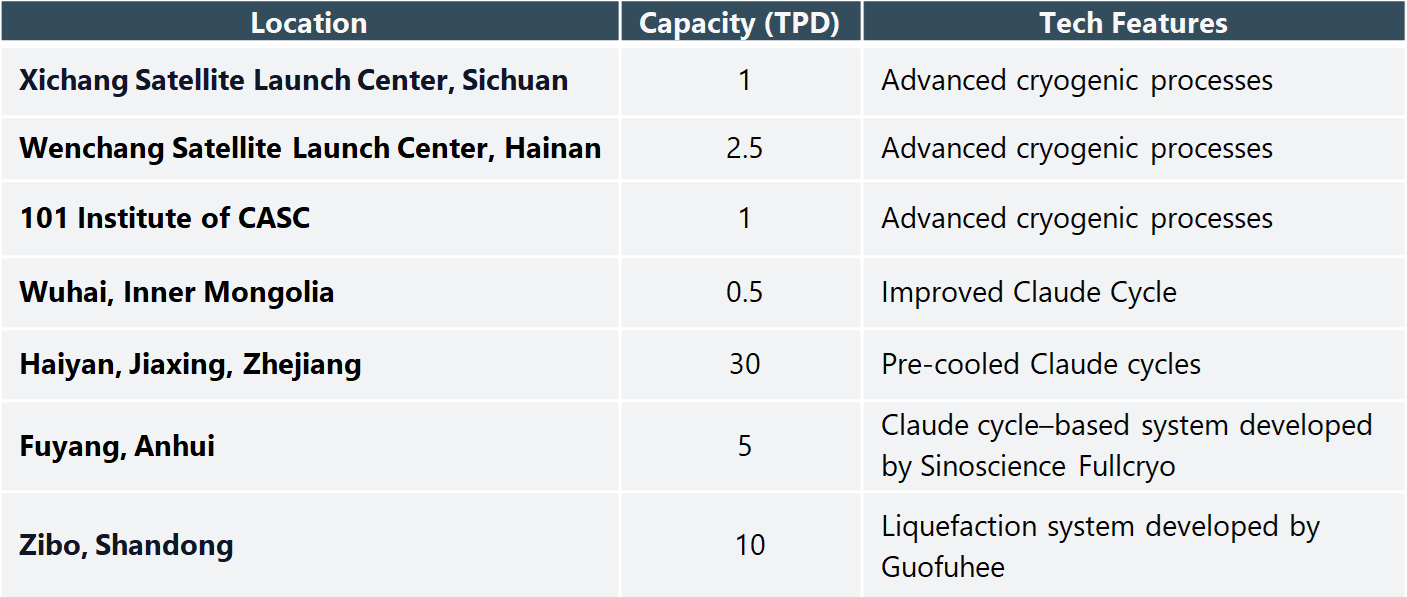
China’s Hydrogen Industry Medium- and Long-Term Plan (2021–2035) prioritizes breakthroughs in hydrogen storage and transport, while the 14th Five-Year Plan for Energy Technology identifies cryogenics as a bottleneck. Within this policy context, Sinoscience Clean Energy’s modular 1–30 TPD systems offer flexibility for emerging hydrogen hubs and aim to reduce reliance on imported helium refrigerators and liquefiers.
Unlike single-product start-ups, the company is building a multi-sector cryogenics platform spanning hydrogen, fusion, quantum, and aerospace to generate engineering synergies. Helium refrigerators serve both Tokamaks and quantum dilution fridges, while liquefaction modules can scale to rocket fueling systems. Modularization and co-development with national labs aim to set domestic benchmarks and influence global standards.
By 2026, Sinoscience Clean Energy plans to deliver its 30 TPD liquefier prototype and launch China’s first engineering-ready quantum cryogenic sensing system, validating its platform across hydrogen, fusion, and quantum. The move reflects a broader trend in China: cross-sector champions at the nexus of energy, climate, and frontier science, driving rapid advances in LH2, cryogenics, and deep tech.