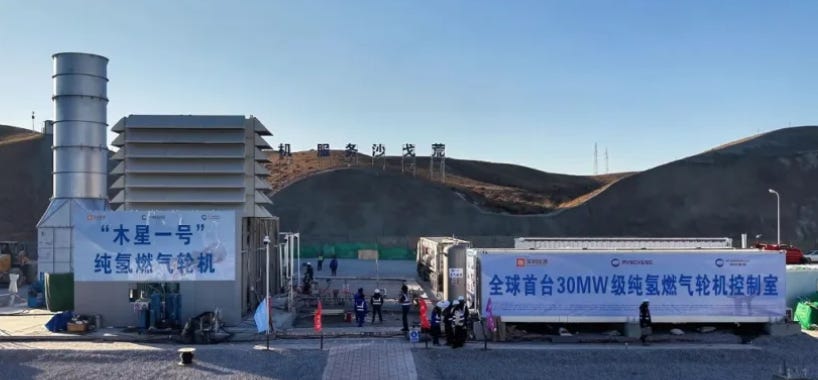
On December 28, 2025, China commissioned the world’s first 30-MW pure hydrogen gas turbine into stable operation.
The Jupiter-1 turbine, developed by Mingyang Hydrogen, a subsidiary of Mingyang Smart Energy, in Wuxi, Jiangsu Province, and deployed at a demonstration facility in Otog Banner, Inner Mongolia, has entered sustained electricity generation using 100% green hydrogen. The project validates, at commercial scale, a complete “electricity-to-hydrogen-to-electricity” (P2H2P) energy conversion cycle.
Technical and Commercial Milestone
Jupiter-1 has achieved continuous, stable power generation at its demonstration site in the Otog High-Tech Industrial Development Zone in Inner Mongolia’s Ordos region. This marks the first time a 30 MW-class gas turbine has operated at full load on pure hydrogen in a real, engineered environment, successfully closing the loop from surplus renewable electricity to hydrogen production and back to grid power.
The project is a collaboration between Mingyang Hydrogen and Shenzhen Energy Group and is integrated with a 500 MW wind farm and a 5 MW off-grid photovoltaic hydrogen production system. Electrolyzers with a combined hydrogen output of 48,000 Nm³ per hour supply green hydrogen, which is stored in 12 spherical tanks, each with a volume of 1,875 cubic metres, before being dispatched to the turbine for power generation.
The power system is part of a broader industrial ecosystem that includes a 150,000-tonne-per-year green ammonia synthesis facility. In parallel, Inner Mongolia is advancing a hydrogen–ammonia gas turbine integrated application pilot project. This initiative uses hydrogen–ammonia blended fuels as a transitional and complementary pathway toward fully pure hydrogen gas turbine deployment.
With a total investment of CNY 110 million, the project will install two 8 MW multi-fuel hydrogen gas turbine generation units and associated grid-connection facilities, while conducting demonstration research on hydrogen–ammonia turbines in long-duration and ultra-long-duration hydrogen energy storage scenarios. Construction began in April 2025, with commissioning expected by December 2026.
Key Technologies and Specifications
At the core of the demonstration is the Jupiter-1 gas turbine, a purpose-built hydrogen combustion system with the following key characteristics:
- Rated electrical output: 30 MW, operating entirely on pure hydrogen
- Fuel type: 100% green hydrogen with zero direct carbon emissions
- Hydrogen production: Approximately 48,000 Nm³ per hour, produced via electrolyzers powered by wind and solar energy
- Hydrogen storage: Twelve large-volume tanks, each with a capacity of 1,875 m³, enabling supply buffering and operational flexibility
- Zero-carbon combustion: Advanced micro-premixed combustion technology designed to manage hydrogen’s high flame speed, flashback risk, combustion instability, and elevated NOx formation tendency, incorporating proprietary 3D-printed injectors and multi-stage aerodynamic control systems
The project progressed through multiple development milestones, with Jupiter-1 completing full-speed, no-load testing in March 2025 following extensive laboratory validation of the pure hydrogen combustion chamber.
Commercial Relevance and Market Context
Beyond its technical achievement, the demonstration carries significant commercial implications for the emerging hydrogen economy.
- Grid flexibility and storage: Hydrogen turbines such as Jupiter-1 provide dispatchable generation that can absorb surplus renewable energy and deliver electricity on demand, supporting grid stability in systems with high wind and solar penetration.
- Decarbonization impact: Operating on 100% green hydrogen, Jupiter-1 displaces fossil-fuel generation at its rated capacity, reducing CO₂ emissions by more than 200,000 metric tonnes annually compared with a conventional thermal power unit, according to project estimates.
- Energy export potential: The project strengthens China’s position in the global hydrogen equipment manufacturing market, where few players have demonstrated comparable scale, system integration, and operational maturity.
- Policy alignment: The project is included in China’s first batch of national hydrogen energy pilot initiatives, supporting the country’s goals to peak carbon emissions by 2030 and achieve carbon neutrality by 2060, while catalyzing investment across hydrogen production, storage, and utilization technologies.
From an operational perspective, the turbine’s capacity is well suited to distributed energy systems and industrial park applications, filling a gap between smaller fuel-cell installations and large centralized fossil-fuel power plants. The programme further validates the “electricity-hydrogen-electricity” (P2H2P) value chain as a commercially viable model for managing renewable intermittency and delivering ancillary grid services.
Strategic and Market Implications
I. Filling a Global Capability Gap
Hydrogen combustion turbines capable of reliable operation on 100% hydrogen at meaningful scale have long been a target in clean-energy technology. While several manufacturers have announced hydrogen-capable designs, Jupiter-1 stands among the first demonstrable 30 MW-class pure hydrogen systems in operation, giving China a clear first-mover advantage in this segment.
II. Enhancing Grid Services
Unlike battery systems, which primarily address short-duration storage needs, hydrogen turbines can provide long-duration energy storage across daily and multi-day cycles. This makes them well-suited to addressing seasonal and deep-storage challenges that batteries alone cannot economically serve, while reducing renewable curtailment.
III. Scaling Beyond Demonstration
The project’s technical success, combined with integration into green ammonia production and hydrogen–ammonia hybrid turbine development, suggests a scalable model of energy–industrial symbiosis. Surplus renewable electricity is converted into hydrogen and allocated between industrial feedstock and power generation, creating diversified revenue streams that improve project economics and reduce investment risk.
IV. Competitive Dynamics
Western manufacturers such as Siemens Energy and General Electric have pursued hydrogen-capable turbines, often emphasizing hydrogen blending rather than full-scale pure hydrogen combustion. Mingyang’s demonstration may accelerate global competition, prompting rivals to intensify R&D efforts or recalibrate technology strategies as decarbonization requirements tighten.
V. Safety, Standards, and Regulation
Widespread deployment of hydrogen turbines will require robust safety systems, standardized codes for high-pressure hydrogen infrastructure, and clear regulatory frameworks for grid integration and market participation. This demonstration provides valuable operational data that could inform international standards development and support broader global adoption.
Outlook and Challenges
Despite the milestone achieved by Jupiter-1, hydrogen turbine technology continues to face challenges related to unit size, system efficiency, and overall cost.
From an energy efficiency perspective, hydrogen-based power systems incur losses across electrolysis, compression or storage, and combustion. Current P2H2P round-trip efficiency (RTE) is typically in the range of ~30–40% for fuel-cell-based systems and ~20–28% for simple-cycle hydrogen gas turbines, with reconversion losses accounting for the majority of inefficiency. While fuel cells offer higher RTE, gas turbines remain more scalable, easier to integrate with existing thermal power infrastructure, and better suited to providing grid inertia and other essential system services.
Importantly, efficiency losses become less critical when renewable electricity is sufficiently inexpensive, particularly when compared with the high costs of long-duration storage solutions that batteries cannot economically deliver. In several regions of China, renewable energy costs have fallen to exceptionally low levels, with solar power priced at approximately CNY 170–240/MWh (US$23–33/MWh) and wind power at around CNY 210–275/MWh (US$28–38/MWh). At these price points, converting surplus renewable electricity into hydrogen for long-duration storage and dispatchable generation becomes increasingly viable.
At the same time, alternative long-duration energy storage (LDES) pathways are also advancing. For example, Hami Energy’s 100 MW/400 MWh vanadium redox flow battery project (see link), commissioned in August 2025, delivers a reported round-trip efficiency of approximately 68%, highlighting the performance advantages of electrochemical storage for certain use cases. However, flow batteries remain capital-intensive and are generally better suited to medium-duration applications, whereas hydrogen systems offer greater flexibility for multi-day, seasonal, and cross-sector energy storage.