More than 50 pilot parks are selected in a landmark policy push, with Envision Energy involved in over a fifth of the projects, highlighting the rise of AI-driven power systems as core national infrastructure.
In December 2025, China’s National Development and Reform Commission (NDRC), Ministry of Industry and Information Technology (MIIT), and National Energy Administration (NEA) jointly released the first batch of National Zero-Carbon Industrial Park Pilots, naming 52 industrial parks nationwide.
The list includes major industrial and economic hubs, such as the Ordos Zero-Carbon Industrial Park in Inner Mongolia, the Beijing Economic-Technological Development Zone, and the Tianjin Economic-Technological Development Zone—areas that sit at the core of China’s manufacturing base and energy system.
Beyond its symbolic significance, the announcement formally establishes zero-carbon industrial parks as a new category of national infrastructure. Rather than isolated demonstration projects, these parks are designed as replicable institutional models to support manufacturing competitiveness, accelerate power system reform, and advance China’s “dual-carbon” goals.
For the cleantech and AI sectors, the list carries additional weight. Envision Group is involved in more than one-fifth of the selected parks, highlighting the growing role of AI-driven power systems as foundational infrastructure in China’s industrial decarbonization strategy.
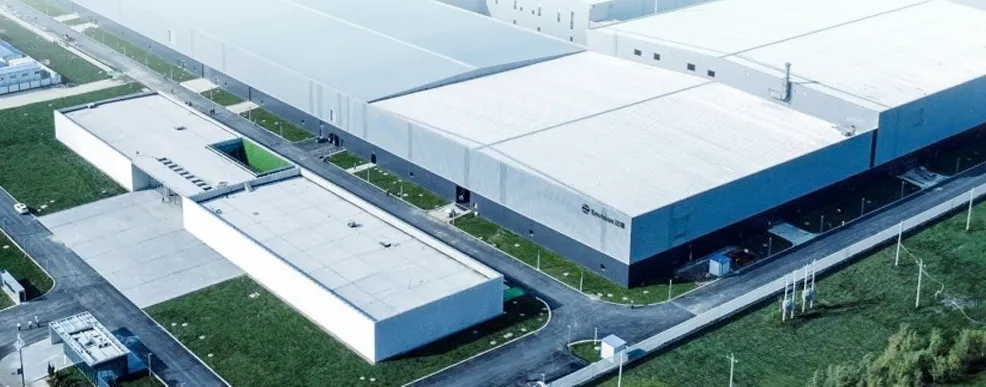
Zero-Carbon Parks Move from Concept to National Policy
The first batch of 52 parks spans nearly all regions of China. It covers energy-rich provinces such as Inner Mongolia, Ningxia, Xinjiang, and Gansu; traditional industrial heartlands including Hebei, Shandong, Liaoning, and Shanxi; and advanced manufacturing and digital economy clusters such as Beijing E-Town, Shanghai Lingang, and Guiyang’s big-data zones.
This breadth is strategic. Policy research cited by regulators shows that industrial parks account for more than half of China’s total industrial carbon emissions. These parks are characterized by highly concentrated energy demand, rigid load structures, and complex interactions with regional power grids—making them among the most difficult parts of the economy to decarbonize.
By elevating zero-carbon parks to national pilot status, policymakers are positioning them as testbeds for a new industrial–energy nexus. The goal extends well beyond emissions reductions within park boundaries. Instead, the pilots are intended to validate new power system architectures, electricity pricing mechanisms, and governance models that could later be scaled nationwide.
Within this context, Envision’s participation in more than ten parks stands out. Its projects span heavy-industry clusters, such as the Baotou Rare Earth High-Tech Zone, and export-oriented hubs like the Yancheng Dafeng Port Economic Development Zone. These are among China’s most carbon-intensive and structurally rigid industrial environments, enhancing their value as policy and system-level pilots.
AI Power Systems: the Backbone of Zero-Carbon Parks
At the centre of Envision’s approach is what it calls an “AI power system”, a digitally native energy architecture designed to integrate large volumes of variable renewable energy with continuous, industrial-scale loads.
In conventional industrial parks, energy flows are largely one-directional: electricity is imported from the grid, consumption patterns are inflexible, and decarbonization depends heavily on offsets or incremental efficiency gains. The zero-carbon park model replaces this with a tightly coupled system that integrates on-site and nearby renewable generation, energy storage, microgrids, flexible loads, and real-time optimization.
A critical component of this architecture is AI-enabled energy storage. Unlike traditional battery systems used mainly for peak shaving or backup, AI-driven storage functions as an intelligent system stabilizer, coordinating renewable generation, grid interaction, and industrial loads at millisecond-level response times.
For example, at the Ordos Zero-Carbon Industrial Park, AI-controlled storage systems synchronize wind and solar output with production processes, allowing certain industrial loads to dynamically adjust consumption in response to renewable availability. This enables the park to maximize green electricity utilization while maintaining production continuity—even during extended periods of low wind or solar output.
Technically, this requires advanced power electronics, real-time data acquisition, predictive algorithms, and digital twins that model both physical assets and energy flows. As the number of enterprises and load types in a park grows from dozens to hundreds, the optimization challenge increases exponentially—underscoring why policymakers increasingly view AI power systems, rather than simple “green power direct supply” arrangements, as the only viable solution for complex, mixed-use industrial parks.
From Demonstration Projects to Scalable Business Models
From a commercial perspective, zero-carbon industrial parks sit at the intersection of several major value pools: renewable generation, energy storage, digital energy management, carbon accounting, and emerging electricity market mechanisms.
For industrial tenants, the immediate value lies in cost and risk reduction. By increasing the share of locally sourced renewable power and optimizing consumption through AI-driven scheduling, parks can lower long-term electricity costs and reduce exposure to grid congestion and price volatility. In regions with abundant wind and solar resources, this can result in structurally lower energy costs than conventional grid supply.
For park operators and developers, zero-carbon status is rapidly becoming a competitive differentiator. Export-oriented manufacturers, particularly those serving European markets subject to carbon border adjustment mechanisms (CBAM), face mounting pressure to demonstrate verifiable, product-level carbon footprints. A park-level zero-carbon framework reduces compliance complexity and lowers reporting costs.
Envision’s business model reflects this multi-layered value chain. Rather than operating solely as an equipment supplier, the company positions itself as a system integrator and long-term partner, delivering end-to-end solutions that span renewable assets, energy storage, AI platforms, and carbon management services.
Central to this offering is Envision EnOS Ark™, a park-level AI energy and carbon management platform built on a “physical AI” foundation. Acting as the park’s “zero-carbon brain”, EnOS Ark™ integrates real-time data on energy flows, emissions, and asset performance, supporting carbon inventorying, green power traceability, emissions accounting, certification, and participation in both electricity and carbon markets.
Envision’s EnOS intelligent IoT operating system has already been connected to 788 GW of energy assets, equivalent to roughly one-quarter of global installed grid-connected renewable capacity, providing a scale foundation for these park-level applications.
For regulators, the platform’s emphasis on measurable, reportable, and verifiable (MRV) data addresses a core credibility challenge in zero-carbon claims. For enterprises, it enables energy and carbon to be managed as strategic inputs rather than after-the-fact compliance metrics.

Wuxi: A Model of China’s Early Zero-Carbon Pilot
As national zero-carbon industrial park pilots move from policy design to real-world implementation, Wuxi offers a concrete example of how park-level decarbonization can scale into a broader urban framework.
In 2021, Envision, Sequoia Capital, and Wuxi High-Tech Zone jointly established the Envision–Sequoia Carbon Neutrality Fund in Wuxi, alongside two dedicated centers: the Envision Zero-Carbon Digital Innovation Center and the Sequoia Low-Carbon Technology Incubation Center. Together, these initiatives laid the foundation for a local ecosystem of carbon-neutral technology innovation.
Through the Envision EnOS Ark Management Platform, the city has built an integrated system enabling real-time monitoring, precise tracking, and early warning across the full lifecycle of energy use and carbon emissions. The platform connects enterprises, industrial parks, and government authorities into a unified digital carbon-management framework.
In the first phase, approximately 200 enterprises were onboarded. Through the platform, companies can conduct real-time, full-value-chain carbon accounting; streamline regulatory reporting; continuously track energy consumption and efficiency projects; procure green electricity and green certificates with one click; connect directly to carbon markets; and integrate energy management with emissions reduction—forming a closed-loop pathway toward carbon neutrality.
Beyond operational management, the Envision EnOS Ark platform also serves as an ecosystem enabler. Designed as an “Android-style” operating system, it aggregates carbon assets across enterprises and parks through an open IoT architecture and standardized data interfaces. This openness allows startups, incubators, and research institutions to develop new applications and services on top of the platform—supporting not only Wuxi’s zero-carbon strategy, but also solutions scalable across China and globally.
As one of China’s earliest cities to pursue zero-carbon demonstration at scale, Wuxi, backed by one of the country’s earliest carbon-neutrality funds jointly launched by industry and investment, has formed a distinctive “One Fund, Two Centers, One Platform” model. This “Wuxi blueprint” offers a practical pathway for cities seeking high-quality growth while accelerating both digital and ecological transformation.
A Signal of Deeper Power System Reform
The release of the 52-park list also sends a clear signal about the direction of China’s power sector reform. Policy documents accompanying the announcement repeatedly reference concepts such as “green power direct supply”, “near-site renewable integration into incremental distribution networks”, and “direct green electricity provision”.
These ideas go beyond earlier green power trading pilots, which were largely confined to bilateral contracts between individual renewable generators and single large users. Such arrangements proved difficult to scale in multi-tenant industrial parks and could not effectively cover shared loads such as commercial facilities, transport infrastructure, or data centres.
The new framework implies that renewable energy will increasingly connect directly into park-level distribution networks, effectively becoming part of the local grid rather than an external supply source. This represents a meaningful loosening of traditional boundaries between generation, grid operation, and retail—using zero-carbon parks as controlled policy laboratories.
Importantly, the policy also recognizes that decarbonization is a phased process. The coexistence of “whole-park” pilots and “park-within-a-park” pilots reflects an acceptance of partial rollout and incremental implementation, lowering entry barriers for local governments and enterprises alike.
Internationally, the implications are significant. As global competition intensifies around clean manufacturing and green supply chains, China’s ability to deploy replicable, AI-enabled zero-carbon industrial systems could become an exportable capability, much as solar and wind manufacturing did over the past decade.
Zero-Carbon Parks: Infrastructure for a New Industrial Era
Taken together, the first batch of national zero-carbon industrial parks marks a shift from aspirational climate targets to system-level execution. The emphasis on AI power systems reflects a growing recognition that decarbonizing complex industrial ecosystems is less a hardware challenge than a coordination problem, one that requires digital intelligence at scale.
For technology providers such as Envision, the opportunity extends beyond asset deployment to shaping standards, platforms, and operating models. By participating in the development of national zero-carbon park standards, the company is embedding digital twins, real-time carbon management, and AI-driven optimization into the institutional framework of China’s energy transition.
For policymakers, zero-carbon parks offer a pragmatic pathway to reconcile three competing objectives: sustaining industrial growth, restructuring the energy system around renewables, and delivering verifiable emissions reductions. If successful, they may become the basic unit through which China’s next-generation power system and industrial policy are jointly implemented.
As these pilots move from planning to operation, the ultimate test will be performance—cost competitiveness, system reliability, and data-driven carbon outcomes. The direction is clear: in China’s energy transition, the zero-carbon industrial park is no longer an experiment. It is emerging as the operating system of a new industrial era, with the potential to turn best practices into global benchmarks.