New national guidelines elevate green industrial microgrids from pilot projects to core infrastructure, reshaping how industry produces, consumes and balances green energy.
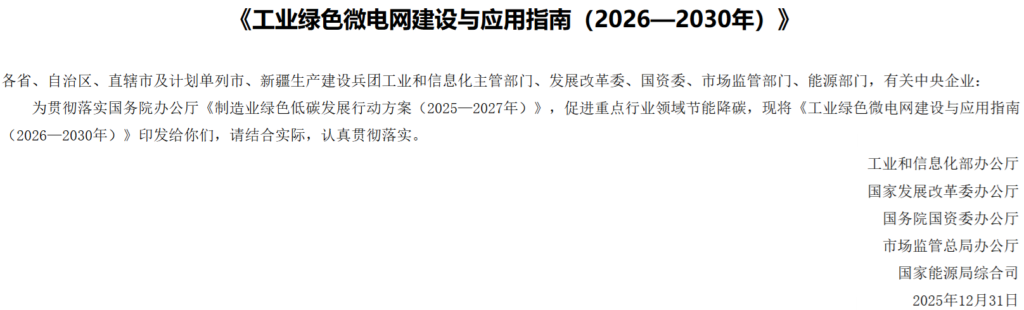
On January 9, five Chinese ministries jointly released the Guidelines for the Construction and Application of Green Industrial Microgrids (2026–2030), signalling a coordinated push to embed green electricity, green hydrogen, and digital energy management deep into China’s industrial system.
The document—issued by the Ministry of Industry and Information Technology (MIIT), the National Development and Reform Commission (NDRC), the State-owned Assets Supervision and Administration Commission (SASAC), the State Administration for Market Regulation (SAMR), and the National Energy Administration (NEA)—elevates industrial green microgrids from pilot initiatives to a national infrastructure priority.
For hydrogen, energy storage and cleantech markets, the message is unambiguous. The guidelines provide both a technical roadmap and a commercial signal: industrial sites are expected to evolve into integrated producers, consumers and balancers of renewable power and clean hydrogen at scale.
A policy framework for 2026–2030
Unlike many high-level strategy documents, the new guidelines are designed as a practical framework for the design, construction, and operation of industrial enterprises and parks. They set out clear principles, core system components, development models, application scenarios, and implementation requirements for green industrial microgrids over the next five years
At their core is a shift away from single-energy, grid-dependent industrial power systems towards “multi-energy complementary” microgrids. These are defined as integrated systems that coordinate local solar, wind and hydrogen resources with industrial waste heat and waste gases, alongside electricity, heat (or cooling) and gas supply, to meet diversified industrial energy demand more efficiently and reliably.
Crucially, hydrogen is no longer framed as a standalone fuel or a distant option. Instead, “clean, low-carbon hydrogen production and utilization” is positioned alongside renewable power generation and new-type energy storage (NTES) as a foundational element of industrial green microgrids.
The timing is significant. China faces the dual challenge of surging electricity demand from electrification and advanced manufacturing, while maintaining power system stability on the path to its 2060 carbon neutrality target. Industrial users account for roughly two-thirds of national electricity consumption, making them the most powerful lever for large-scale green power absorption and demand-side flexibility.
Hydrogen-enabled microgrids
Against this backdrop, the guidelines move beyond conceptual endorsement and begin to define how hydrogen should be technically integrated into industrial energy systems. The result is a clearer vision of hydrogen-enabled microgrids, in which hydrogen supports both deep decarbonization and power system optimization.
I. Multi-energy system architecture
The guidelines define industrial green microgrids as integrated systems comprising:
- Renewable power generation, including solar PV and wind
- Clean, low-carbon hydrogen production and utilization
- New-type energy storage systems
- Power conversion and flexible interconnection equipment
- Digital energy and carbon management platforms
From a system perspective, hydrogen plays a dual role. It functions both as a clean fuel for industrial processes and on-site power generation, and as a form of long-duration energy storage that complements batteries and other storage technologies.
II. “Hydrogen production + hydrogen use” integration
In regions rich in wind and solar resources, the guidelines encourage the orderly development of integrated “hydrogen production + hydrogen use” projects, subject to industrial structure adjustment policies. This explicitly supports colocated electrolysis facilities directly linked to industrial hydrogen demand, reducing transport costs, improving efficiency and strengthening system controllability.
The document also highlights the scaling up and purification of industrial by-product hydrogen, including from coke oven gas, chlor-alkali tail gas and propane dehydrogenation processes. This reflects a pragmatic transition strategy: leveraging existing hydrogen streams in the near term while green hydrogen capacity continues to expand.
III. Advanced electrolysis and power generation
On the equipment side, the guidelines call for accelerated development and deployment of:
- High-efficiency water electrolysis hydrogen production units
- High-efficiency hydrogen fuel cell power generation systems
- Integrated wind–solar flexible hydrogen production systems
Although no specific technical parameters are mandated, the emphasis on “high efficiency” and “flexible operation” aligns with global benchmarks for industrial-scale alkaline, PEM, and emerging AEM electrolyzers. These systems typically offer wide load-following ranges—often from 10% to 100% of rated capacity—and rapid ramping capabilities, making them well suited to variable renewable power.
The guidelines also recognize hydrogen internal combustion engines (H2 ICE) and fuel cells as viable on-site generation options, depending on industrial load profiles and hydrogen availability.
IV. Hydrogen as energy storage
In the section on new-type energy storage, hydrogen is explicitly listed alongside lithium-ion batteries, flow batteries and compressed air energy storage. Technology selection is to be guided by typical daily load curves and renewable generation profiles, enabling peak shaving, valley filling and cross-period energy utilization.
This positions hydrogen storage as a solution for longer-duration balancing, from multiple days to seasonal cycles, where batteries may be cost-prohibitive or technically constrained, particularly in industrial parks with large seasonal or process-driven load variations.
Industrial parks as anchor customers
The guidelines make clear that industrial parks, rather than isolated demonstration projects, are expected to serve as the main deployment platform. These clusters concentrate energy demand, infrastructure and management capacity, making them natural anchor customers for green microgrids and hydrogen systems.
I. Scalable demand from heavy industry
Priority application scenarios include aluminum electrolysis, polysilicon production, and industrial parks with energy-intensive processes. These sectors share several defining characteristics:
- Extremely high and relatively stable electricity demand
- Growing regulatory and market pressure to decarbonize
- Technical potential for flexible operation within defined safety limits
Aluminum smelting typically consumes 14–16 MWh per ton of primary output, while polysilicon production requires 60–100 MWh per ton. Even limited flexibility across such loads translates into gigawatts of adjustable demand at the system level.
II. Demand-side response and ancillary services
Industrial green microgrids are explicitly encouraged to participate as “large-scale, real-time adjustable resources” in demand-side response and ancillary service markets. Water electrolysis hydrogen systems are singled out for their wide adjustment range, allowing operators to rapidly reduce or increase loads to absorb renewable power peaks or relieve grid congestion.
Commercially, this opens multiple revenue and value streams:
- Lower electricity procurement costs through peak avoidance
- Payments for demand response and ancillary services
- Improved utilization of captive renewable assets
- Potential carbon cost savings under emissions trading mechanisms
III. Lowering the cost of green hydrogen
By integrating electrolyzers directly into microgrids with dedicated renewable supply and flexible operation, the guidelines implicitly address one of green hydrogen’s biggest barriers: cost. International benchmarks suggest electricity accounts for 60–70% of green hydrogen production costs.
Microgrid-based hydrogen production allows electrolyzers to operate preferentially during periods of low-cost, high-output renewable generation, improving capacity factors and reducing levelised hydrogen costs. Over time, this could help green hydrogen approach cost parity with grey hydrogen in selected industrial applications.
From pilots to system transformation
Beyond individual technologies, the guidelines signal a shift from isolated pilots to system-level transformation, with implications for industrial strategy, energy markets and technology deployment models.
I. A distributed, modular pathway
The document emphasizes modular and distributed approaches, including small-scale, skid-mounted green ammonia units and distributed green methanol production. This contrasts with the prevailing global narrative that green hydrogen derivatives must be produced exclusively in large, export-oriented hubs.
Instead, China is backing “right-sized” solutions embedded within industrial value chains, shortening supply chains, reducing infrastructure risk and accelerating deployment.
II. Vertical integration across the value chain
Encouragement to “open up” the green electricity–green hydrogen–green ammonia/methanol chain reflects a strategic push towards vertical integration. Industrial enterprises are being nudged to move beyond energy consumption into energy conversion and, potentially, energy product manufacturing.
For state-owned enterprises under SASAC oversight, this aligns with broader mandates to strengthen integrated energy capabilities and enhance system resilience.
III. Digitalization and carbon management
While less prominent than hydrogen, digital energy and carbon management systems are a core requirement. These platforms enable real-time optimization across electricity, hydrogen and thermal flows, and provide the data backbone for carbon accounting, compliance and operational optimization—capabilities that will become increasingly important as China tightens industrial carbon oversight.
IV. Implications for equipment manufacturers and developers
For technology suppliers, the guidelines provide strong policy backing for:
- Electrolyzer manufacturers developing flexible, high-efficiency systems
- Hydrogen storage and balance-of-plant providers
- Power electronics and digital energy management software companies
For developers and EPC contractors, industrial parks emerge as a bankable market segment with clearer policy support and defined use cases, reducing some of the uncertainty that has weighed on standalone hydrogen projects.
A policy signal with global resonance
Although the guidelines are a domestic policy document, their implications extend well beyond China. Few major economies have articulated such a detailed, hydrogen-inclusive framework for industrial microgrids at the national scale. By embedding hydrogen within industrial energy systems—rather than treating it as a parallel or downstream sector—China is effectively testing a model for large-scale, demand-driven hydrogen deployment in real industrial loads.
Execution will be decisive: aligning local implementation with grid rules, ensuring safety and reliability, and making the economics work without excessive subsidies. The policy direction is clear: green industrial microgrids are no longer experimental pilots; they are becoming a central pillar of China’s industrial decarbonization strategy, favouring on-site self-sufficiency for future manufacturing.
For executives across hydrogen, storage, and industrial energy, the message is clear: as China scales green industrial microgrids, the factory fence line—where power, heat, hydrogen, and storage converge—is emerging as one of the most consequential frontiers of the global energy transition.