China’s island-wide customs reform is reshaping high-tech manufacturing and clean-energy competitiveness
Hainan, China — In the first week following the island-wide customs launch of the Hainan Free Trade Port (FTP) on December 18, 2025, China’s most ambitious tariff-free trade experiment delivered impressive early results. Imported “zero-tariff” goods exceeded CNY 400 million in value, while more than 1,900 foreign trade enterprises registered under the new regime – an early indicator of strong investor confidence.
Beyond the headline figures, the FTP’s expanded tariff exemptions and value-added processing incentives are rapidly emerging as a strategic catalyst for advanced manufacturing and climate-technology supply chains. Among the most promising beneficiaries are hydrogen and fuel cell technologies, where cost reduction, scale, and supply chain integration are central to global competitiveness.
Island-Wide Customs Operation: Scope and Strategic Design
On December 18, 2025, China formally transitioned the Hainan Free Trade Port from a collection of pilot zones to a fully island-wide independent customs regime. Under the new framework, the share of tariff lines eligible for zero tariffs rises from roughly 21% to 74%. The number of duty-free items expands from approximately 1,900 to around 6,600 tariff codes.
A defining feature of the regime is the value-added processing rule: goods that undergo at least 30 per cent value-added processing in Hainan can enter the Chinese mainland tariff-free. This requirement is explicitly designed to promote substantive industrial activity, such as manufacturing, testing, and system integration, rather than simple re-export or light assembly.
The policy also replaces a “positive list” system with a streamlined negative list under a unified customs framework, materially reducing compliance complexity and administrative burden for eligible enterprises.
Hydrogen and Fuel Cells: Technology Meets Tariff Reform
The hydrogen and fuel cell value chain spans hydrogen production and storage, fuel cell stack manufacturing, and balance-of-plant systems. China continues to rely on imported components and materials across several of these segments, with importers often facing duties of up to 17% on selected inputs.
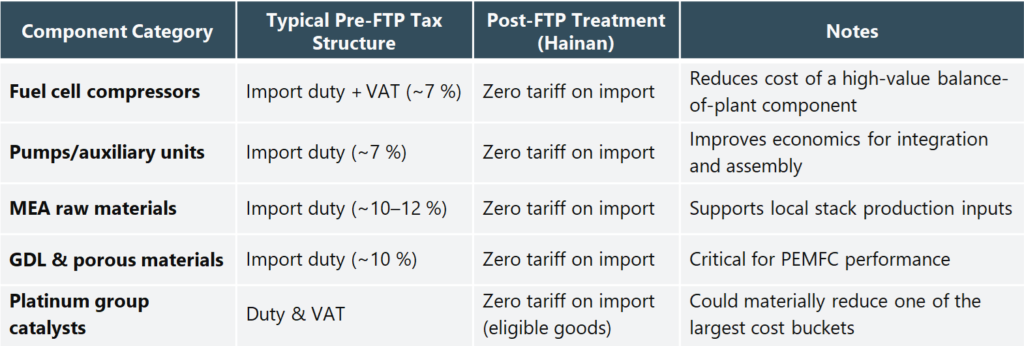
To ease cost pressures, China has introduced temporary tariff reductions on key fuel cell materials, including gas diffusion layers (GDLs) and auxiliary hardware, as outlined in the table above.
The Hainan Free Trade Port significantly extends this approach by embedding tariff relief within a broader industrial framework. While specific rates vary by product code and are periodically updated by China Customs, the policy direction is clear: to lower input costs while incentivizing local value creation.
Tariff Landscape for Key Hydrogen and Fuel-Cell Inputs
The expanded zero-tariff regime now covers a wide range of critical components. For hydrogen and fuel cell manufacturers, this materially alters cost structures and investment calculations. High-value balance-of-plant components, stack materials, and catalysts can be imported tariff-free into Hainan, lowering upfront costs and improving margins.
More importantly, when combined with value-added processing, these imports can be converted into finished or semi-finished products that enter the mainland market without duties, an advantage unavailable under traditional bonded-zone or processing-trade models.
Value-Added Processing: Incentives and Industrial Logic
Under the FTP rules, imported goods that achieve at least 30 per cent value-added in Hainan—defined as local processing contributing 30 per cent or more of final product value—qualify for tariff-free entry into mainland China. This mechanism goes beyond trade facilitation; it functions as a deliberate industrial-policy lever.
In practical terms, a hydrogen fuel cell developer could:
- Import advanced subcomponents (such as MEAs, plates, or catalysts) into Hainan under zero-tariff treatment
- Conduct assembly, system integration, validation, and performance testing locally, surpassing the 30% value-added threshold
- Sell completed modules or systems into the mainland market without paying import duties
The result is a strong incentive to invest in skills, equipment, and process know-how on the island, anchoring higher-value manufacturing rather than encouraging simple transshipment.
Commercial and Competitive Implications
China is pursuing large-scale hydrogen deployment across transport, particularly heavy-duty vehicles, as well as stationary power, grid balancing, and industrial off-grid applications. Achieving cost competitiveness is critical, especially in comparison with established hydrogen manufacturing ecosystems in Japan and the European Union.
Many Chinese manufacturers continue to depend on imported materials due to domestic capacity gaps. By extending zero-tariff treatment to upstream inputs and enabling duty-free mainland access following local processing, the Hainan FTP has the potential to materially reduce landed costs and strengthen China’s position across the hydrogen value chain.
Cost Competitiveness and Policy Synergy
The FTP’s tariff framework aligns closely with broader national priorities, including hydrogen industrial policies and regional deployment clusters. Lower effective input costs—combined with simplified customs procedures, VAT and consumption-tax incentives, and an expanded pool of eligible enterprises—can significantly improve operating economics for firms based in Hainan.
Together, these measures form a coherent policy stack that rewards scale, integration, and technological upgrading.
Integration into Global Supply Chains
Hainan is positioning itself not merely as a trade hub but as an integrated manufacturing and innovation platform. Global OEMs and upstream suppliers can import critical components tariff-free, establish local production or assembly lines, and gain preferential access to the mainland Chinese market.
Comparable free-trade-zone models in Singapore and South Korea have demonstrated how such frameworks can reduce supply chain fragmentation. If effectively implemented, Hainan’s approach could strengthen China’s role as a global hydrogen manufacturing leader while lowering barriers for foreign participation.
Outlook and Strategic Considerations
The FTP’s new regime is still at an early stage, and its full impact will unfold over the next three to five years. Key variables to watch include:
- Regulatory clarity around tariff classification and value-added calculation
- Consistency and transparency in customs execution
- Companies’ ability to localize genuinely high-value processes, such as stack assembly and advanced testing
- Integration with the national hydrogen strategy and cross-provincial logistics networks
Even so, the initial surge in trade volumes and enterprise registrations points to strong market momentum. For the hydrogen and fuel cell industries, where global competition is intensifying and cost curves are decisive, the Hainan Free Trade Port may represent a strategic inflection point, embedding China more deeply into global clean-energy supply chains.