Hydrogen-based direct reduction and electric steelmaking mark a major advance in China’s steel decarbonization, with implications for cost structures, supply chains, and industrial policy alignment.
On December 23, China commissioned its first million-tonne-scale near-zero-carbon steel production line in Zhanjiang, Guangdong province. Led by Baowu Steel Group, the project integrates hydrogen-based direct reduced iron (DRI), high-efficiency electric arc furnace (EAF) steelmaking, and continuous casting into a fully connected short-process route capable of producing high-grade flat steel with substantially lower carbon emissions.
The commissioning marks the first time China has achieved full end-to-end industrial integration of a “hydrogen metallurgy plus electric melting” process at scale. More than a technical milestone, the Zhanjiang line establishes a commercially relevant template for deep decarbonization in a sector that accounts for roughly 15 per cent of China’s total carbon dioxide emissions and remains dominated by coal-based blast furnace–basic oxygen furnace (BF–BOF) production.
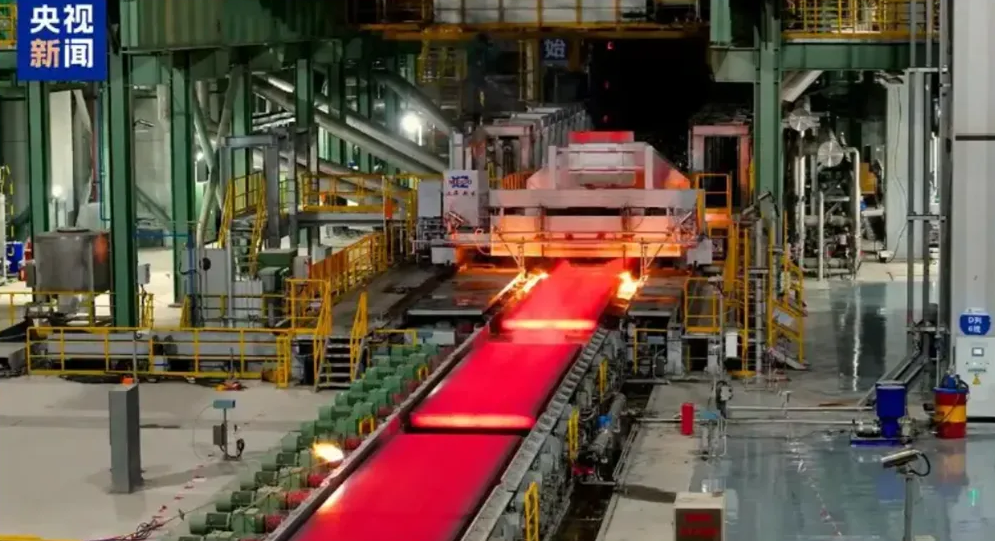
A milestone in industrial-scale hydrogen metallurgy
The Zhanjiang near-zero-carbon steel line completes a full production chain encompassing hydrogen-based ironmaking, electric furnace steelmaking, secondary refining, and slab casting. At its core is China’s first domestically developed million-tonne-class hydrogen-based shaft furnace, which entered operation in December 2023 and has now been fully integrated with downstream steelmaking assets.
The production line comprises three principal components:
- a one-million-tonne hydrogen-based shaft furnace producing direct reduced iron using hydrogen as the primary reducing agent;
- a newly built 220-tonne high-efficiency electric arc furnace, supported by advanced refining facilities;
- a 2150-mm single-strand slab continuous casting line supplying high-quality slabs for flat steel production.
Together, these units form a complete short-process steelmaking route designed to deliver low- and near-zero-carbon steel slabs, which can then be rolled using Baowu’s existing hot- and cold-rolling infrastructure. Project disclosures indicate that the metallization rate of the direct reduced iron met design targets, validating the technical feasibility of hydrogen-rich operation and providing an engineering reference for future replication.
Hydrogen-based shaft furnace: replacing coke at the source
In conventional BF–BOF steelmaking, coke functions as both fuel and reducing agent, generating large volumes of CO₂ as iron ore is reduced to molten iron. By contrast, the hydrogen-based shaft furnace reduces iron ore in the solid state using hydrogen-rich gas. When hydrogen replaces carbon monoxide as the dominant reductant, the primary by-product shifts from carbon dioxide to water vapour, addressing emissions at their source rather than relying on downstream capture or offsetting.
The Zhanjiang shaft furnace is engineered to operate under high hydrogen concentrations and has demonstrated stable metallurgical performance at an industrial scale. This is a non-trivial achievement: hydrogen reduction kinetics, thermal balance, and material handling differ significantly from traditional gas-based DRI processes that rely mainly on natural gas.
In a global context, the project places China alongside early movers in hydrogen-based ironmaking, such as Sweden’s HYBRIT initiative and Germany’s SALCOS programme. Unlike many European projects that remain at pilot or pre-commercial scale, the Zhanjiang line has crossed the threshold into million-tonne operation, narrowing the gap between demonstration and deployment.
Electric arc furnace and refining: electrifying the melt
Downstream of the shaft furnace, direct reduced iron is blended with scrap steel and melted in a 220-tonne electric arc furnace designed for high energy efficiency and flexible charge composition. This allows operators to optimize the DRI-to-scrap mix in response to feedstock availability, cost, and quality requirements.
At Zhanjiang, the EAF and refining units are supplied with dedicated green electricity, significantly reducing Scope 2 emissions. The integration of secondary refining and a modern slab caster enables the production of high-grade slabs suitable for demanding applications – including automotive steels addressing a long-standing concern over whether low-carbon steel routes can consistently meet the quality standards of advanced manufacturing.
Quantifying the carbon impact: structural, not incremental
According to project estimates, the near-zero-carbon production line can reduce carbon emissions by 50–80 per cent compared with a conventional BF–BOF route of equivalent capacity. These reductions are driven by three structural levers:
- Process substitution: Eliminating coke-based ironmaking removes the largest single source of emissions in steel production.
- Electrification: Replacing fossil-fuel-based thermal processes with electric melting sharply lowers direct emissions.
- Green power integration: Supplying electricity from renewable sources reduces indirect emissions associated with power consumption.
In the context of China’s steel industry—where average emissions intensity remains well above that of best-in-class EAF-based producers globally—the Zhanjiang line represents a step change rather than a marginal efficiency gain.
Cost and the hydrogen question
Despite its technical promise, hydrogen-based steelmaking faces a central economic challenge: the cost and availability of green hydrogen. While hydrogen can technically replace carbon as a reducing agent, its competitiveness depends on renewable electricity prices, electrolyzer efficiency, and high asset utilization rates.
The Zhanjiang project addresses this constraint through vertical integration with renewable energy. The site has installed more than 124 MW of on-site green power capacity, with planned annual generation of 150 million kWh, is advancing onshore wind projects, and holds equity stakes in a 400 MW offshore wind development. Together, these assets form an integrated “wind–power–hydrogen” supply chain designed to stabilize input costs and improve long-term economics.