UtmoLight’s perovskite PVs demonstrate resilience in severe winter conditions, highlighting both technical robustness and accelerating commercialization as China advances GW-scale production and global competitiveness.
China’s photovoltaic sector continues to attract global attention – not only for its unmatched scale and cost leadership, but increasingly for the maturation of next-generation technologies capable of operating reliably under challenging weather conditions.
In late January 2026, severe winter storms swept across large parts of China, bringing heavy snow, sleet and sustained sub-freezing temperatures. The extreme weather event became an unintended but consequential stress test for emerging perovskite-based solar modules.
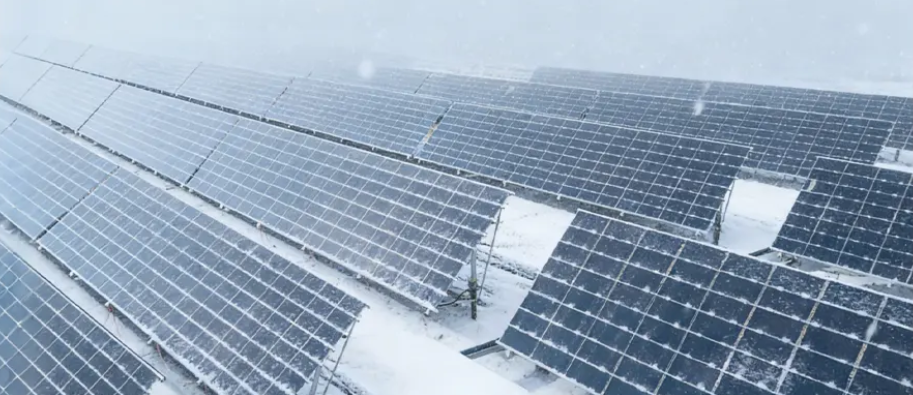
At field sites in Daqing, Shanghai, and Turpan, perovskite PV modules manufactured by UtmoLight continued to deliver stable power output despite snow cover and low irradiance. Performance under diffuse light and cold conditions reinforced both the technical promise and the growing commercial readiness of perovskite technology. Notably, Daqing, located in far northeastern China, experiences climatic conditions comparable to those of Canada, underscoring the relevance of these results for cold-weather markets.
The episode also highlighted broader energy-system contrasts. While parts of the U.S. experienced sharp regional spikes in natural gas prices during a similar cold snap, China’s national gas and electricity markets remained quite stable – underscoring the vulnerabilities of fossil-fuel-dependent supply chains and reinforcing the strategic value of resilient renewable generation.
Taken together, the real-world performance of perovskite PV and the rapid scaling of industrial capacity strengthen China’s position as a leader in photovoltaic innovation, with perovskite technologies increasingly positioned to complement, and potentially challenge, conventional crystalline silicon.
Key technologies and performance characteristics
The winter conditions of late January, marked by snow accumulation and prolonged low temperatures across northern and eastern China, tested a wide range of PV installations. Field data released by UtmoLight indicate that its perovskite modules maintained stable output throughout the event, even under snow cover and weak light. Comparative observations suggest performance superior to nearby crystalline silicon arrays operating under similar conditions.
I. Low temperature coefficient
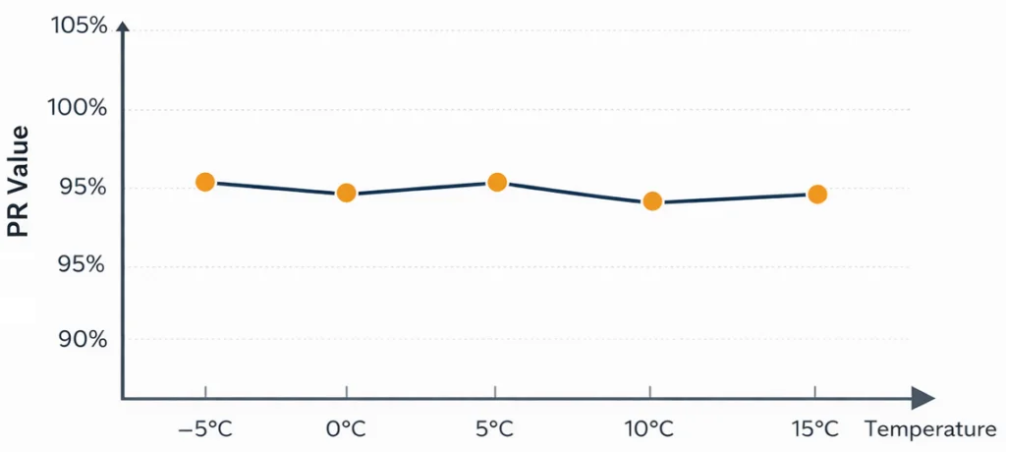
One of the defining advantages of perovskite PV is its exceptionally low temperature coefficient. While crystalline silicon modules typically exhibit coefficients of approximately –0.3% to –0.4% per °C, optimized perovskite modules developed by UtmoLight demonstrate values in the range of –0.001% to –0.004% per °C, roughly two orders of magnitude lower. As a result, perovskite PVs deliver highly stable power output over a wide temperature range, enabling reliable energy production in climates with seasonal variability.
II. Snow and dust-shedding design
UtmoLight’s modules incorporate surface engineering that reduces the accumulation of snow and dust, providing natural shedding and minimizing performance losses in snowy or dusty environments. This design feature is particularly relevant for northern climates and arid regions where soiling can materially affect yields.
III. Weak-light generation
Perovskite absorbers benefit from strong optical absorption and favourable bandgap characteristics, enabling superior performance under diffuse and low-light conditions such as heavy cloud cover, snowstorms or high latitudes. Early field data indicate that daily energy yields under such conditions can exceed those of conventional silicon modules by more than 60%.
IV. Module specifications and mass production
UtmoLight has progressed from pilot lines to industrial-scale manufacturing. Its GW-scale production facility in Wuxi, Jiangsu, began mass production in 2025 and is designed to deliver approximately 1.8 million ultra-large perovskite modules annually. Each module achieves up to 490 W of output with a full-area efficiency of 17.44%. The company targets mass-production efficiencies of 22–23% or higher by 2027.
Independent testing and certification have already verified steady-state efficiencies exceeding 20%, setting new benchmarks for large-area perovskite modules. The Wuxi facility ranks among the world’s first commercial operations dedicated to perovskite PV at the gigawatt level.
Scale, policy, and cost dynamics
China’s push into perovskite PV unfolds alongside the continued global expansion of solar capacity. In 2025, Chinese manufacturers shipped hundreds of gigawatts of PV modules worldwide, reinforcing their dominance in international markets. Within this context, perovskite technology is emerging as a potential evolutionary step – offering lighter weight, simpler manufacturing processes and, over time, lower production costs than crystalline silicon.
Market projections suggest the global perovskite solar cell market could exceed US$24 billion by 2035, driven by GW-scale factory construction and broader industrial adoption. As the market transitions from forecast to execution, early commercial deployments are providing insight into where perovskite PV can deliver immediate value.
UtmoLight’s modules are gaining early traction across distributed generation, rooftop installations and building-integrated PV (BIPV) applications. Initial customers include utility-scale developers and energy service companies seeking stable yields across diverse environmental conditions.
Policy support has further accelerated deployment. Chinese authorities have backed demonstration projects across varied terrains, from high-latitude regions in Qinghai to arid desert environments in Xinjiang, enabling systematic performance evaluation across climate extremes. These efforts align with national strategic objective of maintaining leadership in clean-technology manufacturing.
Strategic and market implications
Real-world validation in harsh winter conditions addresses one of the most critical bottlenecks for perovskite PV: long-term operational stability. While laboratory research has delivered rapid efficiency gains, widespread adoption depends on demonstrated durability in field environments. Performance during the January 2026 cold snap adds to a growing body of evidence that perovskite modules can operate reliably beyond controlled settings.
From a market perspective, China’s rapid industrial scale-up has the potential to disrupt established PV supply chains and reshape global value chains. With facilities such as UtmoLight’s Wuxi gigawatt line now operational, perovskite modules are poised to become increasingly cost-competitive, particularly in markets where low-light performance, reduced weight and resilience to extreme weather are valued.
There are also geopolitical dimensions. As Europe and North America contend with energy-price volatility linked to fossil fuel exposure, technologies capable of delivering stable, low-carbon electricity across seasons are gaining strategic importance. Chinese perovskite PV products may find growing demand in export markets traditionally considered less favourable for solar deployment.
UtmoLight’s winter performance points to a broader shift in industry expectations around efficiency, cost and durability. Combined with China’s accelerating industrial capacity, perovskite PV is moving from experimental promise toward commercial contention.
For energy planners, investors and policymakers, the implication is clear: perovskite technology has entered an early stage of maturity. If long-term durability continues to be demonstrated alongside competitive lifecycle economics, perovskite PV could become a cornerstone of resilient, decarbonized power systems – particularly in regions increasingly exposed to cold-climate extremes.