Bilateral trade agreements, new safety standards, and certification capacity reshape cross-border investment, accelerating battery storage, EV manufacturing and compliance-driven market access.
On January 16, Canada and China established a new bilateral partnership aimed at increasing Canadian exports to China by 50% by 2030. The agreement sets in motion a broad trade, investment, and standards agenda with far-reaching implications for clean energy, electric vehicles, and advanced manufacturing.
Beyond the headline trade target, the partnership is expected to catalyze joint ventures, accelerate supply chain localization, and deepen alignment around technical standards and certification infrastructure that underpin market access in grids, energy storage, and electrification.
The timing is notable. Global investment in clean energy surpassed US$1.8 trillion in 2025, according to the International Energy Agency, while grid-scale energy storage installations are forecast to grow at more than 20% annually through 2030. Canada brings resource depth, regulatory stability, and growing EV manufacturing ambitions; China contributes scale, cost-competitive supply chain, and technology leadership in batteries and power electronics. The partnership seeks to combine these complementary strengths while managing risk through trusted partners and standards-based assurance.
The context matters. On the same day the partnership was announced, CSA Group granted Witnessed Manufacturer’s Testing for Certification (WMTC) status to Wuxi Konowei New Energy Technology, an innovative company focused on the R&D and production of thermal management systems and key components for new energy vehicles, energy storage equipment, and data-centre cooling systems.
A trade pact with industrial consequences
The new partnership sets a clear economic objective: to expand Canadian exports to China by 50% within four years. To achieve this, both governments committed to increasing two-way investment across clean energy and technology, agri-food and advanced manufacturing. Renewable energy sits at the core of the agreement, underpinning progress across the other priority sectors.
Officials expect that within three years the framework will drive substantial new Chinese joint-venture investment in Canada, particularly in EV manufacturing and associated supply chains. The emphasis on “trusted partners” reflects Canada’s effort to balance openness to foreign capital with industrial resilience – protecting and creating automotive jobs while building domestic capabilities in batteries, power electronics and thermal management systems.
For Chinese companies facing saturated domestic markets and shifting global trade patterns, Canada offers a stable gateway to North American demand and alignment with USMCA trade rules. For Canadian policymakers, the partnership provides a dual lever to accelerate decarbonization and reindustrialization.
From trade flows to technical rules: standards matter
Trade and investment alone do not move hardware across borders. In sectors such as energy storage, EVs, and data-centre infrastructure, technical standards increasingly determine who can sell, where and at what cost.
As cross-border projects proliferate, scrutiny of safety, reliability and lifecycle performance has intensified. High-profile fire incidents involving lithium-ion energy storage systems, grid disruptions and rising cyber-physical risks have pushed regulators, insurers and financiers to demand testing that goes well beyond nominal operating conditions. Compliance is shifting from a regulatory checkbox to a strategic capability.
This transition, from industrial ambition to technical validation, marks a critical inflection point. Standards bodies now function as de facto market gatekeepers, translating policy intent into enforceable technical requirements that directly shape product design, cost structures and time-to-market.

CSA Group expands certification infrastructure in China
Within this evolving landscape, standards organizations play a pivotal role in enabling safe, scalable and investable clean energy deployment across borders. CSA Group, one of the world’s leading standards development, testing and certification bodies, has moved decisively to expand its presence and capabilities in China in support of global market integration.
Against this backdrop, CSA Group has accelerated its certification infrastructure build-out in China, reinforcing the standards backbone that supports the Canada–China clean energy partnership. Witnessed testing status allows manufacturers to conduct defined tests in-house under CSA oversight, reducing certification timelines by weeks or months—an increasingly valuable advantage in fast-moving EV and energy storage markets.
In April 2025, the Canadian Standards Association opened its CCIC–CSA Group Electromagnetic Compatibility (EMC) Laboratory in Kunshan, Jiangsu. As CSA Group’s first EMC laboratory in China, the facility provides EMC testing services for industrial equipment, automotive products, household and commercial appliances, and laboratory and measurement instruments.
EMC compliance is a prerequisite for entry into most global markets, and local testing capacity significantly reduces cost, complexity and logistical friction for manufacturers.
CSA/ANSI C800:25: a new benchmark for storage reliability
In March 2025, CSA Group released CSA/ANSI C800:25, the first consensus-based standard to explicitly define robust test protocols for energy storage system reliability and quality assurance, including approved Large-Scale Fire Testing (LSFT).
The standard addresses a gap long recognized by industry and regulators. Existing frameworks, such as UL 9540, focus primarily on predictable installation conditions and baseline system safety. CSA/ANSI C800:25 goes further by simulating real-world failure scenarios that can lead to hazardous incidents, cascading failures or prolonged system downtime.
As a standalone standard, CSA/ANSI C800:25 evaluates representative energy storage systems under extreme environmental conditions, mechanical shock, abuse scenarios and full-scale fire exposure. The objective is not merely to prevent ignition, but to assess structural integrity, fire containment, propagation behaviour and post-event recoverability under worst-case stresses.
For developers, the standard implies higher upfront testing requirements but materially lower lifecycle risk. For insurers and financiers, it provides a more credible basis for underwriting large-scale projects. For regulators, it offers a harmonized reference that can be integrated into permitting, zoning and grid interconnection frameworks.
Certification in action: Envision, BYD, and CATL
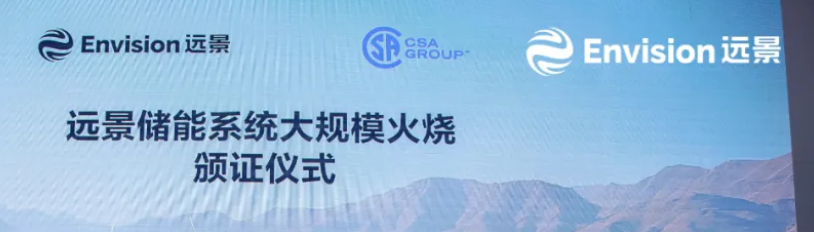
The commercial implications of CSA/ANSI C800:25 are already visible. In August 2025, CSA Group awarded Envision’s intelligent trading energy storage system a Large-Scale Fire Testing certificate under the new standard, following successful completion of LSFT in June. The test involved four fully charged 5 MWh units (20 MWh in total), placed in pairs just 5 cm apart. The systems were exposed to burn conditions for three hours and then allowed to burn for 49.5 hours without external intervention.
For Envision, a global leader in energy storage and energy management, the certification strengthens its positioning in markets where bankability, insurability and safety differentiation are increasingly decisive.
In September 2025, CSA Group awarded large-scale fire testing certification to BYD’s MC Cube BESS and Cube T28 energy storage systems. One month later, CSA Group further awarded UL 1973 and UL 9540 product certifications, along with Witnessed Manufacturer’s Testing for Certification (WMTC) status, to CATL’s 5.6 MWh EnerX energy storage system.
UL 1973 addresses battery safety for stationary applications, while UL 9540 covers system-level energy storage safety. Together with CSA/ANSI C800:25, these certifications form a layered assurance framework spanning component safety, system performance and extreme-event resilience.
Cost, speed and market access
From a commercial standpoint, standards compliance is no longer a passive cost of doing business but an active driver of competitiveness. Industry estimates suggest that local witnessed laboratories can reduce certification cycles by 20–30%, accelerating revenue recognition and shortening project timelines. Advanced reliability standards can also lower insurance premiums and financing costs, particularly for utility-scale storage projects where a single failure can erase years of returns.
Within the Canada–China partnership, alignment around CSA-led standards and testing infrastructure creates a shared technical language. Canadian projects incorporating Chinese technology can more readily demonstrate compliance with North American expectations, while Chinese manufacturers gain clearer, faster pathways into global markets without extensive redesign for each jurisdiction.
Strategic implications for the clean energy value chain
Strategically, the convergence of trade policy, standards development and certification capacity signals a maturation of the global clean energy value chain. As technologies scale, competitive advantage is shifting away from headline metrics such as energy density or cost per kilowatt-hour toward resilience, reliability and regulatory credibility.
For Canada, embedding CSA standards into bilateral cooperation strengthens its influence over global technical norms—an often underappreciated lever of industrial policy. For China, early alignment with more stringent reliability benchmarks positions its manufacturers ahead of tightening regulatory curves worldwide.
The result is a recalibration of competition: not simply who can build at the lowest cost, but who can deliver systems that are safest, fastest to market and most trusted. In a world where energy storage underpins power grids, EV fleets and data centres, that credibility is becoming as valuable as capacity itself.