China’s green hydrogen industry entered a new phase of scale and integration this summer. The pace and scope of projects indicate a transition from demonstration to industrial deployment.
In July, three landmark green hydrogen–ammonia–methanol projects achieved commercial operation, marking the shift from fragmented pilots to cohesive industrial-scale complexes. Together, they demonstrate technological maturity at scale and growing downstream market readiness in hydrogen-based fuels.
- SPIC Daan hydrogen–ammonia integration: The world’s largest single-site green ammonia production facility (180,000 tonnes/year), setting three global firsts:
- The largest alkaline + PEM hybrid electrolysis system
- The largest solid-state hydrogen storage facility (48,000 m³)
- The largest DC microgrid hydrogen system
- Shanghai Electric Taonan biomass-coupled methanol: China’s first commercial-scale green methanol facility, with Phase I capacity of 50,000 tonnes per year. It is also the first in the country to obtain full-chain EU ISCC certification, enabling export-ready low-carbon methanol to EU markets. The project shows that biomass coupling and certification standards are becoming integral to China’s export strategy.
- Envision Chifeng hydrogen–ammonia facility: Phase I delivers 320,000 tonnes per year of green ammonia, making it the largest operating project of its kind worldwide. Production has already been used for fueling in Dalian, demonstrating downstream readiness for shipping and industrial use. With future expansion, the facility is expected to surpass existing global benchmarks for green ammonia.
Together, these three projects mark China’s rapid leap from pilot demonstrations to industrial-scale deployment, setting new benchmarks in integrating renewable power, hydrogen, and downstream fuels into cohesive mega-projects. They also illustrate how multiple regions—Inner Mongolia, Jilin, and Liaoning—are emerging as hydrogen clusters with potential for cross-provincial integration.
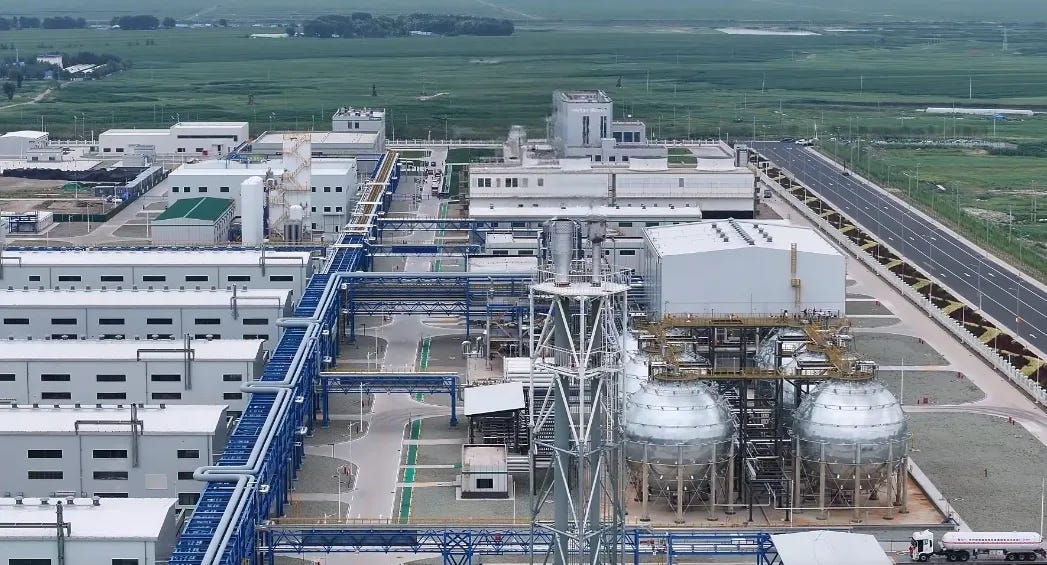
Sinopec Kuqa Green Hydrogen Demonstration Project
In August, Sinopec’s Kuqa Project in Xinjiang surpassed 13,000 tonnes of cumulative hydrogen output since its June 2023 launch, achieving an average utilization rate of 31% over 770 days. Powered by a 300 MW solar farm, the facility has a 20,000-tonne-per-year electrolysis capacity, with hydrogen transported via a 6-kilometre pipeline to a nearby petrochemical complex, replacing hydrogen previously produced from natural gas reforming.
As China’s first large-scale solar-to-hydrogen operation, Kuqa has served as both a technical and commercial testbed. To further expand hydrogen consumption, Sinopec New Star Xinjiang Green Hydrogen Energy has been piloting hydrogen blending into city gas networks since late 2024, with 500 tonnes of green hydrogen already injected into local pipelines. The next step is to establish a hydrogen–natural gas fueling hub to supply regional hydrogen refuelling stations.
On August 23, Sinopec announced a tender for 48 alkaline electrolyzers (1,000–1,500 Nm³/h) for a coal chemical project in Ordos, designed to produce 30,000 tonnes of green hydrogen per year. This is another large-scale hydrogen project for Sinopec; its earlier Kuqa project deployed 52 electrolyzers (1,000 Nm³/h each) with a design capacity of 20,000 tonnes per year.
Green Methanol Projects on the Rise
August also saw a surge of green methanol project launches and signing ceremonies across China. LONGi, Huajin Energy, CGN, and others announced large-scale projects integrating renewable hydrogen with carbon capture and biomass. Together, these projects position green methanol as the next frontier of hydrogen commercialization, with applications in chemicals, marine fuels, and sustainable aviation fuel (SAF).
- LONGi: On August 11, LONGi Green Energy broke ground on its 400,000-tonne-per-year green methanol project in Inner Mongolia, with a total investment of CNY 2.36 billion. The facility integrates wind–solar hydrogen with biomass gasification: agricultural waste is gasified to supply CO₂, which is then catalytically combined with 100% green hydrogen to produce methanol. The plant will process more than 600,000 tonnes of biomass annually, producing 190,000 tonnes of methanol in Phase I and 210,000 tonnes in Phase II.
- Jilin Yushu: On August 12, Huajin Energy’s CNY 21.4 billion green methanol project was signed in Yushu, Jilin Province. Highlights include:
- Dual pathway: Combines renewable power electrolysis with biomass CO₂ capture to produce green methanol. It will be China’s first combined bio- and e-methanol production complex based on biomass waste gasification.
- Phase I scale: 800 MW of planned wind capacity; 960,000 Nm³/h hydrogen generation; 270,000 tonnes per year methanol capacity (150,000 tonnes biomass methanol; 120,000 tonnes e-methanol), primarily for marine fuel markets in the EU and Asia.
- Partnerships: Agreements signed with 18 core partners, including technology providers, overseas offtakers, Caterpillar Solar Turbines, Harbin Gear, Jiangsu Shuangliang, Shanghai Puhe Green Carbon for core equipment, and Sany, Trina, SunGrow, and CSSC Peric for electrolysers.
- ETL provider: Iceland-based Carbon Recycling International (CRI) will supply its Emissions-to-Liquids (ETL) technology and support ISCC certification for the project.
- Charoen Pokphand Group (Fujian): On August 1, CP Group signed a CNY 15 billion agreement for a 1-million-tonne-per-year green methanol and downstream products project in Gulei, Fujian. Leveraging offshore wind resources and biomass feedstocks, the complex will produce methanol and extend into SAF and green jet fuel, creating an integrated “green energy + green chemicals” industrial chain.
- China General Nuclear: On August 6, CGN released the environmental impact assessment (EIA) for its wind–solar hydrogen–methanol integration project in Inner Mongolia. Key highlights:
- Investment: CNY 14.96 billion
- Electrolysis: 55 alkaline electrolyzers (2,000 Nm³/h each), total capacity 110,000 Nm³/h (~56,000 t/y)
- Hydrogen storage: 23 spherical tanks (total 448,000 Nm³ capacity)
- Power source: Dedicated wind farms
- Scale: Expected to become one of the largest integrated hydrogen–methanol platforms in China
- Duolun County, Inner Mongolia: On August 27, the Government of Duolun County signed a framework agreement with China Power Construction Group and China Hydrogen Energy Group for a CNY 31 billion green methanol project. The project will develop 3.5 GW of wind power to produce 200,000 t/y of green hydrogen, which, combined with biomass-derived CO₂, will yield 1 million t/y of green methanol.
Together, these projects demonstrate not only geographic breadth from Inner Mongolia to Fujian, but also technological diversification, from wind–solar hybrid bases to biomass coupling and offshore wind integration. The scale and variety suggest that methanol, alongside ammonia, may form the backbone of China’s hydrogen economy in the late 2020s.
Outlook and Scale-up
China’s push into green hydrogen and methanol is anchored in national policy. The Hydrogen Industry Development Medium- and Long-Term Plan (2021–2035) explicitly set a 2025 target of 100,000–200,000 tonnes of renewable hydrogen per year. By end-2024, China had built 122,000 t/y, with 1.4 Mt/y under construction and over 7 Mt/y in planning.
For green methanol, ultra-low-cost renewable electricity is the foundation, particularly for marine and aviation applications where fuel-switching economics are tight. China has some of the world’s lowest renewable power costs, at around $25/MWh for utility-scale solar and $30–35/MWh for onshore wind.
China’s latest green hydrogen, ammonia, and methanol projects mark the leap from pilots to commercial scale. Their success could reshape global market dynamics and prove the economic case for large-scale renewable hydrogen—ushering in a new era for hydrogen-based fuels.