New vehicle fuel systems, mobile refuelling infrastructure, and long-distance LH2 transport containers signal a shift from pilot-scale experimentation toward scalable hydrogen logistics and heavy-duty mobility deployment.
On March 9, China Aerospace Science and Technology Corporation (CASC) unveiled three liquid hydrogen (LH2) technologies aimed at commercializing hydrogen-powered heavy transport and infrastructure.
Developed by CASC’s Sixth Academy, the suite includes an onboard LH2 fuel system for hydrogen fuel cell vehicles, a mobile liquid hydrogen refuelling skid with dispenser, and a 40-foot liquid hydrogen tank container designed for large-scale logistics.
As China’s central state-owned aerospace enterprise, CASC has increasingly expanded from space systems into the strategic energy sector. The new equipment platform signals a transition from experimental hydrogen technologies toward commercially deployable infrastructure.
CASC has a total of eight academies, each focusing on different areas, including the 1st Academy on launch vehicles; the 5th Academy on satellites and spacecraft; the 6th Academy on aerospace propulsion technology, employing about 10,000 personnel across institutes and factories; and the 8th Academy on launch vehicles and satellites.
From aerospace cryogenics to hydrogen industry infrastructure
The products represent a coordinated push to industrialize liquid hydrogen across the full value chain from production and storage to transport and end-use mobility, leveraging technologies originally developed for aerospace propulsion systems.
The platform centres on three integrated products designed to address bottlenecks in liquid hydrogen mobility and supply chains:
- A side-mounted 2×40 kg onboard liquid hydrogen storage system, branded Track-1000S, developed for heavy-duty hydrogen trucks
- A mobile liquid hydrogen refuelling skid and dispenser, capable of providing temporary or flexible refuelling capacity outside permanent hydrogen stations
- A 40-foot liquid hydrogen tank container designed to enable long-distance hydrogen transport across road and maritime logistics networks
Taken together, these technologies target three of the most challenging segments of the hydrogen value chain: vehicle onboard storage and fuel supply, refuelling infrastructure, and long-distance hydrogen logistics. Each segment has historically constrained the scalability of hydrogen-powered transport due to cost, infrastructure requirements, or efficiency losses.
CASC’s strategy is to apply its expertise in cryogenic engineering, developed through decades of rocket fuel handling, to build a commercially viable liquid hydrogen equipment ecosystem.
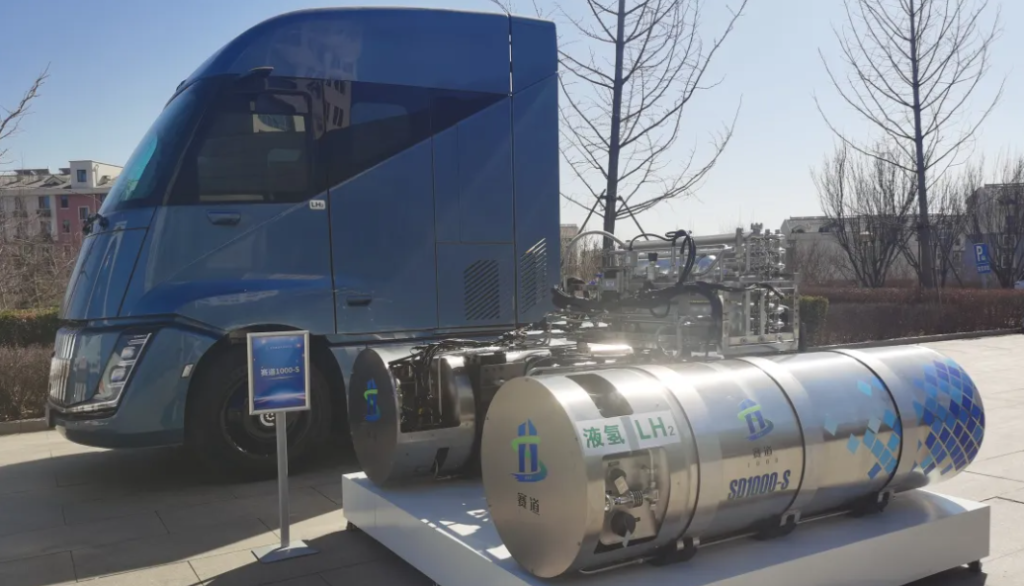
LH2 fuel system for heavy trucks
The Track-1000S onboard fuel system is China’s first onboard liquid hydrogen storage system deployed in heavy-duty trucks. It features two 40-kg cryogenic hydrogen tanks arranged in a side-mounted configuration.
This architecture differs from earlier rear-mounted systems and enables better integration with truck chassis designs. Key technical characteristics include:
- Total hydrogen storage capacity: 80 kg
- Range capability: over 1,000 km under full load
- Subcooled liquid hydrogen storage to reduce boil-off losses
- Dual-tank cooperative liquid supply technology
- Integrated hydrogen–electric vehicle architecture
The side-mounted design frees space at the rear of the vehicle while improving aerodynamics by reducing drag around the cab. CASC says the system also inherits features from its earlier rear-mounted Track-1000 system but offers more flexible vehicle integration.
Compared with compressed gaseous hydrogen storage, liquid hydrogen provides significantly higher energy density. A typical 70 MPa hydrogen truck system may carry roughly 40–50 kg of hydrogen, whereas liquid hydrogen systems can potentially double that capacity.
The system is currently being tested in regional demonstration programs with partners including Foton Motor.
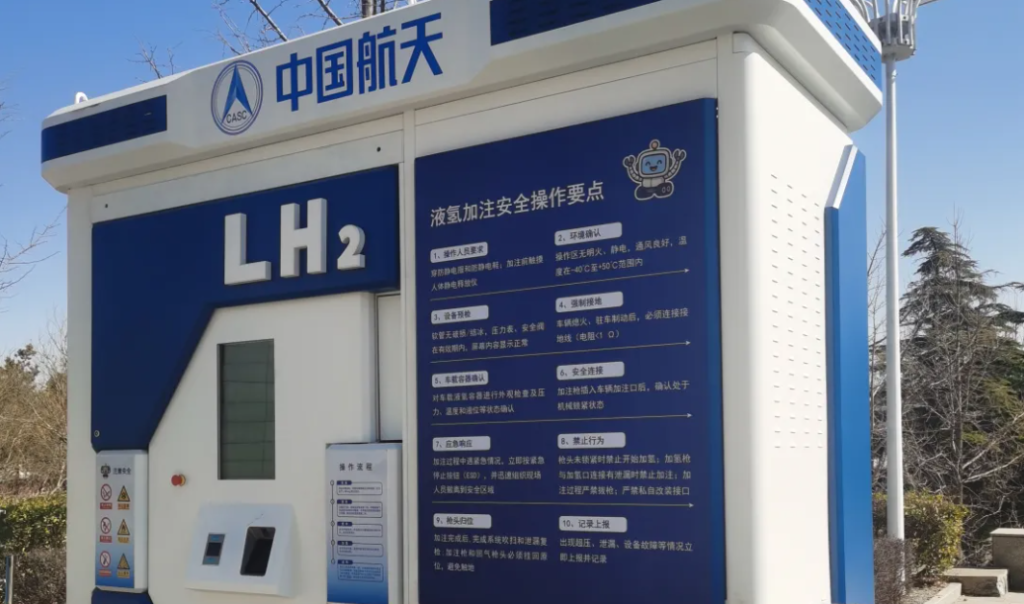
Refuelling infrastructure: mobile LH2 stations
The mobile liquid hydrogen refuelling skid and dispenser integrates several key components into a single portable platform, including:
- Cryogenic liquid hydrogen pump
- Hydrogen dispensing nozzle
- Flow metering system
- Integrated safety and control systems
The system represents China’s first mobile subcooled liquid hydrogen refuelling solution, enabling hydrogen refuelling without a fixed station. Key performance metrics include:
- Refuelling flow rate: 15 kg/min
- Liquid hydrogen utilization efficiency: >95%
- Refuelling time for a heavy truck: ~15 minutes
The platform resolves several long-standing technical challenges associated with liquid hydrogen refuelling, including dynamic sealing of large-diameter cryogenic cylinders, suppression of low static-pressure hydrogen vaporization, and minimization of vented hydrogen losses. These improvements significantly reduce hydrogen losses during refuelling, which have historically been both costly and a safety concern.
The mobile architecture also opens new commercial deployment models. Instead of investing in multi-million-dollar permanent hydrogen stations, operators could deploy temporary refuelling points for logistics fleets, demonstration corridors, or remote industrial sites.
In practice, such systems could function as “pop-up hydrogen stations,” accelerating early-stage adoption of hydrogen heavy transport.
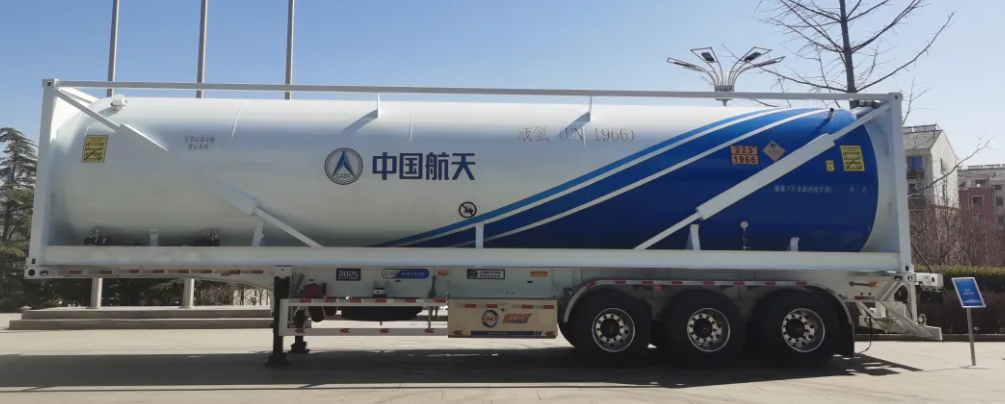
Logistics: 40-foot LH2 tank container
CASC’s 40-foot liquid hydrogen tank container is designed as a standardized cryogenic transport solution compatible with global road and maritime container logistics.
The container introduces several technical innovations, such as variable-density high-vacuum multilayer insulation, composite cryogenic adsorbents, and ultra-low boil-off design. Performance metrics include:
- Daily evaporation rate: 0.52%
- Hydrogen hold time: more than 8 days
- Transport radius: over 2,000 km
This compares with roughly 500 km transport distances typical for comparable hydrogen logistics solutions. The container’s hydrogen capacity is also several times greater than that of standard high-pressure gaseous hydrogen tube trailers of similar dimensions.
Economically, CASC estimates that liquid hydrogen transport using this container can reduce unit hydrogen delivery costs by more than 50% compared with high-pressure gaseous hydrogen transport.
If realized at scale, such improvements could reshape hydrogen supply chains, particularly where renewable energy resources and hydrogen demand are geographically mismatched. For example, hydrogen produced in wind- and solar-rich western China could be transported to coastal industrial clusters at significantly lower logistics costs.
Enabling the hydrogen value chain
The three products reflect a broader strategic push by CASC to position itself as a comprehensive hydrogen technology supplier. Central to that strategy, the Sixth Academy has developed capabilities across the hydrogen value chain, including:
- Hydrogen production technologies
- Liquefaction systems
- Storage and transport equipment
- Refuelling infrastructure
- Safety and testing platforms
This integrated capability positions CASC as both an equipment supplier and system integrator within China’s rapidly expanding hydrogen sector. Globally, major aerospace and energy companies, including Airbus, Air Liquide, and Linde, are investing heavily in cryogenic hydrogen technologies for transport and aviation applications.
CASC’s entry into the segment reflects China’s strategy of leveraging aerospace engineering capabilities to accelerate hydrogen infrastructure deployment. If the new equipment platforms prove commercially viable, they could help establish liquid hydrogen as a practical fuel for long-haul trucking, maritime transport, and eventually aviation.
Toward an industrial LH2 ecosystem
Beyond individual products, CASC emphasizes ecosystem development as a core objective. The group serves as a leading member of China’s aerospace hydrogen alliance and plays a leading role in regional and national hydrogen industry initiatives.
The new product suite, therefore, represents more than incremental technological upgrades. It signals the emergence of a commercial liquid hydrogen equipment ecosystem spanning vehicles, infrastructure, and logistics.
For hydrogen to scale globally, such integrated systems will be critical. As governments push for deep decarbonization of heavy industry and transport, liquid hydrogen technologies, once confined to rocket launch pads, may increasingly underpin the next generation of clean energy infrastructure.