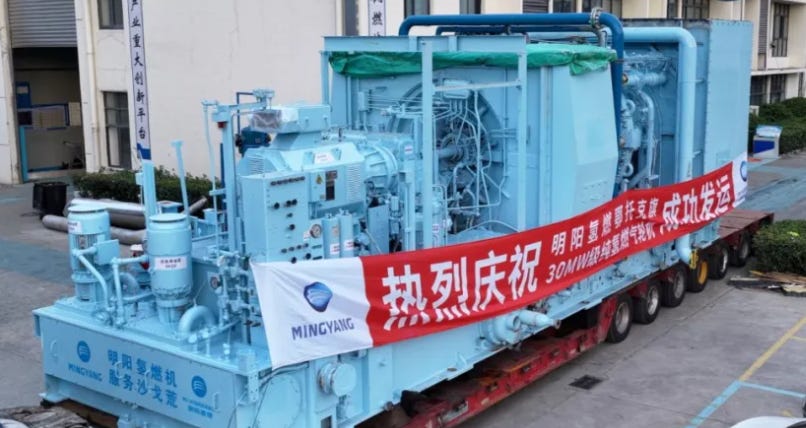
On August 8, Mingyang Hydrogen, in collaboration with Shenzhen Energy, began construction on the world’s first 30 MW-class pure hydrogen gas turbine storage demonstration project in Ordos, Inner Mongolia. This project represents a major step in China’s hydrogen power generation and long-duration energy storage capabilities.
The turbine, named Jupiter One, is part of Shenzhen Energy’s integrated green hydrogen and green ammonia synthesis complex. It is the world’s first 30MW pure hydrogen turbine project to enter full-scale engineering implementation, completing the entire “power-to-hydrogen-to-power” (P2H2P) cycle. The facility will use intermittent renewable energy to produce green hydrogen, store it for extended periods, and reconvert it into stable electricity to smooth grid fluctuations and enhance system reliability.
Key Technologies and Specifications
The turbine represents cutting-edge hydrogen-to-power conversion, with zero carbon emissions, competitive capital costs per kilowatt, rapid startup, and a wide operating range—critical features for grid balancing and renewable integration.
Designed for fast start-up and reactive power support, the turbine has already passed full ignition and high-speed no-load tests. It will be deployed at Shenzhen Energy’s green ammonia complex, which includes:
- 500 MW wind farm and 5 MW solar array
- Hydrogen production capacity of 48,000 Nm³/h (~4.3 tonnes/hour) from wind and solar electrolysis
- Hydrogen storage in twelve spherical tanks (1,875 m³ each), totalling 22,500 m³ for long-duration storage
- 150,000 tonnes/year green ammonia synthesis capacity, showcasing industrial-scale hydrogen utilization
A distinctive feature of the complex is the 5 MW off-grid solar-to-hydrogen demonstration plant, which adopts China’s first “intrinsic off-grid hydrogen production technology.” Unlike conventional systems, this breakthrough design operates without any connection to the main power grid or reliance on energy storage.
Powered directly by the 5 MW solar array, the facility uses flexible hydrogen production and purification processes to deliver stable output under variable solar conditions. Already validated at the 100-kilowatt laboratory scale at Tsinghua University, the MW-scale project is expected to achieve “grid-independent, sunlight-following, and sunlight-responsive” operation. The approach simplifies system design, lowers upfront capital costs, and reduces grid dependence, representing a leap forward in off-grid hydrogen production technology.
Policy Support and Market Implications
In June 2025, China’s National Energy Administration (NEA) issued the Notice on Organizing Hydrogen Pilot Projects in the Energy Sector (关于组织开展能源领域氢能试点工作的通知), supporting pilots for hydrogen, ammonia, and hydrogen-blended gas turbine power generation. This reflects growing recognition of hydrogen turbines as a potential pathway toward large-scale green hydrogen deployment.
Scheduled for commissioning by the end of 2025, the Ordos project will be the world’s largest pure hydrogen gas turbine demonstration. Integration with a 150,000-tonne green ammonia facility enhances economic viability and showcases the synergies of a circular hydrogen economy.
Unlike earlier models from Kawasaki (2020) and Siemens (2023), China’s project integrates large-scale renewables with on-site hydrogen storage. From a value chain perspective, it combines renewable generation, electrolytic hydrogen production, bulk hydrogen storage, turbine-based reconversion, and industrial ammonia synthesis, offering a replicable model for next-generation power systems and deep renewable integration.
Outlook and Challenges
Hydrogen turbine technology still faces limitations in unit size and cost. Mingyang’s 30 MW-class solution represents an engineering step toward higher capacities and cost reductions. Although energy losses occur across electrolysis, storage, and combustion, they become less critical when renewable energy is sufficiently inexpensive—especially compared with the high costs of long-duration storage that batteries cannot economically deliver. In some regions of China, renewable costs have fallen as low as around CNY 170–240/MWh (US$23–33/MWh) for solar and CNY 210–275/MWh (US$28–38/MWh) for wind.
From a performance perspective, current hydrogen-to-power (P2H2P) round-trip efficiency (RTE) stands at ~30–40% for systems using fuel cells and ~20–28% for simple-cycle hydrogen turbines, largely due to reconversion losses. While fuel cells offer higher RTE, turbines are more scalable, easier to integrate with existing thermal power infrastructure, and capable of providing grid inertia.
Other LDES pathways are also advancing. Hami Energy’s 100 MW/400 MWh vanadium redox flow battery project (see link), commissioned in August, delivers an RTE of about 68%.
As technology matures, hydrogen turbines could evolve into a cost-competitive solution for LDES. For policymakers and investors, this policy-backed project suggests that hydrogen turbines may become an important component of China’s long-duration storage and decarbonization plans.