In December 2025, China connected the world’s largest vanadium redox flow battery (VRFB) energy storage station to the grid at full capacity, marking a major milestone in the industrialization of long duration energy storage (LDES). The 200 MW/1,000 MWh project, developed by Rongke Power (RKP), entered full commercial operation as part of China Three Gorges Group’s Jimusar solar-plus-storage complex in Xinjiang.
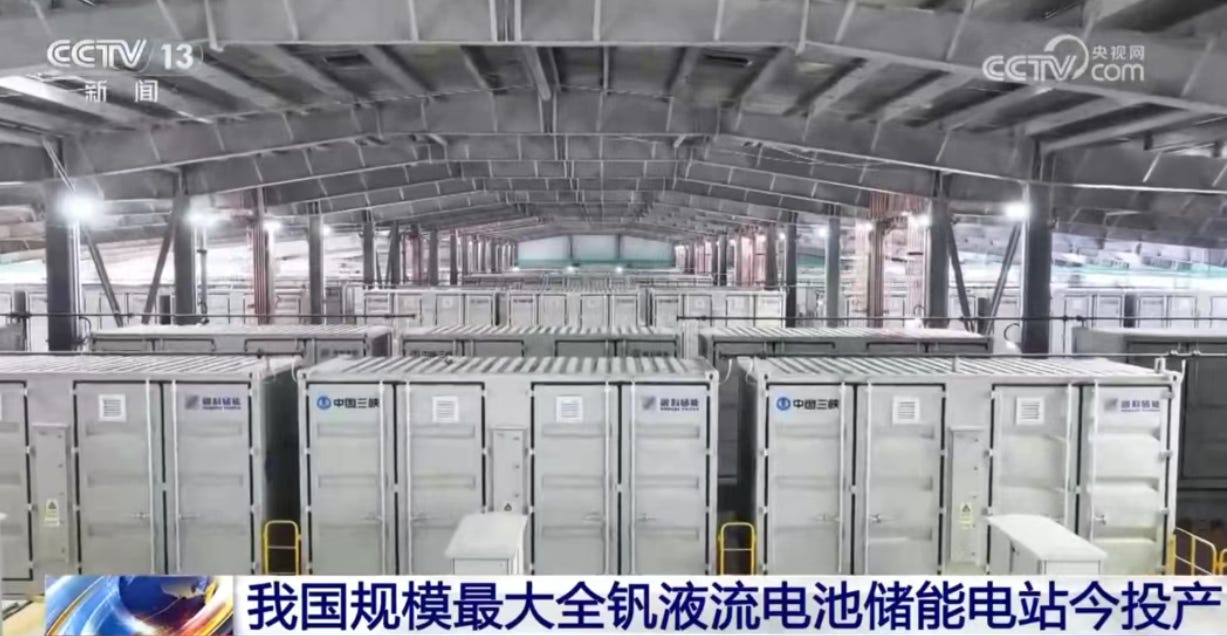
The commissioning represents more than a single project’s success. It signals that vanadium flow batteries, long viewed as a promising alternative to lithium-ion for long-duration applications, have crossed into the GWh-scale commercial era. For China’s power system, grappling with rising renewable penetration and grid-balancing constraints, the project offers a concrete, large-scale solution to curtailment and flexibility challenges. For the global storage industry, it establishes a new benchmark for non-lithium energy storage deployment.
A GWh-scale project reaches full operation
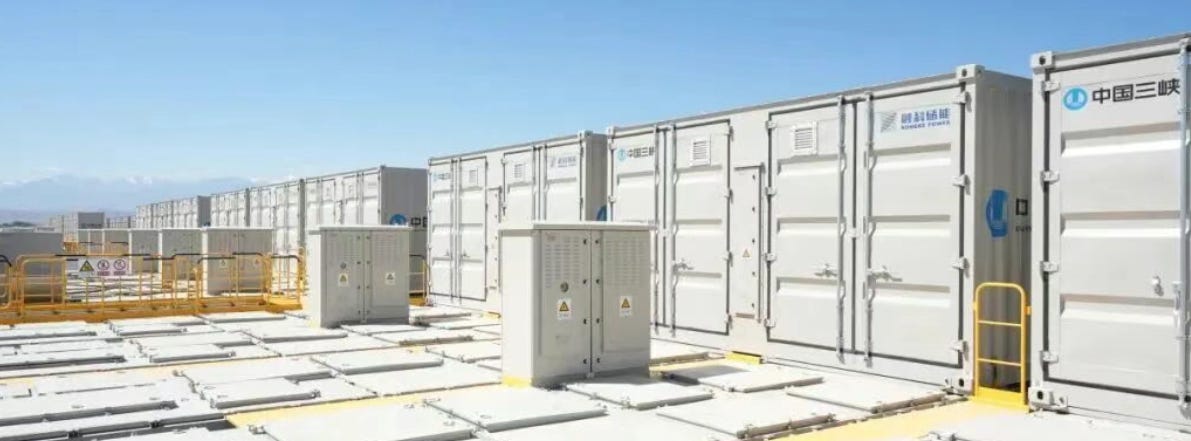
The Jimusar project comprises a 200 MW vanadium redox flow battery system with a storage duration of five hours, delivering a total energy capacity of 1 GWh. Developed and delivered independently by Rongke Power, the facility achieved full-capacity, grid-connected operation on December 31, following phased commissioning and testing.
It is currently among the largest battery energy storage stations in operation worldwide. While lithium-ion systems dominate global installed storage capacity, most projects exceeding the 1 GWh threshold rely on lithium-based chemistries. Jimusar therefore stands out not only for its scale, but also for demonstrating that flow batteries can be deployed, engineered, and operated reliably at a comparable size.
The project is integrated with a 1 GW photovoltaic power plant in Jimusar County, Xinjiang—one of China’s most resource-rich yet grid-constrained renewable energy hubs. The region’s rapid solar and wind buildout has long faced challenges related to intermittency, long-distance transmission requirements, and rigid ultra-high-voltage (UHV) export profiles. The Jimusar storage facility is designed to address these bottlenecks directly.
Full-chain delivery: Demonstrating industrial-scale execution capability
A defining feature of the project is Rongke Power’s role as a full-chain delivery provider. The company independently undertook the entire project lifecycle, from core technology and equipment supply to system integration, plant design, construction, commissioning, and grid connection.
Key components, including vanadium electrolyte, battery stacks, and system integration, were all supplied by Rongke Power. This vertically integrated approach reduces interface risk, shortens delivery timelines, and enhances system reliability, particularly for projects at unprecedented scale.
The successful delivery validates Rongke Power’s ability to execute GWh-class storage projects to utility-grade standards, setting both an engineering and commercial benchmark for China’s “new-type energy storage” sector. It also signals that VRFB supply chains, from vanadium electrolyte production to stack manufacturing and balance-of-plant systems, are sufficiently mature to support large-scale deployment.
Key technologies and specifications
Scale and configuration
- Power capacity: 200 MW
- Energy capacity: 1,000 MWh (1 GWh)
- Storage duration: 5 hours
- Battery type: Vanadium redox flow battery
- Application: Grid-connected long-duration energy storage integrated with solar generation
The 1 GWh energy capacity is equivalent to the combined battery capacity of more than 16,000 electric vehicles equipped with 60 kWh battery packs, underscoring the sheer scale of the installation.
Vanadium redox flow batteries
Vanadium flow batteries store energy in liquid electrolytes contained in external tanks, decoupling power—determined by stack size—from energy capacity, which is defined by electrolyte volume. This architecture makes them particularly well-suited to long-duration applications requiring storage durations of four hours or more.
Key technical advantages include:
- Long cycle life: VRFBs can typically achieve 20,000–30,000 charge–discharge cycles with minimal degradation
- Intrinsic safety: Aqueous electrolytes eliminate thermal runaway risks associated with lithium-ion batteries
- Deep discharge capability: Systems can operate at 100% depth of discharge without material damage
- Flexible scaling: Energy capacity can be expanded by increasing electrolyte volume
These attributes align closely with the operational requirements of high-renewable power systems, where daily cycling, long asset life, and safety are critical.
Engineering for extreme environments
Xinjiang’s harsh climate posed significant engineering challenges, including strong winds, sandstorms, and large seasonal temperature swings. To ensure long-term reliability, Rongke Power implemented a series of adaptive design innovations:
- Indoor steel-structure plant layout: Key systems are housed within enclosed steel structures to protect equipment from sand and dust intrusion
- Specialized dust-proof designs: Critical components incorporate enhanced sealing and filtration to ensure stable operation in windblown sand conditions
- Wide-temperature intelligent thermal management: Integrated heating and cooling systems enable stable operation in both extreme cold and extreme heat, preserving battery performance and extending service life
- Automated electrolyte maintenance: A fully automated electrolyte capacity recovery and additive system enables precise, hands-free maintenance, reducing operational labour and lifecycle costs
Together, these measures enhance system availability and reduce operating expenditure, an essential consideration for long-lived storage assets expected to operate over multiple decades.
Economics and business model implications
By smoothing renewable output variability and supporting ultra-high voltage (UHV) transmission schedules, the project enhances both grid stability and renewable economics.
While flow batteries typically entail higher upfront capital costs than lithium-ion systems, their economics improve significantly over long lifetimes and high-cycle applications. With minimal degradation and extended service lives, VRFBs can achieve a competitive levelised cost of storage (LCOS) in long-duration use cases.
The Jimusar project explores a commercial model for large-scale, independent energy storage integrated with renewable generation. Through “solar + storage” co-optimization, storage assets enhance project revenues by:
- Increasing effective renewable energy utilization
- Reducing curtailment penalties
- Providing grid services such as peak shaving and load shifting
This model is increasingly relevant as China’s power markets evolve to place greater value on flexibility, capacity, and ancillary services alongside energy output.
Future outlook
Globally, long-duration energy storage remains an emerging segment. While lithium-ion technology dominates current deployments, alternative pathways—including flow batteries, compressed air, pumped hydro, and hydrogen—are gaining momentum.
At 1 GWh, Jimusar ranks among the largest operational non-lithium energy storage projects worldwide. Its five-hour configuration places it firmly within the LDES category, beyond typical lithium-ion peak-shaving applications. With multi-decade lifetimes and minimal degradation, VRFBs align more closely with utility infrastructure investment horizons than shorter-lived battery assets.
The Jimusar project marks a pivotal moment for long-duration energy storage. It demonstrates that GWh-scale vanadium flow battery systems can be delivered, integrated, and operated reliably under demanding real-world conditions. As renewable penetration deepens and power systems require ever-greater flexibility, such technologies are likely to play an increasingly important role.
For Rongke Power, the project cements its position as a leading global supplier of flow battery solutions. For China’s power system, it provides a scalable blueprint for integrating massive renewable capacity without compromising reliability. For the global cleantech sector, it reinforces a broader conclusion: the future of energy storage will be plural, defined by fit-for-purpose technologies deployed at scale.