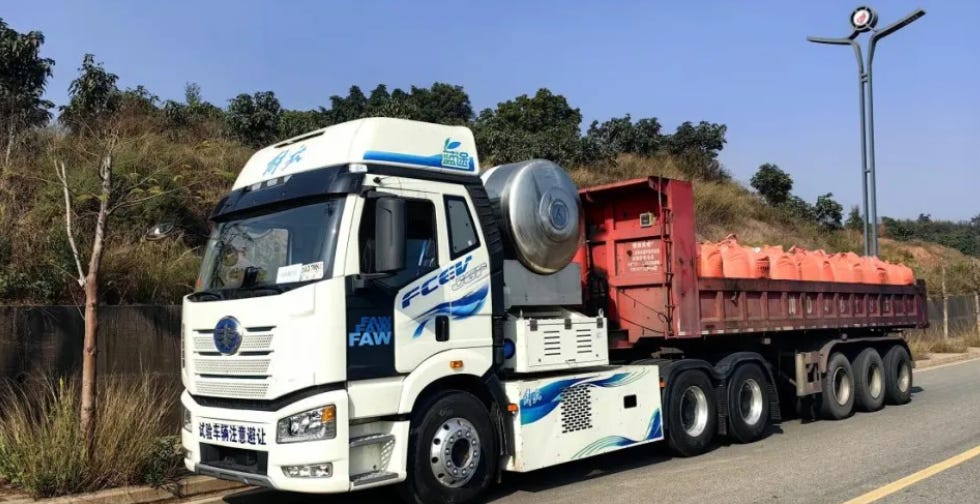
On December 31, 2025, a liquid hydrogen heavy-duty truck jointly developed by FAW Jiefang and leading state-owned technology enterprises began China’s first-ever public-road demonstration of its kind in Panzhihua, Sichuan. With a verified driving range exceeding 1,000 kilometres and supported by the country’s first civilian liquid hydrogen refuelling station, the project marks a critical step in moving liquid hydrogen trucks from laboratory research into real-world commercial validation.
The demonstration places China among a small group of jurisdictions globally testing liquid hydrogen as a viable zero-emission solution for long-haul freight, one of the most challenging segments to decarbonize.
From Prototype to Public-Road Validation
The LH2 vehicle was co-developed with the Academy of Aerospace Liquid Propulsion Technology (AALPT), also known as the Sixth Academy of the China Aerospace Science and Technology Corporation (CASC), and Dongfang Electric (Chengdu) Hydrogen Energy Technology. Together, the partners combined automotive manufacturing, aerospace cryogenic expertise, and fuel cell system integration.
The road trial coincided with the commissioning of China’s first civilian liquid hydrogen refuelling station (see link), which opened in Panzhihua on December 4. Capable of operating a closed-loop “production–storage–refuelling” system, the facility enabled safe and repeatable refuelling of liquid hydrogen at –253°C, addressing a long-standing barrier between experimental liquid hydrogen technologies and commercial deployment.
Key Technologies and Specifications
A Mature Vehicle Platform Meets Aerospace-Grade Hydrogen Systems
The demonstration truck integrates three core technology components, designed to minimize system risk while delivering step-change performance.
- Vehicle platform: The truck is based on FAW Jiefang’s J6P heavy-duty chassis, a mature platform validated over millions of kilometres in commercial operation across China. Leveraging an established architecture reduced uncertainties related to durability and serviceability, allowing development efforts to focus on the hydrogen powertrain.
- Liquid hydrogen storage and supply: The vehicle uses AALPT’s “Saidao 1000” large-capacity onboard liquid hydrogen storage and supply system. A 100-kilogram-class liquid hydrogen tank operates at –253°C and incorporates multi-layer insulation and aerospace-derived safety controls to minimize boil-off and maintain thermal stability during extended operation.
- Fuel cell system: Power is supplied by a high-power fuel cell system developed by Dongfang Hydrogen, engineered for sustained output under long-haul operating conditions, including mountainous terrain and variable payloads.
Together, these systems deliver an energy density difficult to achieve with compressed hydrogen. Liquid hydrogen offers a volumetric energy density of approximately 8.5 MJ per litre, compared with around 5.6 MJ per litre for 70 MPa compressed hydrogen. In vehicle packaging terms, this enables substantially longer range without compromising payload capacity or requiring multiple large storage tanks.
Infrastructure as a Commercial Enabler
Technology alone does not create a market. Historically, liquid hydrogen in China has been confined mainly to aerospace and specialized industrial uses. Therefore, the credibility of the Panzhihua demonstration depends on the parallel deployment of China’s first civilian liquid hydrogen refuelling station with full-chain operational capability.
During the demonstration, the station successfully supported repeated refuelling operations, confirming that liquid hydrogen can be handled safely and efficiently outside tightly controlled aerospace or laboratory environments.
Liquid hydrogen infrastructure is inherently more complex and capital-intensive than compressed hydrogen, requiring advanced cryogenic materials, insulation, and safety systems. Demonstrating civilian operability removes a critical barrier to scaling liquid hydrogen mobility.
Stress-Testing in Real Operating Conditions
Panzhihua’s mountainous terrain and complex road conditions provided a demanding real-world test environment, placing sustained stress on powertrain performance, thermal management, and energy system stability.
Throughout the demonstration, the truck reportedly operated smoothly, maintaining stable performance across varying loads and driving profiles. For fleet operators, such reliability is more decisive than headline specifications. Proven performance under harsh conditions is what distinguishes an experimental pilot from a commercially viable asset.
The results suggest that the integration of FAW Jiefang’s heavy-duty platform with aerospace-derived liquid hydrogen systems has reached a level of engineering maturity suitable for early-stage commercial trials.
Economics, Scale, and Policy Alignment
Liquid hydrogen has traditionally been viewed as uneconomic for road transport due to the energy penalty of liquefaction, which typically consumes 25–30 per cent of hydrogen’s energy content. In the context of long-haul heavy trucking, however, the economics begin to shift.
Key advantages include:
- Fewer refuelling stops, improving vehicle utilization
- Higher payload efficiency, avoiding cargo capacity trade-offs
- Lower long-distance logistics costs, as liquid hydrogen becomes more economical than compressed hydrogen over extended transport distances
As China expands renewable hydrogen production, particularly in western regions with abundant wind and solar resources, the relative cost position of liquid hydrogen is expected to improve further.
A Replicable Collaboration Model
Beyond technology, the project highlights a coordinated industrial approach. The demonstration brought together:
- FAW Jiefang: vehicle integration, manufacturing, and commercialization
- AALPT: liquid hydrogen production and onboard storage
- Dongfang Electric: high-power fuel cell technology
- Local government: policy support, infrastructure deployment, and application scenarios
This “government–industry–research–application” model shortens the path from R&D to deployment and offers a template that could be replicated in other regions and hydrogen applications.
From Demonstration to Scale
Globally, truck manufacturers and energy companies are pursuing multiple decarbonization pathways, including battery-electric drivetrains, compressed hydrogen, synthetic fuels, and hybrid solutions. The Panzhihua project strengthens the case that liquid hydrogen could emerge as a leading option for long-distance, heavy-load, zero-emission trucking.
While costs remain higher today, scale effects, standardization, and domestic supply chain development could narrow the gap. The project team is now working with industry bodies to convert operational data into national standards for liquid hydrogen refuelling, safety, and vehicle integration, an essential step for unlocking large-scale investment.
Though challenges remain, particularly around cost and infrastructure scale, the Panzhihua project shows that liquid hydrogen is no longer a distant future option. It is emerging as a technically credible and commercially testable solution for one of the hardest segments of transport to decarbonize.