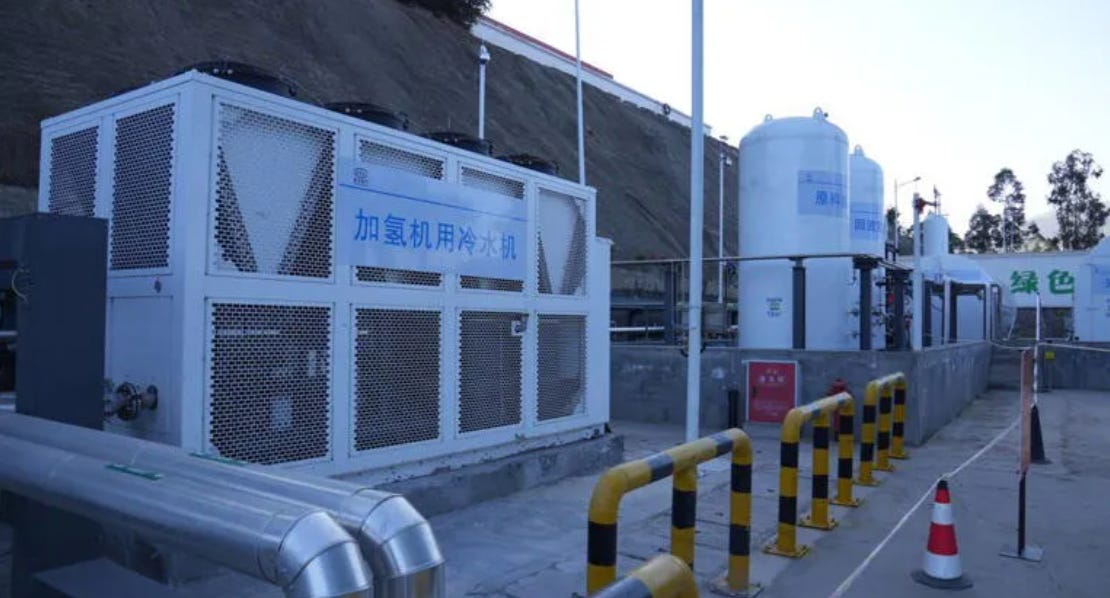
On December 4, China commissioned its first civilian liquid hydrogen (LH2) refuelling station in Panzhihua, Sichuan, marking a pivotal milestone in the country’s hydrogen transport infrastructure for heavy-duty trucks.
The opening ceremony also featured road testing of LH2 heavy-duty trucks, with the successful refuelling of a FAW Jiefang J6P (Blue Journey) liquid hydrogen truck, which was jointly developed by the Academy of Aerospace Liquid Propulsion Technology (AALPT), also known as the Sixth Academy of the China Aerospace Science and Technology Corporation (CASC), in collaboration with FAW Jiefang and Dongfang Electric.
Panzhihua, a city long known for vanadium–titanium magnetite mining and processing, is repositioning itself as a hub for critical materials and clean energy innovation. Located in the city’s National Vanadium and Titanium High-Tech Industrial Development Zone, the LH2 station represents China’s first integrated system combining hydrogen pipeline supply, a central–distributed refuelling station architecture, and liquid hydrogen applications.
From strategic agreement to operational infrastructure
The LH2 station is the tangible outcome of a strategic cooperation agreement signed in November 2023 by five stakeholders: AALPT, the Panzhihua Vanadium and Titanium High-Tech Industrial Development Zone, Dongfang Electric, FAW Jiefang, and the Sichuan Special Equipment Inspection and Research Institute.
With a total investment of CNY 83 million (USD 11.5 million), the project broke ground in April 2024 and was completed within eight months. The build-out includes a liquid hydrogen production facility, a refuelling station, and supporting infrastructure for LH2-powered heavy-duty trucks.
The station will function both as a refuelling facility and as an external hydrogen supply node, making it China’s first pipeline-fed “central station” capable of supplying hydrogen to subsidiary distributed stations or directly to end users. This architecture mirrors established liquid hydrogen logistics systems used in aerospace and industrial gas markets, which until now have not been applied to civilian transport in China.
According to the agreement, the project will extend beyond a single site, serving as the anchor for a 500,000-square-metre hydrogen energy industrial park, with a hydrogen industry cluster targeting annual revenues of CNY 10 billion.
Key technologies and system specifications
Liquid hydrogen liquefies at –253°C, requiring advanced cryogenic engineering and rigorous safety management. In the Panzhihua project, hydrogen gas is first precooled to –196°C using liquid nitrogen as a cold source. It is then further cooled and liquefied using helium as the refrigeration medium through a compression–expansion refrigeration cycle, ultimately reaching the liquid hydrogen temperature threshold.
Once liquefied, the hydrogen is stored in dedicated cryogenic tanks and transferred to the refuelling station, where it is dispensed directly into vehicle-mounted liquid hydrogen tanks. The station’s current refuelling capacity is 500 kilograms per day, modest by industrial hydrogen standards, but sufficient for early-stage fleet demonstrations and system-level validation.
At this capacity, the station could support about 10 to 15 liquid hydrogen heavy-duty trucks per day during initial trials, depending on vehicle configuration and duty cycles. While not yet commercially scalable, the facility provides a realistic testbed for fleet operators, equipment suppliers, and regulators.
The FAW Jiefang truck deployed at the site integrates with the “Track 1000” liquid hydrogen supply system, a cryogenic fuel delivery solution designed for heavy-duty transport applications with 100-kilogram-class onboard storage. Earlier this year, the vehicle completed full-system bench testing and on-road trials, clearing the way for demonstration under real logistics conditions in Panzhihua.
Integrated “produce–store–transport–use” model
The project features end-to-end integration of the hydrogen value chain. Rather than treating hydrogen production, liquefaction, distribution, and end use as separate segments, the Panzhihua model links them into a single operational system.
Internationally, liquid hydrogen supply chains remain largely confined to aerospace applications, such as NASA and European Space Agency launch systems, or niche industrial uses. China’s scale advantage in cryogenic equipment manufacturing, built on decades of aerospace and industrial gas experience, could enable rapid cost reductions. The involvement of AALPT underscores the transfer of space-grade cryogenic technologies into civilian energy and transport systems.
AALPT has indicated that upcoming road tests will focus on collecting operational data across the liquid hydrogen production plant, refuelling station, and heavy-duty trucks under specific regional transport scenarios in Panzhihua.
Such data are critical for improving system reliability, driving cost reductions, and informing regulatory frameworks. Liquid hydrogen introduces new challenges in safety management, inspection, and certification – particularly for civilian use. The participation of the Sichuan Special Equipment Inspection and Research Institute highlights the project’s role as both a technological and regulatory learning platform.
Breakthrough in liquid-driven high-pressure liquid hydrogen pump technology
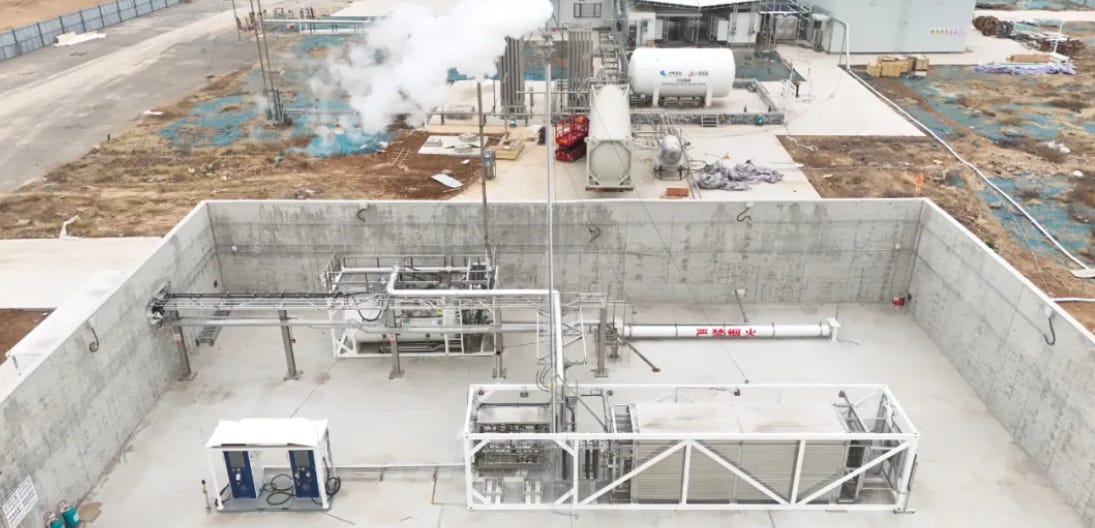
China’s advances in liquid hydrogen infrastructure are underpinned by technological breakthroughs across the LH2 value chain. A notable example is the liquid-driven high-pressure liquid hydrogen pump jointly developed by the National Institute of Clean and Low-Carbon Energy (NICE) of China Energy Group and Guohua Investment.
In early December, the technology successfully passed a scientific and technological evaluation conducted by academicians and leading experts in the liquid hydrogen sector. The review concluded that the overall system has reached an internationally advanced level, while the liquid-driven pressurization technology itself has achieved an internationally leading position.
The newly developed pump addresses several critical technical challenges, including material embrittlement at cryogenic temperatures, component shrinkage mismatch, low-temperature high-pressure sealing, and heat-leak-induced vaporization of liquid hydrogen. Testing and validation with liquid hydrogen demonstrated an outlet pressure of up to 90 MPa and a flow rate of 120 kg per hour at 87.5 MPa. At this operating pressure, refuelling energy consumption is approximately 0.93 kWh per kilogram of hydrogen.
The successful development of this pump is expected to strengthen China’s LH2 infrastructure by enabling more efficient liquid hydrogen filling, transfer, refuelling, and pressurized vaporization.
2025: a pivotal year for China’s liquid hydrogen industry
2025 marks an inflection point for China’s liquid hydrogen sector, with rapid progress in infrastructure deployment, technology commercialization, capital raising, and regulatory frameworks. Recent highlights include:
- December: Jiangnan Shipyard (under China State Shipbuilding Corporation) and Southwest Shipping signed cooperation agreements for two ultra-large liquid hydrogen transport vessels. In the same month, China Energy submitted a project filing for key technologies in liquid hydrogen production, storage, and transport, with a total investment of CNY 373 million.
- November: China Three Gorges Corporation, the world’s largest renewable power producer, successfully produced liquid hydrogen at its “source-grid-load-storage integrated” pilot base in Ulanqab, Inner Mongolia, while in Shandong, Sinopec’s 10-TPD Qilu liquid hydrogen project officially entered large-scale commercial production.
- October: Beijing Fullcryo Technologies, specializing in large-scale cryogenic refrigeration equipment, cryogenic system engineering, and industrial gas supply and incubated at the Chinese Academy of Sciences (CAS) Institute of Physics and Chemistry, launched its IPO process.
- September: China’s Ministry of Transport released the Technical Specification for Road Transport of Hydrogen (Including Liquid Hydrogen).
- August: Sinoscience Clean Energy secures Series A financing at the billion-CNY scale.