New subsidies, mandatory efficiency upgrades, and stricter compliance requirements are expected to accelerate investment across China, benefiting industrial leaders in energy efficiency, waste heat recovery, and green hydrogen, such as Shuangliang Eco-Energy.
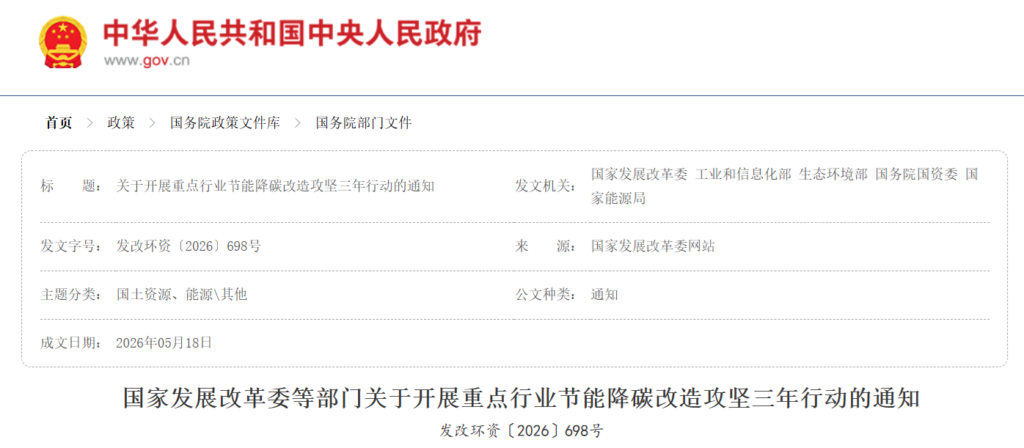
On June 15, NDRC, MIIT, MEE, SASAC and NEA jointly issued the Three-Year Action Plan for Energy-Saving and Carbon-Reduction Upgrades in Key Industries (NDRC Huanzi [2026] No. 698). The policy represents a significant escalation of China’s industrial decarbonization agenda.
Beyond reducing emissions, the plan is designed to stimulate investment, strengthen industrial competitiveness and accelerate the transition to lower-carbon manufacturing. For sectors including steel, aluminum, cement, refining, petrochemicals, chemicals and power generation, the action plan establishes a clear three-year roadmap supported by measurable performance benchmarks and increasingly stringent compliance requirements.
By combining regulatory mandates, financial incentives, and technology deployment targets across nine major industrial sectors, the program is expected to unlock substantial investment opportunities in energy-efficiency technologies, waste heat recovery, electrification and green hydrogen, while advancing the country’s carbon-peaking objectives.
A large-scale industrial upgrade program
The scale of the initiative is considerable. By the end of 2028, China aims to increase the share of production capacity that meets current energy-efficiency benchmarks by an average of 20 percentage points across key industrial sectors. The coal-fired power sector is expected to improve by 15 percentage points.
At the same time, production capacity operating below mandatory energy-efficiency standards is expected to be largely phased out.
The government estimates that the program will generate cumulative energy savings exceeding 100 million tonnes of standard coal equivalent and reduce carbon dioxide emissions by more than 200 million tonnes. This reduction is broadly comparable to the annual carbon footprint of a mid-sized industrialized economy.
Financial incentives are being deployed alongside regulatory pressure. Eligible energy-efficiency and carbon-reduction projects may receive subsidies covering up to 20% of approved capital investment, with priority given to projects that achieve benchmark energy-performance levels.
The policy also introduces stronger economic signals. Facilities that fail to meet mandatory energy-consumption standards may face additional electricity charges of up to CNY 0.1 per kWh. Projects that fail to complete required upgrades by the end of 2028 could ultimately face mandatory shutdown.
Equally important, provincial governments are required to submit implementation plans and project lists by July 2026, creating a near-term pipeline of projects and signalling an accelerated procurement cycle over the next three years.
Waste heat recovery takes centre stage
One of the most striking features of the action plan is its repeated emphasis on waste heat recovery.
The steel sector is instructed to strengthen the recovery and utilization of by-product gases, waste heat and waste pressure. Electrolytic aluminum producers are required to optimize flue-gas heat recovery and cascading energy-utilization systems. Cement manufacturers are encouraged to deploy oxygen-enriched and oxy-fuel kiln combustion technologies, while refining and ethylene producers are directed to improve low-grade heat utilization and optimize heat-exchange networks.
This policy focus reflects a long-standing inefficiency within industrial energy systems. Industrial waste heat accounts for more than 30% of total industrial energy consumption, yet a substantial portion remains unrecovered. Much of this energy exists as low-grade heat, which has historically been difficult to utilize economically.
Globally, advanced industrial economies have increasingly integrated waste heat recovery into broader decarbonization strategies. In Europe and Japan, industrial heat pumps, district-heating integration and advanced heat-network optimization have become important tools for reducing fossil-fuel consumption. China’s latest policy signals a similar shift towards maximizing energy productivity before deploying higher-cost carbon-abatement measures.
The action plan is therefore expected to create substantial opportunities for technology providers specializing in industrial energy optimization. Given the scale of the targeted upgrades, the resulting investment cycle could rank among the largest industrial decarbonization programs undertaken anywhere in the world.
Against this backdrop, industrial companies capable of delivering integrated energy-saving solutions are likely to be among the primary beneficiaries of the policy. Demand is expected to extend beyond individual pieces of equipment towards comprehensive systems that combine efficiency improvements, emissions reductions and digital optimization.
One company whose technology portfolio aligns closely with these priorities is Shuangliang, which has spent decades building capabilities across waste heat recovery, clean energy and industrial carbon management.
Shuangliang: from equipment supplier to integrated decarbonization partner
Shuangliang Eco-Energy Systems, headquartered in Jiangyin, Wuxi, has emerged as one of the companies most closely aligned with the priorities outlined in the action plan.
With more than four decades of experience in energy conservation and environmental technologies, the company has built a portfolio spanning waste heat recovery, industrial heat pumps, photovoltaic power generation, hydrogen production and digital energy management.
Shuangliang has established a leading position in lithium bromide absorption heat-pump technology, a product category recognized as a national manufacturing champion in China. Leveraging this expertise, the company has developed integrated waste heat recovery solutions for the steel, petrochemical and chemical industries.
Its reference projects illustrate the scale of potential energy savings. At the Beijing Gaojing Thermal Power Plant zero-carbon waste heat project, Shuangliang deployed eight steam-driven lithium bromide absorption heat-pump units that reduce flue-gas temperatures from 80°C to 30°C while recovering approximately 195 MW of thermal energy. The project is expected to add 1.59 million GJ of annual heating capacity, save 43.2 million standard cubic metres of natural gas and reduce carbon emissions by approximately 90,500 tonnes per year.
At the Xigu Thermal Power Plant district-heating project, six 48 MW steam-driven absorption heat pumps recover turbine exhaust condensation heat to provide heating for more than 2.4 million square metres of urban residential and commercial space.
Integrating waste heat recovery, CCUS and green hydrogen
Shuangliang’s strategy extends beyond conventional energy-efficiency solutions.
In carbon capture, utilization and storage (CCUS), the company has developed systems that use compressor waste heat to provide process cooling, reducing downstream electricity demand. At Sinopec Qilu Petrochemical’s 700,000-tonne-per-year CCUS project, the technology is estimated to reduce electricity consumption by 3.8 GWh annually. Similar deployments in northwestern China are reported to achieve annual savings of approximately 3.6 GWh.
The three-year action plan’s emphasis on renewable-energy substitution and industrial electrification also strengthens the business case for green hydrogen.
Industries such as ammonia, methanol, refining and steel are under increasing pressure to replace fossil-fuel-derived hydrogen with renewable alternatives. In response, Shuangliang has invested heavily in both photovoltaic manufacturing and alkaline electrolysis technologies.
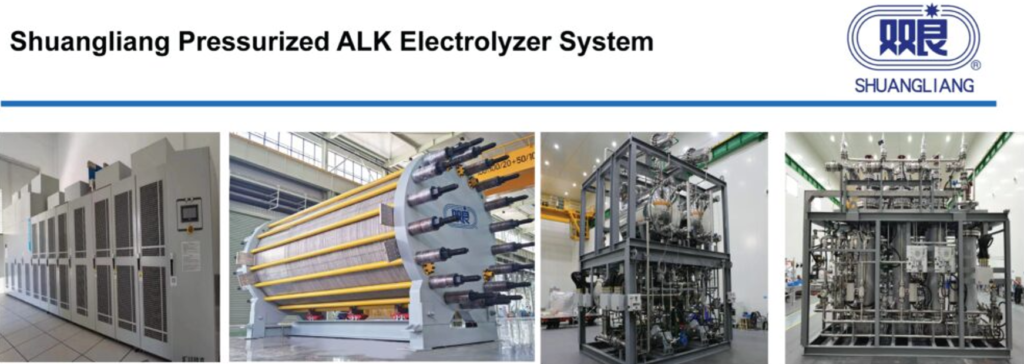
Its integrated solar-to-hydrogen solution combines distributed photovoltaic generation with intelligent electrolysis systems, enabling industrial users to convert intermittent renewable electricity into green hydrogen for ammonia synthesis, methanol production, refinery hydrotreating and hydrogen-based direct reduced iron (DRI) production.
This approach addresses one of industrial decarbonization’s most difficult challenges: replacing carbon-intensive feedstocks rather than simply improving energy efficiency.
Digitalization as the fourth pillar
The action plan ultimately points towards a broader transformation of industrial energy systems.
Beyond equipment upgrades, enterprises are increasingly expected to optimize energy systems, electrify operations and implement integrated carbon-management strategies. Shuangliang has responded by developing digital energy and carbon-management platforms that combine IoT connectivity, cloud-edge collaboration and AI-driven optimization.
The company reports participation in more than ten national-level zero-carbon industrial park projects, highlighting the growing role of digital technologies in enabling industrial decarbonization.
As China’s industrial decarbonization agenda shifts from planning to implementation, competitive advantage is likely to favour companies capable of delivering integrated solutions rather than standalone products. The convergence of waste heat recovery, renewable power, green hydrogen, CCUS and digital energy management is creating a new industrial decarbonization value chain—one that the 2026–2028 action plan is poised to accelerate.
For technology providers, project developers and industrial operators, the next three years may represent one of the largest industrial decarbonization and energy-efficiency investment cycles in China’s history, with ripple effects likely to reshape global industrial decarbonization trends.
International expansion: supporting energy-transition efforts abroad
While China’s industrial decarbonization program is creating a substantial domestic growth opportunity, Shuangliang is also positioning itself to participate in energy-transition projects beyond China’s borders.
Recently, a Shuangliang delegation visited Kyrgyzstan to evaluate opportunities in photovoltaic power generation and urban heating infrastructure. The delegation met with senior officials from Kyrgyzstan’s Ministry of Energy, the Osh municipal government, and the Batken regional government, while also conducting on-site assessments of local energy-infrastructure projects.
Particular attention was given to key project-development considerations, including land approvals, grid-connection requirements, tariff mechanisms and permitting frameworks for both utility-scale and distributed solar projects. The consultations helped clarify potential pathways for project deployment and identified the regulatory conditions necessary for future large-scale investment.
The visit highlights a broader trend emerging alongside China’s domestic decarbonization push: leading Chinese clean-energy technology providers are increasingly seeking international growth opportunities, particularly across emerging markets where demand for renewable power, energy efficiency and modernized urban heating systems is rising rapidly.
For Shuangliang, overseas expansion could provide an additional avenue for growth beyond the domestic industrial-upgrade cycle. The company’s expertise in waste heat recovery, district heating, photovoltaic systems, green hydrogen and integrated energy management aligns closely with global energy-transition efforts to enhance energy security while reducing carbon intensity.