China is moving to reshape the backbone of its sustainable aviation fuel (SAF) industry after the State-owned Assets Supervision and Administration Commission (SASAC) announced on January 8 that China Petroleum & Chemical Corporation Group (Sinopec) and China National Aviation Fuel Group (CNAF) will be restructured following approval by the State Council.
The move brings together the country’s largest integrated energy and chemicals group with Asia’s largest aviation fuel logistics and services provider, signalling a strategic push to accelerate SAF deployment in one of the most difficult-to-abate sectors.
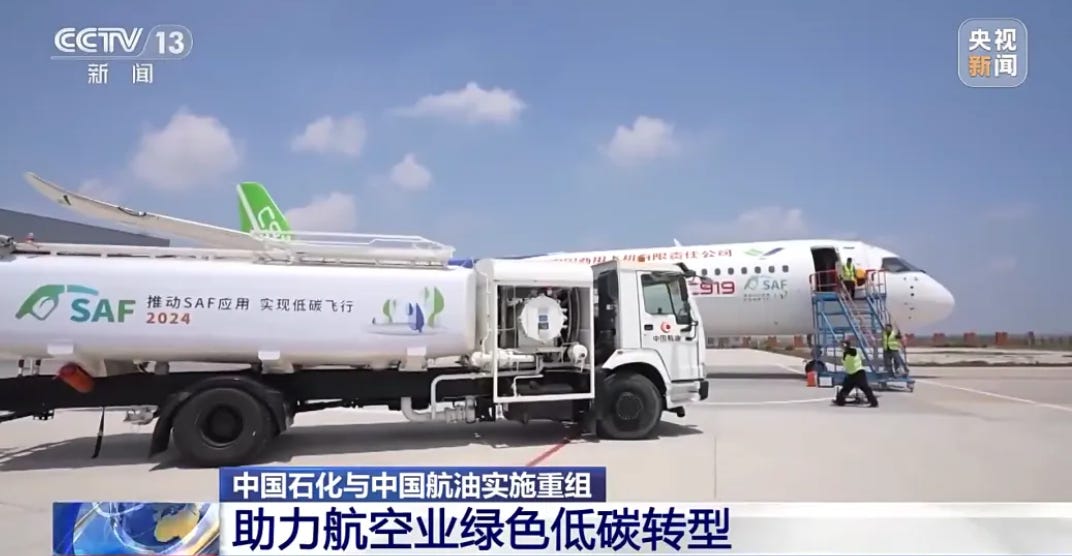
Officially described as a “strong alliance”, the restructuring comes as aviation emissions emerge as a central challenge in China’s broader decarbonization agenda. Sustainable aviation fuel is widely recognized as the most immediately deployable pathway to reduce aviation lifecycle emissions, with potential cuts of 60–80 per cent compared with conventional jet fuel, depending on feedstock and production routes. By integrating upstream SAF production capabilities with downstream aviation fuel distribution and refuelling infrastructure, China is effectively redesigning the SAF value chain under coordinated state oversight.
A state-backed consolidation
According to the SASAC announcement, Sinopec Group and China Aviation Oil will implement a corporate restructuring that places two previously independent central state-owned enterprises into closer organizational and strategic alignment. Sinopec traces its origins to the China Petrochemical Corporation founded in 1983, and was reorganized in 1998 as part of China’s oil and petrochemical sector reforms. Today, it operates as a vertically integrated energy and chemicals conglomerate, spanning refining, chemicals manufacturing, domestic and international trading, and logistics.
China Aviation Oil, established in 2002 and brought under direct SASAC supervision in 2003, occupies a uniquely strategic position in the aviation value chain. It is Asia’s largest provider of aviation fuel services, integrating procurement, transportation, storage, testing, marketing and aircraft refuelling across China’s civil aviation system and key overseas hubs. In practical terms, CNAF controls the “last mile” of aviation fuel delivery.
While the restructuring has yet to disclose changes in equity ownership or detailed governance arrangements, the policy signal is clear: the state intends to align SAF production, certification, logistics and end use within a single, coordinated industrial system.
SAF as a system, not just a molecule
Sinopec is currently China’s earliest and most established SAF producer. The company has developed industrial-scale SAF capacity using hydroprocessed esters and fatty acids (HEFA) pathways, converting waste cooking oil and other bio-based lipids into drop-in aviation fuel that meets ASTM D7566 standards. Crucially, Sinopec has completed flight tests and commercial applications of domestically produced SAF on Chinese-made aircraft, closing a long-standing gap between fuel availability and aircraft certification.
Typical HEFA SAF has a gravimetric energy density comparable to conventional Jet A-1, around 43 MJ/kg, allowing blending ratios of up to 50 per cent without engine modifications. Sinopec’s SAF has reportedly passed both international and domestic airworthiness validations, positioning it for scaled deployment once demand-side constraints are eased.
China Aviation Oil brings a complementary set of technical capabilities. Its nationwide network of fuel farms, hydrant systems and airport refuelling fleets is already optimized for stringent quality control, traceability and safety compliance. SAF introduces additional operational complexity, including feedstock variability, blending management, lifecycle carbon accounting and chain-of-custody certification. CNAF’s role in testing, storage and airport-level handling is therefore critical to avoiding bottlenecks that have constrained SAF roll-outs in other markets.
Following the restructuring, the two enterprises are expected to integrate research and development efforts on next-generation SAF pathways, including alcohol-to-jet (ATJ) and power-to-liquid (PtL) synthetic fuels, alongside existing HEFA routes. These technologies will be essential if China is to scale SAF production beyond the limits imposed by bio-waste feedstock availability.
Scale, policy alignment and cost dynamics
The commercial significance of the restructuring lies in scale and coordination. China is the world’s second-largest aviation market, with jet fuel demand approaching 40 million tonnes per year. Even a modest 2 per cent SAF blending mandate would translate into an annual demand of approximately 800,000 tonnes, several times current domestic production levels.
Globally, SAF remains costly. HEFA SAF typically trades at two to four times the price of conventional jet fuel, depending on feedstock availability and policy support. In Europe and the United States, demand has been driven by blending mandates, such as the EU’s ReFuelEU Aviation regulation, and fiscal incentives, most notably under the U.S. Inflation Reduction Act. China has yet to introduce a nationwide SAF mandate, but the restructuring points to a preparatory industrial strategy: build supply-side capability first, then stimulate demand through regulatory mechanisms.
Sinopec’s refining scale and feedstock procurement capabilities could help reduce unit costs through co-processing and economies of scale, while CNAF’s dominant position in aviation fuel supply reduces distribution friction. Together, the combined entity can internalize margins across the SAF value chain, from feedstock sourcing and conversion to blending, certification and final delivery, improving overall project economics.
International trade represents another strategic dimension. China Aviation Oil already operates overseas procurement and supply networks. Integrated SAF capabilities could allow China not only to meet domestic demand but also to participate more actively in emerging international SAF markets, particularly along Asia-Pacific routes where airlines face tightening emissions requirements from foreign jurisdictions.
Aviation decarbonization
Aviation is widely regarded as one of the most challenging sectors to decarbonize, given the lack of viable alternatives to high-energy-density liquid fuels. Electrification is limited to short-haul applications, while hydrogen-powered aviation remains decades away from large-scale commercial deployment. SAF therefore occupies a central role in near- to medium-term aviation decarbonization strategies.
By restructuring Sinopec and China Aviation Oil, China is effectively creating a national SAF champion with end-to-end capabilities. The approach mirrors earlier industrial strategies in solar photovoltaics, wind turbines and batteries, where vertical integration and scale helped drive down costs and accelerate deployment.
From a market perspective, the move could reshape competitive dynamics. Independent SAF producers may find it hard to compete without access to CNAF’s distribution infrastructure or Sinopec’s refining assets. At the same time, airlines may benefit from a more reliable and standardized SAF supply, even if pricing remains influenced by state policy rather than purely market forces.
The restructuring also strengthens China’s position in international aviation climate governance. As the International Civil Aviation Organization’s CORSIA scheme tightens over time, countries with domestic SAF supply chains will be better placed to manage compliance costs for their airlines.
A systems-level approach on SAF
The Sinopec–China Aviation Oil restructuring is less about corporate reshuffling than about systems engineering. SAF is not merely a fuel; it sits at the intersection of chemistry, logistics, certification, policy and economics. By aligning the country’s largest energy producer with its dominant aviation fuel service provider, China is seeking to address the SAF challenge at system scale.
If successful, the model could accelerate SAF adoption more rapidly than fragmented, market-led approaches seen elsewhere. For global climate tech and hydrogen-adjacent sectors, the signal is clear: in China, decarbonizing hard-to-abate industries will increasingly be pursued through state-led integration, with SAF well positioned as a strategic pillar of aviation’s low-carbon transition.