China’s domestically built 2.19-exaflop LineShine system has reclaimed global supercomputing leadership, combining a CPU-only architecture, AI-for-Science capabilities and ultra-large-scale interconnects to redefine exascale computing and high-performance computing (HPC) competition.
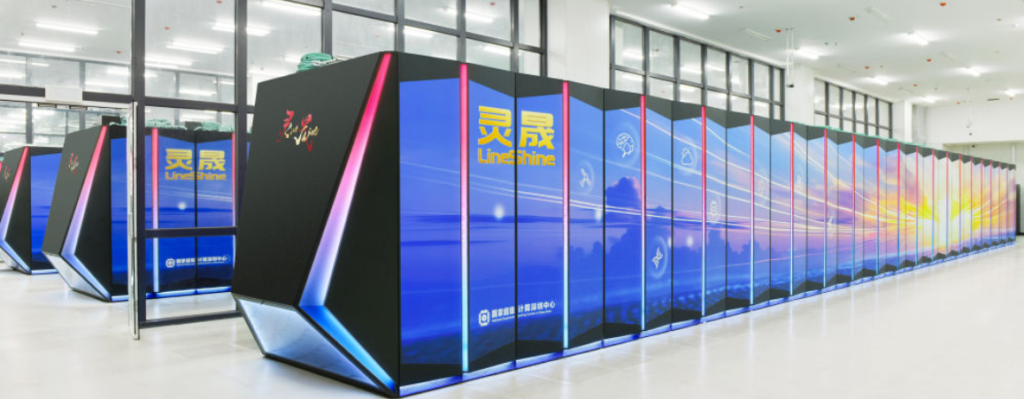
On June 23, China returned to the top of the global supercomputing rankings for the first time in nine years, with its domestically developed LineShine system delivering 2.19 exaflops of sustained double-precision performance in the latest TOP500 list released at the ISC2026 conference in Hamburg. The system outperformed the United States’ El Capitan supercomputer (1.809 exaflops) by more than 20%, marking both a symbolic and technological milestone in the global race for exascale computing.
The achievement re-establishes China at the forefront of high-performance computing, with implications extending beyond scientific research to AI model development, industrial simulation and the emerging field of AI for Science.
China regains global HPC leadership
The TOP500 ranking confirmed LineShine, deployed at the National Supercomputing Center in Shenzhen, as the world’s fastest supercomputer. It marks China’s return to the top of the TOP500 rankings for the first time since Sunway TaihuLight led the list in 2016.
LineShine surpassed El Capitan at Lawrence Livermore National Laboratory, which ranks second, followed by Frontier (1.353 exaflops) at Oak Ridge National Laboratory, Aurora (1.012 exaflops) at Argonne National Laboratory, and Germany’s JUPITER Booster (1.0 exaflop).
Beyond raw performance, LineShine represents a new architectural approach. Unlike most of today’s leading supercomputers, which rely heavily on GPU accelerators largely supplied by US companies such as Nvidia, LineShine achieves exascale performance through a fully CPU-based design integrated with high-bandwidth memory (HBM) and a domestically developed software stack.
Key technologies and system architecture
LineShine features a vertically integrated architecture spanning processors, networking, storage and software. At its core is the domestically developed LX2 CPU, which combines scientific computing and AI acceleration with China’s first on-chip high-bandwidth memory (HBM). The HBM boosts memory bandwidth by around 10 times over conventional CPUs, significantly improving performance for large-scale simulations and AI workloads.
The system is supported by the proprietary Lingqi interconnect, linking up to 100,000 compute nodes through 2 million ports, alongside exabyte-scale storage and a unified HPC-AI software platform. Fully liquid-cooled cabinets deliver 51 GFLOPS/W, making LineShine one of the world’s most energy-efficient exascale supercomputers.
From scientific computing to industrial AI
Supercomputers are increasingly becoming strategic industrial infrastructure rather than purely scientific research tools.
LineShine already supports applications including climate and weather modelling, Earth system simulation, engineering optimization, materials discovery, drug development, brain science, and large-scale AI training and inference. The system achieves 84.4% parallel scalability across more than 10 million computing cores, enabling efficient execution of extremely large and complex workloads.
Its architecture reflects the growing convergence of high-performance computing, artificial intelligence and industrial simulation, allowing a single platform to support scientific discovery, engineering design and commercial AI applications.
Strategic design: CPU-only architecture
Perhaps LineShine’s most distinctive feature is its CPU-only architecture, diverging from the GPU-centric designs adopted by most of today’s leading supercomputers.
By eliminating CPU-GPU data transfers and simplifying software development, the design reduces communication overhead, avoids dependence on external GPU supply chains, and provides a larger unified memory space by combining HBM with high-capacity DDR memory. The result is a system particularly well suited to AI for Science, where large-scale simulation, data analysis and machine learning increasingly operate as integrated workflows rather than separate computing tasks.
Historical context: from TaihuLight to LineShine
China’s latest achievement builds on more than a decade of sustained investment in indigenous supercomputing technologies.
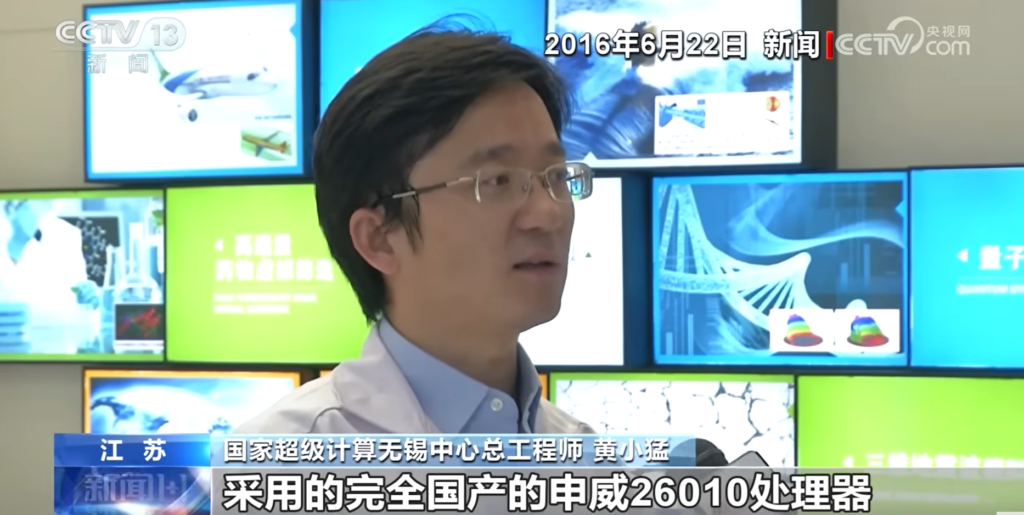
Launched in 2016 at the National Supercomputing Center in Wuxi, Sunway TaihuLight became the world’s fastest supercomputer with a peak performance of 125 petaflops. Powered by the domestically developed SW26010 processor, it was the first Chinese system to top the TOP500 rankings using entirely homegrown processors and remained world No. 1 for four consecutive editions between 2016 and 2018.
LineShine represents the next stage of that technological evolution, moving from petascale leadership to AI-integrated exascale computing built entirely on China’s domestic technology stack.
Global AI and compute implications
LineShine reflects a broader shift in supercomputing—from accelerator-driven performance gains to system-level optimization across processors, memory, networking, software and energy efficiency.
Three implications stand out. First, it demonstrates a credible alternative to GPU-centric exascale architectures. Second, it accelerates the convergence of scientific computing and artificial intelligence, enabling a unified platform for simulation and AI. Third, it reinforces supercomputing as a strategic national infrastructure underpinning scientific research, industrial innovation and future AI competitiveness.
This evolution suggests that leadership in exascale computing may increasingly depend not on peak FLOPS alone, but on how effectively systems integrate processors, memory, networking, AI workloads and energy efficiency at scale.
As 2021 Turing Award laureate Jack Dongarra observed, LineShine demonstrates the promise of a new generation of AI-for-Science system architectures. He is widely recognized for pioneering foundational supercomputing software such as LINPACK and BLAS, tools that underpin modern performance benchmarking in high-performance computing.