At the start of 2026, China’s northwestern provinces have unveiled a coordinated wave of industrial and energy initiatives aimed at anchoring high-quality growth, underscoring the country’s broader strategy to advance its economy through clean energy, advanced manufacturing and deeper regional integration.
From Gansu’s CNY 1.2 trillion industrial upgrading program to Inner Mongolia’s push toward more than 200GW of installed renewable capacity, the region is increasingly emerging as both a policy test bed and a scale engine for China’s next phase of low-carbon development.
The initiatives, announced by provincial governments in the first week of the year, combine large-scale capital deployment, accelerated build-out of renewable energy infrastructure, and deeper integration of digital, green and intelligent technologies across traditional industries. Taken together, they signal a structural shift away from resource-intensive growth toward a more sophisticated industrial and energy system—one with growing implications for global cleantech supply chains, particularly in hydrogen, energy storage and power grid infrastructure.
A coordinated policy and investment push
Northwestern China’s new-year agenda reflects a clear and shared policy logic: leveraging abundant local resource endowments: solar and wind resources, land availability, and established heavy-industrial bases, to serve national strategic objectives such as carbon neutrality, energy security and industrial modernization.
Gansu province announced plans to allocate CNY 1.2 trillion (approximately $165bn) in 2026 to support 310 priority projects focused on the “intelligent, green and integrated” transformation of traditional industries. The projects span metallurgy, chemicals, equipment manufacturing and advanced materials, with a strong emphasis on industrial digitalization, energy-efficiency upgrades, electrification of production processes and low-carbon pathways. The program is designed not only to reduce emissions and energy intensity, but also to improve productivity, cost competitiveness and resilience across traditional sectors.
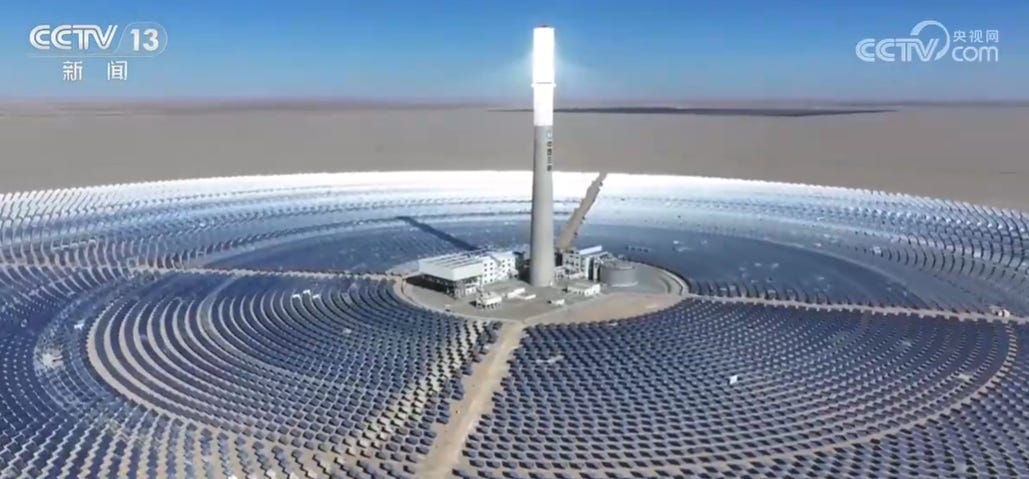
Qinghai province, already a major hub for solar and hydropower, has sharpened its focus on next-generation energy systems. It pledged to accelerate construction of large-scale “Shagehuang” (desert, Gobi and arid land) renewable energy export bases, integrated water–wind–solar power projects, and a diversified energy-storage ecosystem. The province also reiterated its ambition to become a “global solar thermal centre” and to cultivate a trillion-CNY new-energy industrial cluster, building on its early leadership in concentrated solar power (CSP) and long-duration thermal storage technologies.
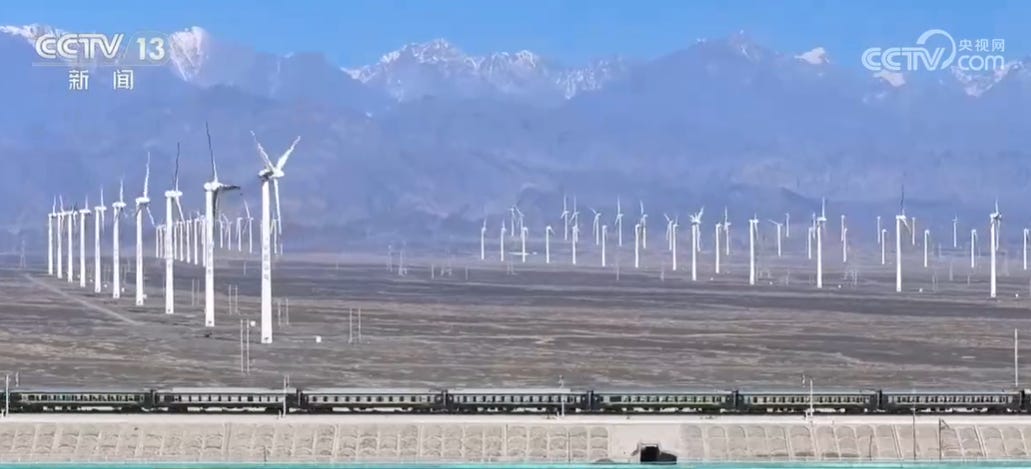
Xinjiang, China’s largest region by land area and one of its richest in wind and solar resources, prioritized the development of a “new-type power system with new energy as the mainstay”. Key measures include faster deployment of large wind and solar bases, expansion of ultra-high-voltage (UHV) transmission corridors under the “Xinjiang power transmission” programme, and efforts to extend, strengthen and integrate upstream and downstream renewable manufacturing value chains.
Inner Mongolia, meanwhile, moved early with concrete and quantifiable targets. Six Shagehuang renewable bases and their associated transmission channels are being fast-tracked, with a commitment to add 30GW of new grid-connected renewable capacity in 2026 alone. Total installed renewable capacity is expected to exceed 200GW, placing the region among the world’s largest renewable power hubs. The province has also announced pilot programmes for national-level zero-carbon industrial parks and green power substitution for data centres and other large existing electricity loads.
Renewables at scale, systems thinking
At the technical level, the northwestern push is defined by scale, system integration and technological diversification.
Utility-scale renewables. The Shagehuang bases under development in Qinghai, Xinjiang and Inner Mongolia typically involve multi-gigawatt wind and solar installations located in resource-rich but sparsely populated areas. Individual bases can exceed 10GW in capacity, placing them among the largest renewable projects globally and well above benchmarks such as India’s 2.25GW Bhadla Solar Park or the US’s planned 3.5GW SunZia wind project.
Grid and transmission. Expansion of UHV alternating-current (AC) and direct-current (DC) transmission is a critical enabler. Operating at voltages of 800kV to 1,100kV, these lines can transmit electricity over distances of 2,000–3,000km with losses typically below 5–7%, significantly lower than conventional high-voltage systems. Xinjiang and Inner Mongolia are core sending regions in China’s west-to-east power transfer strategy, supplying clean electricity to major load centres in central and eastern China.
Energy storage. Qinghai’s emphasis on “diversified storage” reflects a strategic shift beyond short-duration lithium-ion batteries toward a broader portfolio that includes pumped hydro, compressed-air energy storage (CAES), molten-salt thermal storage and other long-duration solutions. In particular, CSP projects with 8–12 hours of molten-salt storage can achieve capacity factors above 40%, providing dispatchable renewable power that supports grid stability and peak demand.
Digital and intelligent retrofits. Gansu’s industrial upgrading programme focuses on industrial internet platforms, AI-enabled process optimization, electrification of industrial heat, and on-site integration of renewable generation and storage. These measures are designed to reduce energy intensity and emissions while improving operational flexibility, output quality and cost efficiency.
Green power substitution for loads. Inner Mongolia’s plan to substitute fossil-based electricity with renewable power for data centres and industrial parks addresses one of the fastest-growing sources of electricity demand. A single hyperscale data centre can consume 100–300MW of power; pairing such loads with local wind and solar generation improves regional load balancing, reduces curtailment risk and strengthens project economics.
Scale, cost and emerging markets
The commercial significance of these initiatives lies primarily in their scale and cost dynamics.
China’s northwestern regions already account for more than 40% of the country’s installed wind and solar capacity. Adding 30GW of renewables in Inner Mongolia alone in a single year would exceed the annual renewable additions of many G20 economies. At current benchmark costs, onshore wind at CNY 2,500–3,000 per kW and utility-scale solar at CNY 2,000–2,500 per kW, the implied annual investment runs into the hundreds of billions of CNY.
Cost competitiveness is reinforced by superior resource conditions. Wind projects in Inner Mongolia and Xinjiang can achieve 3,000–3,500 full-load hours per year, compared with 2,000–2,500 hours in many coastal regions. This translates into levelised costs of electricity often below CNY 0.25 per kWh, making renewables the lowest-cost source of new power generation in the region.
For industrial customers, access to low-cost green electricity supports decarbonization targets and enhances export competitiveness amid tightening carbon-related trade measures, including the EU’s Carbon Border Adjustment Mechanism (CBAM). Zero-carbon industrial parks and green data centres also create stable anchor demand, improving the bankability of large renewable and storage projects.
The build-out further stimulates upstream and downstream markets for turbines, photovoltaic modules, inverters, energy-storage systems, power electronics, grid equipment and digital energy-management solutions. Xinjiang’s focus on extending and strengthening the renewable value chain also points to emerging opportunities in green hydrogen production using low-cost or curtailed renewable power, as well as broader power-to-X applications.
From regional engines to global relevance
Strategically, the 2026 initiatives mark a maturation of China’s northwestern development model. Rather than serving primarily as an exporter of raw energy to eastern provinces, the region is increasingly embedding clean power within integrated industrial ecosystems that combine generation, transmission, manufacturing and end-use demand.
For China’s national energy transition, the northwestern build-out is central to the goal of achieving carbon neutrality by 2060. Large-scale renewable bases, paired with energy storage and UHV transmission, are essential to reducing coal dependence while maintaining grid reliability and system flexibility.
For emerging sectors such as green hydrogen, the implications are substantial. Low-cost, high-load-factor renewable power in regions such as Inner Mongolia and Xinjiang provides favourable conditions for large-scale electrolysis. Although hydrogen was not explicitly highlighted in the latest policy announcements, diversified storage systems and zero-carbon industrial parks form a natural foundation for hydrogen-based steelmaking, chemicals and synthetic fuels.
Internationally, the scale and speed of deployment further reinforce China’s role as a global price-setter in cleantech. As domestic demand absorbs large volumes of equipment, manufacturers can continue to drive down costs through scale and learning effects—benefiting global decarbonization efforts while intensifying competitive pressure on non-Chinese suppliers.
Finally, the emphasis on cross-regional coordination, through west-to-east power transmission, shared industrial chains and integrated energy markets, signals a more networked approach to industrial policy. By aligning energy supply, manufacturing capacity and digital infrastructure across provincial boundaries, northwestern China is positioning itself not only as an energy hinterland but as a core pillar of the country’s next growth cycle.
In 2026, the northwest is increasingly setting the pace of China’s renewable energy transition. While its primary impact remains domestic, the scale, speed and system-level integration emerging from the region are beginning to influence global benchmarks for renewable deployment, grid integration and clean-energy cost reduction.