In early January, a high-precision fuel cell catalyst coating system developed and manufactured by LEAD Hydrogen Intelligent (LHI), the hydrogen, fuel cell, and perovskite unit of Wuxi LEAD, successfully passed stringent acceptance testing in Germany. This represents the first export of Chinese-developed membrane electrode assembly (MEA) manufacturing equipment being exported to Germany and certified under German industrial standards.
Delivered to a leading global technology group, the project signals a material step-change in China’s participation in Europe’s high-end hydrogen equipment value chain. The acceptance process, conducted fully in line with German industrial standards and overseen jointly by the customer and independent German certification experts, places LHI among a small group of global suppliers capable of meeting Germany’s most demanding requirements for fuel cell core process manufacturing.
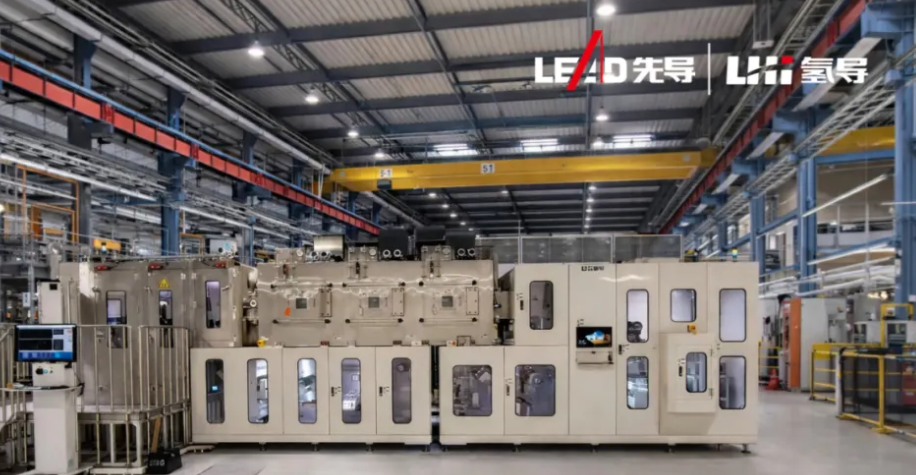
A milestone delivery under German standards
The equipment is a catalyst-coated membrane (CCM) coating machine, widely regarded as the “heart” of proton exchange membrane (PEM) fuel cell production. Acceptance testing covered a comprehensive range of criteria, including coating precision, mechanical installation tolerances, environmental control, operational stability, and long-duration continuous operation. Inspections extended to component-level details, down to individual fastener compatibility, reflecting the depth of scrutiny typical of Germany’s top-tier industrial processes.
For LHI, the successful acceptance represents more than a single project win. It demonstrates that Chinese hydrogen equipment suppliers can now compete at the highest level required by advanced European fuel cell manufacturers—not only on cost, but on precision engineering, process reliability, and lifecycle service capability.
Four innovations addressing core manufacturing bottlenecks
Customer recognition of the system’s performance is underpinned by four core technical innovations—each targeting key challenges in fuel cell manufacturing: quality consistency, precious metal utilization, production flexibility, and energy efficiency.
I. Extreme environmental control
Within LHI’s coating and drying chambers, oxygen concentration is maintained below 0.05% on a sustained basis. This ultra-low-oxygen environment prevents catalyst oxidation during coating and drying, a critical condition for achieving uniform electrochemical performance and long-term CCM durability.
Many conventional coating systems operate at higher residual oxygen levels, increasing the risk of micro-defects and performance variability. In fuel cell stacks, where minor inconsistencies can result in system-level inefficiencies, this degree of environmental control translates directly into higher yields, reduced performance variance, and longer operating life.
II. Slurry-saving design cuts PGM waste by 40%
Platinum group metals (PGMs) remain among the most significant cost drivers in PEM fuel cells. LHI’s system optimizes slurry pipeline design and integrates an advanced recovery architecture, reducing residual catalyst slurry waste by approximately 40%.
At current platinum prices, such reductions can materially lower the cost per kilowatt of fuel cell stacks, particularly at scale. For manufacturers operating under tight margins and policy-driven cost targets, this feature delivers both economic and sustainability benefits.
III. Flexible production architecture for multi-spec output
The CCM coating machine integrates multiple coating modules with rapid changeover and intelligent switching capabilities. It supports a wide range of product widths and enables minute-level switching between anode and cathode catalyst slurries.
This flexibility is increasingly important as fuel cell manufacturers serve a broader range of applications—from heavy-duty mobility to stationary power—each with distinct CCM specifications. Compared with traditional, rigid equipment, flexible architectures reduce downtime, improve asset utilization, and support lean, demand-responsive manufacturing strategies.
IV. Energy-efficient inert-gas drying
Drying is one of the most energy-intensive stages of CCM production. LHI employs an inert gas–protected drying process combined with near-field waste heat recovery, achieving zero oxidation during drying while reducing energy consumption by more than 50%.
In Europe, where industrial electricity and gas prices remain structurally high, energy efficiency is a competitive necessity rather than a secondary consideration. Lower energy intensity improves operating economics and supports compliance with increasingly stringent carbon and energy-efficiency regulations.
Cost, compliance, and scale
From a commercial perspective, CCM manufacturing equipment sits at the intersection of three defining trends in the hydrogen economy.
First, cost pressures are accelerating. Global benchmarks suggest that PEM fuel cell system costs must fall below USD 500/kW—and potentially toward USD 300/kW—to enable mass adoption across transport and distributed power. Equipment that reduces platinum usage, energy consumption, and scrap rates is central to achieving these targets.
Second, regulatory and standards compliance is becoming decisive. Germany and the EU impose some of the world’s most rigorous requirements for industrial safety, process stability, and documentation. LHI’s experience with TÜV, CE, and IEC certification frameworks lowers barriers for customers seeking bankable, policy-aligned manufacturing capacity.
Third, scalable flexibility is emerging as a competitive differentiator. As hydrogen demand grows unevenly across sectors and regions, manufacturers increasingly value equipment that can adapt without costly retrofits, enhancing return on capital employed.
China in Europe’s hydrogen value chain
Strategically, the acceptance of LHI’s CCM equipment underscores a broader shift in the global advanced manufacturing landscape, signaling China’s strengthening role in high-end fuel cell equipment.
Historically, Europe and Japan have dominated high-end fuel cell manufacturing tools, while Chinese companies focused on downstream assembly or cost-competitive components. LHI’s delivery indicates that Chinese suppliers are moving upstream into core process equipment—the segment with the highest barriers to entry due to its precision, reliability, and intellectual property intensity.
For European customers, diversified sourcing of critical equipment enhances supply-chain resilience as hydrogen capacity expansion accelerates under initiatives such as the EU Hydrogen Strategy and Germany’s National Hydrogen Strategy.
For LHI, the delivery strengthens its position as a full-chain hydrogen manufacturing equipment provider, spanning PEM electrolyzer production lines, fuel cell core process tools, and testing platforms. With service networks covering Europe, Australia, North America, and other major hydrogen markets, the company is positioning itself as a long-term industrial partner rather than a transactional supplier.
As the hydrogen sector transitions from pilot projects to industrial scale, the ability to combine engineering precision, cost efficiency, and international compliance will define competitive leadership. LHI’s German qualification positions it to participate significantly in the next phase of Europe’s hydrogen scale-up.