The convergence of physical AI, flexible electrolysis and international certification could reshape how renewable assets manage intermittency, costs and cross-border green-molecule trade.
On September 9, Envision’s Tianji physical-AI weather foundation model took top honours in both international and domestic evaluations at the 2026 Inclusion-Bund Conference’s Energy Storage AI Innovation Forum in Shanghai, which focused on the intersection of “Weather AI × Energy Storage × Power Grid.”
Two weeks later, its EnGen-LPALK ambient-pressure alkaline electrolyser received the world’s first ISO 22734-1:2025 product certification for an alkaline electrolyser from Bureau Veritas. Released in July 2025, the updated standard introduced new criteria, including mandatory risk management for hydrogen-oxygen gas crossovers and cybersecurity compliance for remotely controlled electrolysers.
Taken together, the milestones illustrate a broader strategy: integrating AI, renewable-power infrastructure and hydrogen equipment to manage intermittency, improve asset economics and convert renewable electricity into exportable molecules. The commercial significance lies in their interaction: better weather forecasts can improve renewable-power scheduling and storage revenues, while flexible electrolysis can absorb volatile electricity and reduce balancing requirements.
From weather forecasting to physical AI
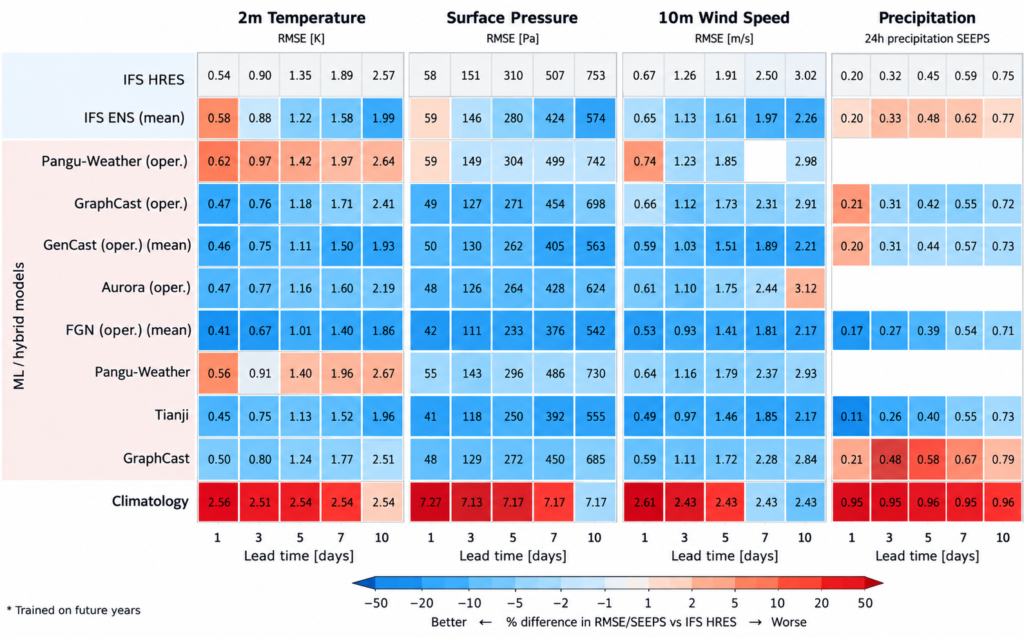
In the international WeatherBench 2 evaluation, Envision Tianji ranked first overall, outperforming comparable models from major technology companies, including Google, Microsoft, and Huawei.
Envision Tianji and Google’s WeatherNext 2 were the only two models ranked in the top tier. Compared with WeatherNext 2, Tianji performed particularly well on wind-speed and precipitation metrics relevant to renewable-energy applications, as shown in the chart below. In the chart, WeatherNext 2 is indicated as FGN, while GraphCast and GenCast are Google DeepMind’s legacy predecessors to the WeatherNext 2 family.
Designed to forecast weather globally at a five-kilometre spatial and 10-minute temporal resolution for up to 45 days, Tianji draws on global meteorological data, satellite remote sensing and first-hand measurements from renewable-energy plants, industrial parks and factories.
This reflects a shift from forecasting weather as an end in itself to using atmospheric intelligence to manage physical assets. An energy-oriented physical-AI model must translate changes in temperature, humidity, rainfall and wind into operational implications for turbines, batteries, power markets and industrial processes.
The distinction is increasingly important as renewable generation becomes more variable. Wind and solar projects face short-term fluctuations that affect dispatch, maintenance, grid commitments and equipment safety. Envision says Tianji has been applied to typhoon management at wind farms, forecasting a storm’s trajectory and impact window up to 72 hours in advance.
During such events, minute-level wind forecasts can inform turbine shutdown and restart decisions, while post-storm analysis can prioritise inspections and accelerate recovery assessments. The commercial proposition is therefore not simply better forecasting, but turning forecast accuracy into decisions that affect asset availability, safety and revenue.
Turning forecasts into storage value
The same principle extends to battery storage. Envision says its AI storage system combines weather, power-output and electricity-price forecasts to optimise trading and dispatch. At projects in Inner Mongolia, the company reports that its transaction-forecasting accuracy ranked first for several consecutive months.
Across benchmark projects in Shandong, Inner Mongolia and Jiangsu, Envision says the system increased overall project revenue by 20 per cent and improved lifetime internal rates of return by eight percentage points.
These figures are company-reported, but they illustrate a broader feature of renewable-power economics: a battery creates value not simply by storing electricity, but by deciding when to charge, when to discharge, and which market opportunities to pursue. As renewable penetration rises, forecasting errors can lead to inefficient dispatch, missed trading opportunities and unnecessary curtailment, while greater accuracy can enable more selective deployment of storage capacity.
Electrolysers designed for intermittent power
On September 21, Envision’s EnGen-LPALK ambient-pressure alkaline electrolyser received ISO 22734-1:2025 certification from Bureau Veritas. Envision describes it as the world’s first alkaline electrolyser certified under the updated standard, which supersedes ISO 22734:2019.
Globally, UTIS (Portugal) is the only publicly confirmed company to have received ISO 22734-1:2025 certification for its PEM electrolyser. PEM electrolysis generally offers safety advantages over alkaline electrolysis due to its lower gas crossover risk.
Before certification, Bureau Veritas witnessed and audited 15 full type tests on the EnGen-LPALK-1000 at Envision’s Chifeng Zero Carbon Industrial Park. The tests covered electrical safety, leakage, pressure, functionality and performance.
The technical proposition centres on three characteristics: low operating pressure, high current efficiency and flexible operation. According to Envision, the electrolyser operates at about 0.3 bar, compared with a reported mainstream operating range in China of about 16–38 bar. During testing, under various operating conditions, the maximum concentration of oxygen in hydrogen was 0.14 per cent, while the concentration of hydrogen in oxygen was 0.29 per cent, according to the company—well below the relevant standard limits and flammability thresholds.
In addition, its insulated, transparent external flow-channel design is intended to reduce stray-current losses. Envision reports current efficiency above 98 per cent, compared with roughly 90 per cent for conventional internal-flow designs, where it estimates that about 10 per cent of current can be lost through alkaline-solution bypass.
At industrial scale, an eight-percentage-point efficiency difference can be commercially significant because electricity is typically the dominant variable cost in hydrogen production. Even incremental gains can therefore affect the levelised cost of hydrogen across large systems and long operating periods.
Flexibility matters as much as efficiency
The potentially more consequential feature, however, may be the electrolyser’s ability to operate flexibly alongside variable renewable generation. At Chifeng, Envision says Tianji forecasts changes in wind and solar availability, while its TianShu energy model optimises production schedules. EnOS, the company’s industrial operating system, then controls electrolyser starts, stops and load changes.
The objective is to allow the electrolyser to shut down safely when renewable power stops and restart when generation returns. This can reduce the need for battery energy-storage systems to maintain a minimum electrolyser load. In practical terms, the value of flexibility lies in reducing the additional infrastructure required to accommodate intermittent power.
The resulting economics are therefore system-level rather than component-level. Instead of independently optimising renewable generation, batteries, electrolysis and ammonia synthesis, the control architecture coordinates them around the same power and production constraints. A flexible electrolyser may consequently reduce total system costs even if its equipment price is not the lowest in the market. More broadly, the model positions AI as part of the industrial control architecture rather than as a separate analytics layer.
Certification strengthens the export equation
International certification adds another commercial dimension. For hydrogen-equipment manufacturers seeking overseas customers, technical performance is only one element of procurement. Safety standards, traceability and independent verification can influence acceptance by project developers, financiers and industrial buyers.
Envision says its green ammonia products have also obtained ISCC PLUS and EU RFNBO certifications. These two forms of product-level certification help demonstrate the sustainability characteristics required by downstream markets. That distinction is increasingly important as Europe and Asia develop regulatory frameworks for renewable hydrogen and its derivatives. Certification can affect both market access and buyers’ ability to document the environmental attributes of imported molecules.
From equipment to an integrated energy platform
Envision’s Chifeng operations provide a commercial test bed for the strategy. The company is developing a 1.52 million-tonne green-hydrogen-and-ammonia project there, with its first 320,000-tonne phase completed in July 2025.
In early 2026, green ammonia produced at the project was shipped to South Korea’s Lotte Fine Chemical. Envision describes the voyage, which departed from Lianyungang in Jiangsu province, as the first commercial-scale green-ammonia export from China. The project illustrates why integrating forecasting, power management and industrial equipment matters: converting renewable electricity into ammonia creates a transportable energy carrier for markets that cannot directly import the underlying electrons.
The model also changes the basis of competition. For developers, the relevant economic metric increasingly extends beyond the capital cost or efficiency of an individual electrolyser to the delivered cost of the complete value chain—renewable electricity, storage, electrolysis, synthesis, certification, logistics and the final molecule.
This creates a potential advantage for integrated operators with access to real-world operating data. At Chifeng, Envision says full-scale equipment is being tested under actual wind and solar conditions, generating operating data that can feed back into product development and system optimisation. The feedback loop between equipment, software and operating assets becomes part of the industrial capability itself.
The emerging competitive metric
The September milestones point to a broader shift in renewable-energy competition: from optimising individual assets to optimising the system around them.
Weather AI can reduce uncertainty in renewable generation. Storage software can translate improved forecasts into trading and dispatch decisions. Flexible electrolysers can absorb renewable electricity without requiring batteries to compensate for minimum-load constraints. International certification can help convert technical performance into commercially acceptable equipment and products.
None of these capabilities, by itself, guarantees project competitiveness. Economics remain sensitive to electricity prices, equipment utilisation, financing costs, infrastructure, regulation and customer demand for certified low-carbon products.
But the boundaries between forecasting, power management and industrial manufacturing are becoming increasingly blurred. As renewable electricity becomes a larger industrial input, competitive advantage may depend less on individual-machine performance than on the ability to coordinate the entire energy-to-molecule value chain—reducing uncertainty, balancing assets and ultimately lowering the cost of delivering reliable low-carbon products to global markets.