On July 8, Envision Energy commissioned the first phase (500 MW) of its 2.5 GW green hydrogen and ammonia project in Chifeng, Inner Mongolia. Phase I, with 1.43 GW of wind and solar capacity and 680 MWh of storage, is expected to produce 320,000 tonnes of green ammonia annually. When all three phases are completed, with a total investment of CNY 40 billion, the annual green ammonia output is projected to reach 1.52 million tonnes.
This is the world’s first commercial-scale hydrogen-ammonia facility operating entirely off-grid on renewable energy, with real-time balancing enabled by AI. The facility has been ISCC certified by Bureau Veritas, which issued the world’s first on-site renewable ammonia certificate, confirming compliance with international green energy and sustainability standards.
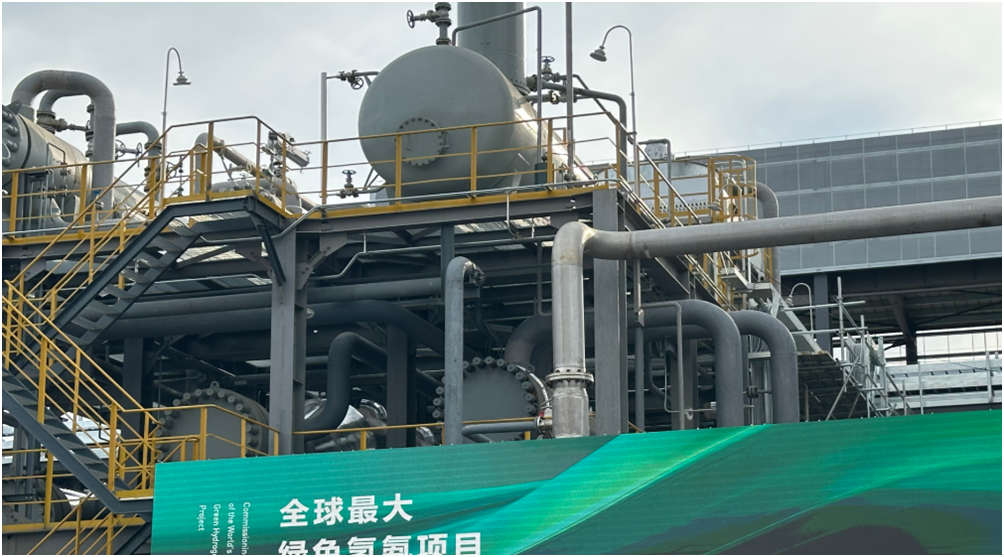
Key Technologies and Specifications
Hydrogen-Ammonia Gas Turbines
Phase I includes twelve 8 MW hydrogen-ammonia gas turbines, each generating up to 64 million kWh annually. These turbines operate flexibly on green hydrogen and ammonia (stored at −33°C under low pressure), ensuring stable electricity output and demonstrating the link between renewable fuels and power generation.
Full Green Power–Hydrogen–Ammonia Chain
The facility integrates 1 GW of wind, 0.43 GW of solar, and 680 MWh of storage to produce hydrogen via electrolysis, with nitrogen captured from air for ammonia synthesis. Dynamic ammonia production converts intermittent renewable energy into a high-value, easily stored, and transportable commodity.
AI-Driven Operations and Smart Grid Integration
Envision’s EnOS™ IoT-based system uses AI forecasting and source-load coordination to balance supply and demand in real time. Output automatically ramps up with increased wind generation and decreases when wind supply falls, minimizing reliance on external grid support or large-scale storage.
Water Reuse and Zero-Carbon Management
A closed-loop water recycling system treats wastewater into pure water for electrolysis, enabling 100% greywater reuse and ensuring zero-carbon, zero-wastewater discharge.
Commercial Relevance
The Chifeng project is among the largest and most cost-efficient green ammonia facilities globally, offering long-duration energy storage and substantial economic benefits. To put its scale and competitiveness into perspective, the table below compares it with the NEOM project in Saudi Arabia.
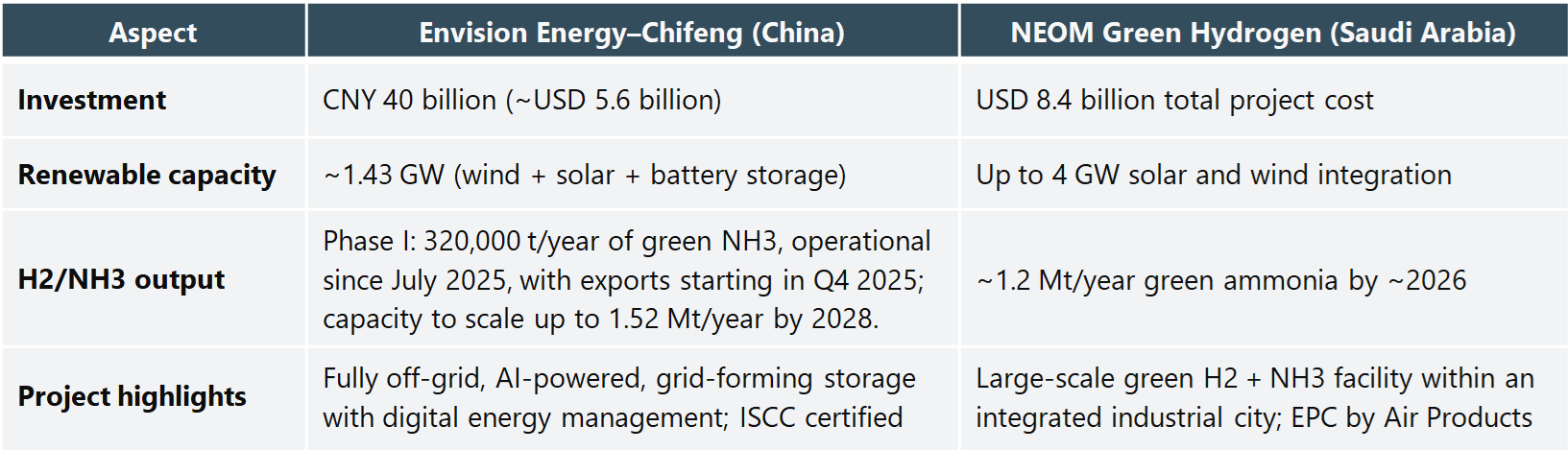
In addition to its technical and cost advantages, the project has established strong commercial foundations. Output from the project has been secured under long-term supply agreements with international buyers, including Japan’s Marubeni Corporation, for shipping fuel, hydrogen derivatives, fertilizers, and chemicals. The project has also signed cooperation agreements with clients from Japan, Singapore, the UAE, and France.
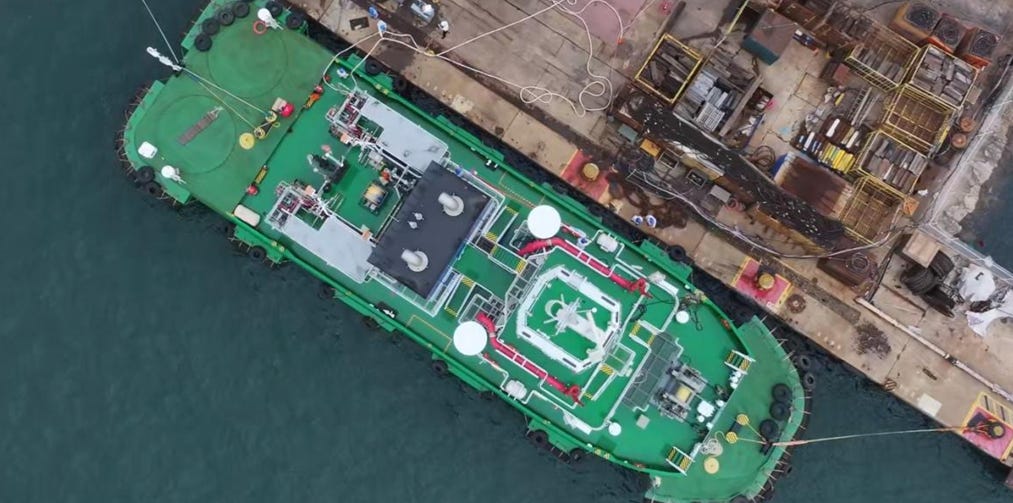
On July 25, the world’s first green ammonia fueling of a 5,500 HP port tug was completed at COSCO Shipping Heavy Industries in Dalian, using ammonia from Envision’s Chifeng plant. The tug, co-developed with Dalian University of Technology, features two full-pressure ammonia tanks powering the main engine. It is classed by the China Classification Society and certified with the “Ammonia Fuel Tug” symbol.
This milestone marks the world’s first end-to-end value chain, from renewable electricity through ammonia production, transport, fueling, and maritime use, establishing a breakthrough for green shipping. Dalian Port’s green fuel system can now supply both domestic and international vessels with clean fuel alternatives.
Looking ahead, the Chifeng project is well-positioned to meet upcoming regulatory requirements. Under the IMO 2027 Carbon Intensity Indicator (CII) framework, ships of 5,000 GT and above will be required to meet stricter annual carbon intensity reduction targets, with full implementation starting in 2028. By supplying zero-carbon ammonia for maritime use, the project contributes directly to reducing CO₂ emissions per cargo-carrying capacity and nautical mile, supporting operators in achieving compliance with the IMO’s decarbonization roadmap.
Geographic Advantage and Integrated Ecosystem
Located in wind- and solar-rich Inner Mongolia, Chifeng, a prefecture-level city covering ~90,000 km², has installed over 10 GW of renewable energy capacity, with renewables accounting for 64.2% of its total power generation. The city benefits from up to 4,000 equivalent full-load hours for wind and 2,000 for solar, and has 53 GW of additional capacity available for development (compared with ~40 GW in Nova Scotia, Canada, and ~80–100 GW in Scotland, UK), as shown in the table below.

Chifeng has developed a complete hydrogen, ammonia, and methanol ecosystem. Upstream projects produce 8,000–23,000 tonnes of hydrogen annually. Midstream infrastructure includes high-pressure and low-temperature storage, pipelines, and distribution networks. Downstream applications span hydrogen-powered locomotives, distributed turbines, and maritime fuels, creating a fully integrated industrial chain. In addition, its proximity to Jinzhou Port (250 km) enables cost-effective export of green ammonia via Bohai Bay to both domestic and international markets.
Chifeng’s hydrogen-ammonia-methanol matrix has attracted over CNY 100 billion in investment, spanning upstream production, midstream infrastructure, and downstream applications, solidifying its role as a national green energy hub.
Strategic and Market Implications
The Chifeng project is the first fully dynamic green ammonia facility globally, operating with 100% renewable power and AI-driven coordination of production with generation. It demonstrates a complete industrial chain—from renewables to hydrogen, ammonia synthesis, storage, and transport—offering a fossil-free model replicable in renewable-rich regions worldwide.
Envision’s Chifeng project achieves full-chain “source-load interaction” and zero-carbon production through AI-enabled operations, creating a sustainable and cost-effective industrial model. The launch of Phase I, alongside the first ammonia-powered tug fueling, provides momentum for global green energy trade, accelerates renewable deployment, and sets a blueprint for industrial decarbonization.
By combining turbine innovation and AI-based management, the project transforms renewable energy volatility into a stable, high-value commodity. Envision’s Chifeng project not only advances China’s clean energy ambitions but also offers a practical model for the world’s transition toward a zero-carbon future.