Envision’s Ulanqab AI hub integrates renewable power, storage and physical AI in the Gobi Desert, positioning the energy technology group at the intersection of computing infrastructure and China’s AI expansion.
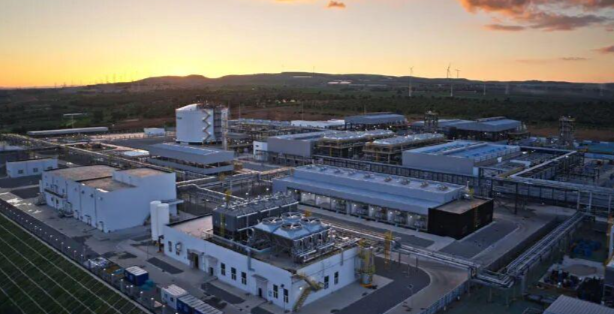
On August 6, Envision Energy announced that the first phase of its “Galaxy Campus” in Ulanqab, Inner Mongolia, had entered operation. At its centre is what the company describes as the world’s largest single AI-computing facility, with more than 120,000 square metres of floor space and a planned capacity to support up to one million GPUs simultaneously.
Envision is turning the Gobi Desert into a test bed for a new category of infrastructure: AI computing centres designed around their energy systems rather than simply connected to the grid. It is extending its expertise in renewable energy, energy management, and industrial software into one of the fastest-growing and most electricity-intensive segments of the digital economy.
Renewable energy enters AI infrastructure
Envision’s proposition rests on a straightforward premise: as AI computing scales, electricity could become as consequential a constraint as computing hardware.
The Ulanqab campus has a planned capacity of 2 GW, positioning it among China’s largest planned AI-computing parks. Rather than placing such a large electricity load entirely on existing grid infrastructure, Envision is developing the project in a region rich in wind and solar resources, with renewable generation more closely integrated with computing demand.
The strategy builds on Envision’s established capabilities in wind power, renewable energy systems and digital energy management. Its AI initiative brings those capabilities into direct contact with the rapidly expanding demand for data centre capacity.
In June, Envision announced its “Mission Gobi” initiative, targeting 5 GW of green AI data-centre capacity across Gobi and desert regions globally by 2030. Ulanqab is the program’s first flagship project.
The ambition is therefore broader than a single data centre. Envision is seeking to establish a repeatable infrastructure model in which renewable generation, grid infrastructure, storage, energy management and AI computing are planned and operated as an integrated system.
Engineering the power layer for AI
The technical challenge is unusually demanding. AI training loads are highly concentrated and can fluctuate rapidly. GPU clusters may move from less than one-third utilization to full load within milliseconds, placing stringent demands on voltage and frequency stability and on the power system’s transient response.
Reliability is equally important. Training a very large model can require continuous operation for two or three months. For these workloads, an interruption is an economic event, potentially disrupting computation and creating substantial costs associated with lost time or restarting workloads.
Envision’s response is an “AI power system” designed to coordinate the energy chain—from generation and grids to storage and electricity consumption.
At the software layer, the company has developed two key systems: “Tianji”, a weather large model, and “Tianshu”, an energy large model. Envision says the systems apply physical-AI approaches to weather and energy modelling, enabling real-time coordination across generation, storage, electricity demand and computing loads.
That marks a departure from conventional data-centre energy management, which typically optimizes consumption within an existing electricity architecture. Envision is attempting to make energy intelligence part of the infrastructure architecture itself.
The approach is particularly relevant to renewable-heavy systems. Wind and solar generation are inherently variable, while AI workloads require high availability. Storage can absorb fluctuations, while forecasting and intelligent controls can help coordinate when energy is generated, stored and consumed.
Turning energy into a computing advantage
For Envision, the commercial opportunity is to convert its renewable energy capabilities into a new source of infrastructure demand.
AI data centres can consume electricity at a scale capable of reshaping the economics of renewable projects. A large, relatively predictable industrial load can provide an anchor for new wind and solar capacity, while direct renewable supply can reduce exposure to grid congestion and potentially lower energy costs.
Envision says its energy intelligence systems have already been tested in operating environments, including repeated top results in AI load-forecasting competitions organized by China Southern Power Grid.
In Chifeng, Inner Mongolia, Envision worked with Tencent on what it describes as the world’s first system-level implementation of China’s “computing-energy coordination” strategy. The project uses direct renewable electricity supply for a data centre and, according to Envision, has reduced comprehensive energy costs by more than 40%.
The figure is company-reported, but the broader commercial proposition is significant. If energy costs can be reduced while maintaining high availability and renewable consumption, energy infrastructure becomes a competitive input for AI operators rather than simply a compliance consideration.
A broader role in the AIDC value chain
The Ulanqab project could also change where Envision sits in the energy value chain.
In the past decade, the company has supplied equipment and technology to renewable energy developers and industrial customers. Its AI infrastructure strategy moves it closer to the demand side of the electricity market, where customers require not merely renewable power but an integrated system capable of delivering computing-grade reliability.
That creates multiple potential layers of value: renewable generation, power infrastructure, energy storage, intelligent energy management and data centre infrastructure.
The model could also deepen Envision’s role in energy management software. If its physical-AI systems can reliably forecast renewable generation alongside computing demand, software becomes the control layer linking assets that were traditionally operated independently.
For Envision, this offers a potential route to capture more value across the infrastructure stack rather than competing primarily on the cost or performance of individual energy assets.
Policy reinforces the model
China’s policy environment provides additional support for the approach.
The country is seeking to expand AI-computing capacity while limiting the energy and carbon intensity of new data centres. National requirements call for green-electricity consumption at new data centres in designated computing hubs to reach at least 80%, increasing the strategic value of projects able to secure renewable power at scale.
For Envision, this creates a convergence between industrial policy and commercial strategy. Its renewable energy capabilities address the growing electricity requirements of AI, while its AI power systems address one of the operational challenges created by variable renewable generation.
The proposition is therefore more ambitious than “green computing”: it is an attempt to redesign the economics and operating architecture of AI infrastructure around energy availability.
Mission Gobi: the larger test
The ultimate test for Envision will be whether Ulanqab can evolve from a flagship project into a repeatable business model. Its 5GW Mission Gobi target will require the architecture to work across multiple desert regions, electricity markets and regulatory environments.
Success will depend not only on renewable resources but also on financing, grid access, storage economics, computing demand and the ability to maintain high availability at industrial scale. These factors will determine whether the model can move from an infrastructure demonstration to a commercially scalable platform.
The geopolitical implications are also growing. As countries compete to expand domestic AI capacity, reliable and affordable electricity is becoming a strategic infrastructure asset. Envision’s approach suggests that future AI clusters could increasingly follow the geography of abundant, low-cost renewable energy rather than the traditional concentration of technology companies.
For Envision, that could mark a transition from renewable energy technology provider to infrastructure orchestrator for the AI economy. The million-GPU ambition may attract the headlines, but the more consequential proposition is that energy can become an intelligent, programmable component of AI computing.