Chifeng facility integrates 2.5 GW of renewables, AI-driven system balancing, and hydrogen–ammonia conversion to establish a commercially viable model for global zero-carbon fuel trade.
On February 27, Envision announced the first export shipment of green ammonia from its Chifeng facility in Inner Mongolia, marking the world’s first fully commercial export of renewable ammonia produced entirely off-grid at scale.
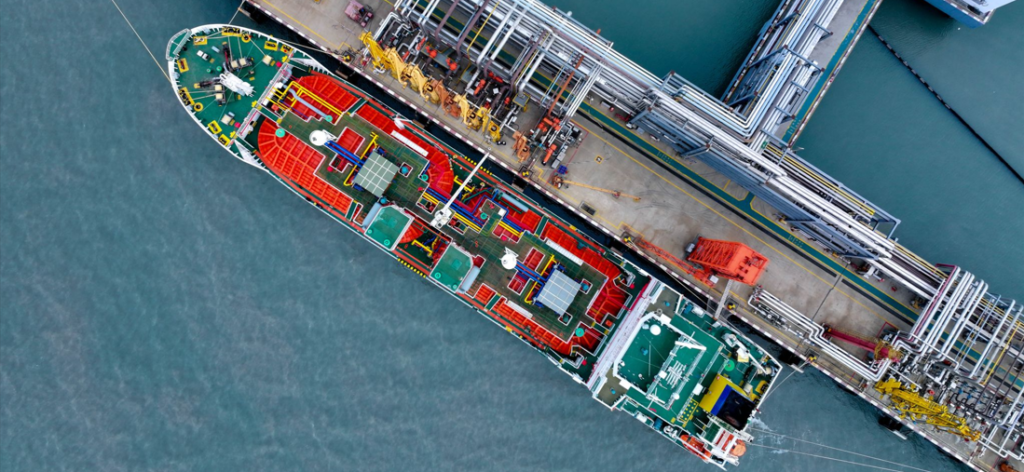
The cargo, shipped via the port of Dalian, is destined for LOTTE Fine Chemical in Korea. The delivery represents Envision’s first green ammonia export to the Korean market and validates the complete supply chain from renewable power generation to international maritime transport. The product conforms to ISCC PLUS chain-of-custody requirements, confirming full traceability and sustainability compliance.
The shipment follows the commissioning of Phase I of Envision’s 2.5 GW green hydrogen and ammonia project in July 2025. With this export, the company has demonstrated an end-to-end value chain from renewable electricity generation and hydrogen electrolysis to ammonia synthesis, storage, customs clearance, and overseas delivery, providing a replicable blueprint for cross-border zero-carbon fuel trade.
Commercial milestone in green ammonia
The Chifeng project is designed to produce 1.52 million tonnes of green ammonia annually upon completion of all three phases, with a total investment of CNY 40 billion.
Phase I, now operational, integrates 1.43 GW of wind and solar capacity alongside 680 MWh of energy storage and is expected to produce 320,000 tonnes of green ammonia per year.
The facility operates entirely off-grid, making it the first commercial-scale hydrogen–ammonia complex powered exclusively by renewable energy without reliance on external grid balancing. Real-time optimization is enabled by AI systems that dynamically coordinate renewable generation with hydrogen production and ammonia synthesis.
The project has received ISCC certification from Bureau Veritas, which issued the world’s first on-site renewable ammonia certificate. This ensures compliance with international sustainability and traceability standards, an essential prerequisite for export markets such as Korea and Japan, where carbon intensity is increasingly tied to subsidy eligibility and procurement criteria.
From renewable electrons to exportable molecules
The Chifeng project’s technical architecture is built on full vertical integration of renewable generation, hydrogen production, and ammonia synthesis.
I. Fully integrated renewable platform
Phase I integrates 1 GW of wind power, 0.43 GW of solar photovoltaic capacity, and 680 MWh of energy storage. These assets provide electricity for large-scale electrolysis. Hydrogen is produced via water electrolysis, while nitrogen is separated from air for ammonia synthesis using the Haber–Bosch process.
By converting intermittent renewable electricity into ammonia, a stable, energy-dense molecule stored at −33°C under low pressure, the facility transforms variable electrons into a globally tradable commodity suitable for long-distance transport.
II. Hydrogen–ammonia gas turbines
Phase I includes twelve 8 MW hydrogen–ammonia gas turbines, each capable of generating up to 64 GWh annually. The turbines operate flexibly on green hydrogen or ammonia.
They serve two core functions:
- Demonstrating closed-loop integration between fuel synthesis and power generation
- Providing system stability and operational flexibility without grid dependence
The ability to combust ammonia directly addresses a central challenge in the hydrogen economy: storing renewable energy over extended durations and reconverting it into dispatchable electricity when required.
III. AI-driven operations
The facility operates on Envision’s EnOS™ IoT-based digital platform. Using AI forecasting and real-time source–load coordination, the system dynamically adjusts electrolyzer and ammonia synthesis output to match renewable generation.
In effect, Chifeng functions as a self-balancing renewable microgrid integrated with chemical manufacturing, an architecture increasingly regarded as critical to scaling green hydrogen economically.
IV. Water and carbon management
The plant employs a closed-loop water recycling system that treats wastewater into purified electrolysis feedstock, achieving 100% greywater reuse and zero wastewater discharge.
Combined with renewable electricity inputs, this enables a zero-carbon, zero-wastewater operational profile, an important differentiator as lifecycle emissions accounting becomes central to international trade compliance.
Scale, contracts, and cost edge
At full capacity, 1.52 million tonnes per year would position Chifeng among the largest and most cost-efficient green ammonia facilities globally, offering long-duration energy storage and substantial economic benefits.
To put its scale and competitiveness into perspective, the NEOM green hydrogen project in Saudi Arabia targets approximately 1.2 million tonnes of green ammonia annually, as shown in the table below.
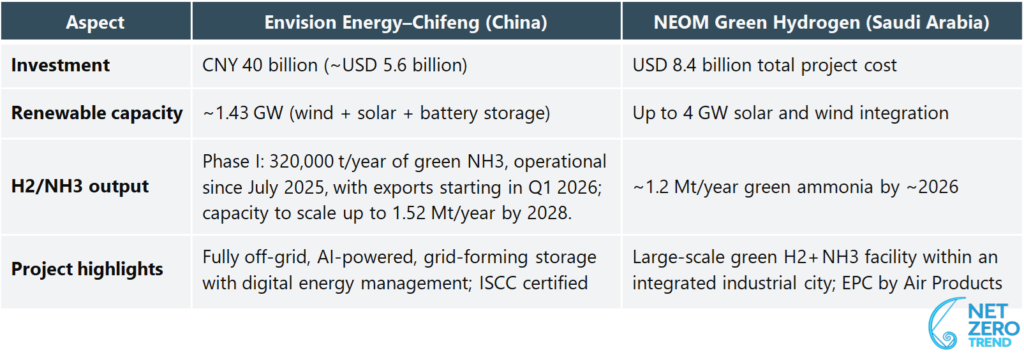
Even Phase I’s 320,000-tonne output represents meaningful industrial scale, sufficient to support shipping fuel trials, fertilizer substitution, and industrial feedstock applications.
Long-term offtake agreements
Envision has secured long-term supply agreements with international buyers, including Japan’s Marubeni Corporation, covering maritime fuel, hydrogen derivatives, fertilizers, and specialty chemicals. Additional cooperation agreements have been signed with partners in Japan, Singapore, the UAE, France, and Korea.
These contracts are strategically significant. In the current hydrogen market, the primary bottleneck is bankability rather than technology. Long-term offtake agreements reduce revenue volatility and enable more competitive project financing.
Cost Dynamics
Green ammonia remains more expensive than conventional ammonia produced from natural gas. However, three structural advantages strengthen Chifeng’s cost position:
- High renewable utilization rates: Up to 4,000 equivalent full-load hours for wind and 2,000 for solar lower levelized electricity costs.
- Economies of scale: Large electrolyzer capacity and integrated system design reduce per-unit capital expenditure.
- Off-grid architecture: Avoiding grid transmission fees and curtailment risk improves operating economics.
While production costs have not been disclosed, industry estimates suggest that projects in high-resource regions such as Inner Mongolia can approach cost parity with fossil-based ammonia when carbon pricing or green premiums are factored in.
Geographic advantage and ecosystem integration
Chifeng’s location in Inner Mongolia provides a structural resource advantage. The region has installed more than 10 GW of renewable capacity, with renewables accounting for 64.2% of total power generation.
The city spans approximately 90,000 km² and benefits from up to 4,000 equivalent full-load hours for wind and 2,000 for solar. It has 53 GW of additional capacity available for development (compared with ~40 GW in Nova Scotia, Canada, and ~80–100 GW in Scotland, UK), as shown in the table below.
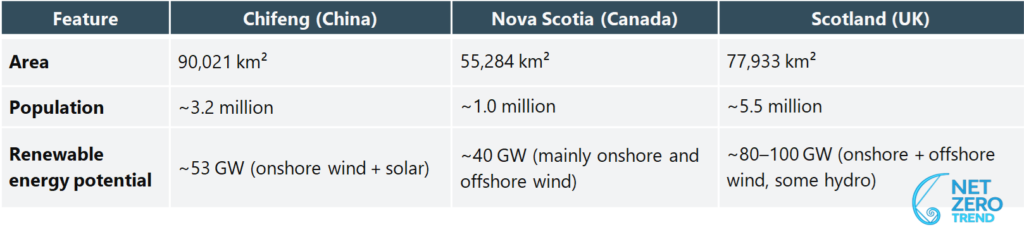
This scale enables industrial clustering effects, including:
- Shared renewable infrastructure
- Supply-chain localization for electrolyzers and turbines
- Industrial symbiosis across hydrogen and ammonia applications
Chifeng is therefore evolving beyond a single asset into a hydrogen–ammonia industrial ecosystem.
Strategic and market implications
Against this backdrop, the first export shipment marks a structural inflection point for global green fuel markets.
I. Proof of end-to-end tradeability
By completing the full chain from production and certification to export and delivery, Envision demonstrates that renewable ammonia can function as a globally traded commodity. This materially reduces perceived risk for buyers and financiers.
II. Northeast Asia market integration
South Korea and Japan are accelerating hydrogen import strategies to meet decarbonization targets. China’s emergence as a commercial-scale supplier introduces new competition and could reshape regional supply chains.
III. Template for wind-to-hydrogen models
The project offers a replicable model:
- Build in resource-rich renewable regions
- Convert renewable electrons into transportable molecules
- Export through established ammonia logistics infrastructure
If scaled, such projects could gradually shift global energy trade from hydrocarbons toward renewable molecules.
A replicable blueprint for zero-carbon fuel trade
The first cargo from Chifeng does not eliminate the cost gap facing green hydrogen. But it establishes something equally critical: operational credibility at commercial scale.
On the Gobi frontier of Inner Mongolia, wind and solar power have been converted into certified, exportable zero-carbon fuel and delivered to a major industrial buyer in Northeast Asia.
For a sector long characterized by pilot projects and policy ambition, Chifeng signals a transition toward industrial reality, where gigawatt-scale renewables, AI-optimized operations, and bankable offtake agreements converge to create a viable pathway for green ammonia at a global scale.