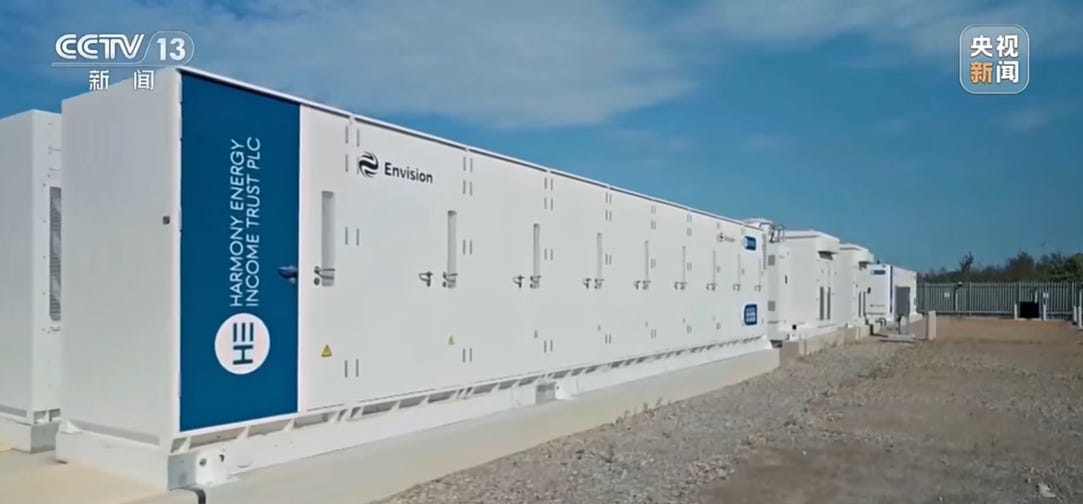
In November 2025, Envision announced a partnership with Statera Energy on a fully AI-enabled energy storage system for the Carrington project in the UK, a 680 MW/1.36 GWh installation set to become the country’s largest single-site battery energy storage system (BESS). The project marks Envision’s first overseas deployment of its AI storage platform and the world’s first commercial BESS built on an AI “energy large model” architecture.
On January 2, 2026, China’s national broadcaster CCTV reported on Envision, highlighting the project as emblematic of China’s renewable energy “go global” strategy. As China accelerates preparations for its 15th Five-Year Plan (2026–2030), which prioritizes the construction of a “new-type energy system” and energy security, Envision’s UK breakthrough illustrates how Chinese cleantech companies are repositioning themselves at the high end of the global renewable energy value chain.
From hardware exports to system intelligence
For more than a decade, China’s renewable energy exports have been driven primarily by cost-competitive manufacturing—solar modules, wind turbines, lithium-ion batteries and power electronics. While this model helped dramatically reduce global clean energy costs, it has increasingly faced trade barriers, margin compression and commoditization.
The Carrington project signals a shift away from this paradigm. Envision is not simply supplying battery containers or inverters; it is delivering an AI-native storage system that integrates hardware, software, forecasting, grid interaction and market trading into a single operational platform.
The UK was a deliberate first choice. As one of the world’s most liberalized and financially sophisticated electricity markets, Britain exposes storage assets to frequent price volatility, complex ancillary service requirements and high expectations for reliability. In such an environment, customers focus less on upfront equipment costs and more on whether a system can consistently deliver revenue while supporting grid stability under high renewable penetration.
By securing its first overseas AI storage order in the UK, Envision has chosen to compete in one of the most demanding global markets—where technical performance, digital intelligence, and lifecycle economics matter more than price.
Key technologies: AI energy models at the core
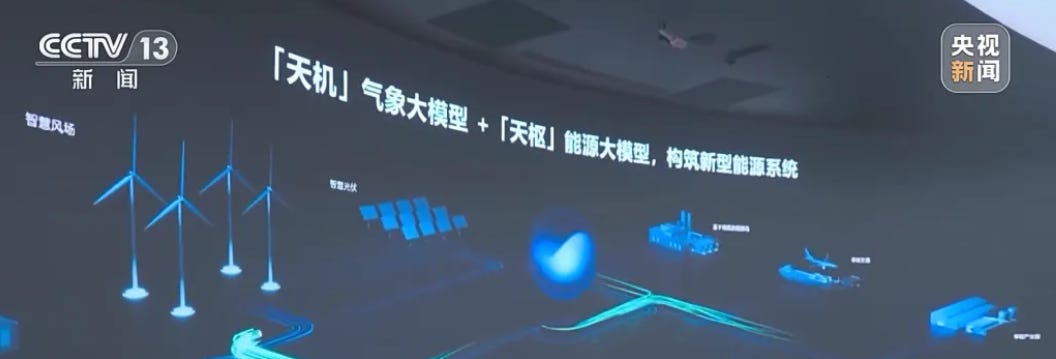
At the center of Envision’s solution is an AI storage system built on two proprietary large-scale models: the TIANJI meteorological model and the TIANSHU energy model. Together, they form a “physics-plus-data” dual-engine architecture designed specifically for high-renewables power systems.
Meteorology meets power systems
Envision began developing its meteorological model in 2015, well before AI became mainstream in the energy sector. Built on petabyte-scale datasets, TIANJI combines physical weather modelling with machine learning to improve wind and solar power forecasting accuracy.
According to the company, this hybrid approach has improved generation forecasting accuracy by nearly 10% compared with conventional methods. In power systems with high renewable penetration, such improvements are economically significant: forecasting errors translate directly into imbalance penalties, inefficient dispatch and higher reserve requirements.
From forecasting to real-time optimization
The TIANSHU energy large model extends this capability from prediction to decision-making. It integrates weather forecasts, grid conditions, asset constraints and electricity market rules to optimize storage operations in real time.
The AI storage platform is organized around multiple intelligent agents, including grid-forming agents and trading agents. Grid-forming functions enable batteries to actively stabilize voltage and frequency, replicating capabilities traditionally provided by synchronous generators. Trading agents optimize charging and discharging across wholesale markets, ancillary services and capacity mechanisms.
This system-level intelligence allows storage assets to move beyond simple price arbitrage, simultaneously increasing renewable energy utilization, enhancing grid resilience and improving full-lifecycle project returns.
Proven at scale: evidence from China’s zero-carbon pilots
Although Carrington is Envision’s first overseas AI storage deployment, the technology has already been validated at scale in China.
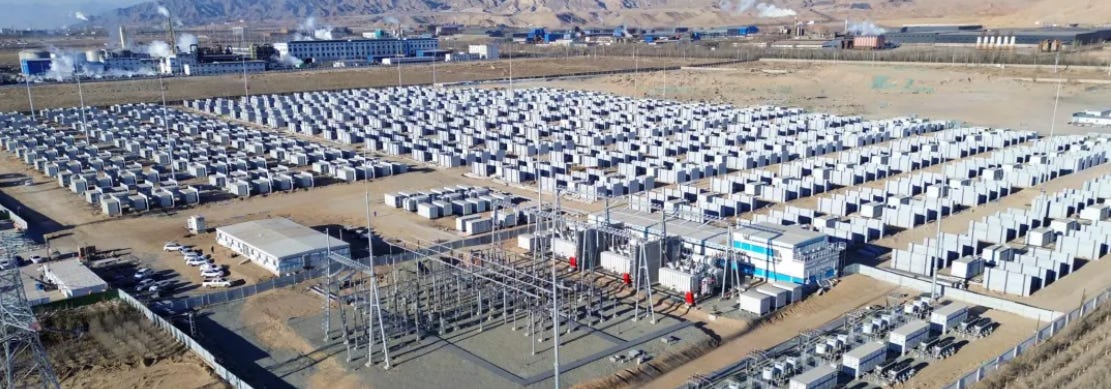
The most prominent example is the Chifeng Net-Zero Industrial Park in Inner Mongolia, home to what Envision describes as the world’s largest AI-driven power system. Combining wind, solar, storage and AI control, the system has operated stably for more than 22 months.
During this period, it has successfully handled multiple extreme events, including stretches of up to 16 consecutive hours with no wind or solar generation. Despite these conditions, the system achieved a 90% energy coverage rate and 95% short-term forecasting accuracy.
By global standards, these results are notable. Many high-renewable systems rely on significant fossil backup or overcapacity to maintain stability during prolonged low-generation periods. Envision’s experience suggests that AI-enabled storage and control can materially reduce these requirements, lowering system costs while maintaining reliability.
As the models continue to learn from operational data, Envision expects further improvements in accuracy and robustness—an important advantage in a sector where performance gains compound over time.
Redefining storage economics
Since early 2025, Envision has secured major storage contracts not only in China but also in Australia, Chile, Italy and Poland, spanning ten strategic markets.
On December 31, 2025, a 12.8 GWh storage cluster, the world’s largest to date, was connected to the grid in Inner Mongolia. All projects in the cluster are equipped with Envision’s AI storage system and passed the stringent “three-charge, three-discharge” grid test on the first attempt. All units will participate directly in China’s power spot markets, setting a global benchmark for large-scale AI storage integration.
The rise of AI storage reflects a broader policy shift. As power systems decarbonize, regulators increasingly recognize that flexibility and intelligence, not just installed capacity, are critical system assets. In China, power market reforms are accelerating, with spot markets expanding nationwide and new mechanisms emerging to reward flexibility and ancillary services. Similar trends are evident in Europe and Australia.
AI storage systems are uniquely positioned to monetize these changes, capturing value that static, rule-based systems often miss by responding dynamically to price signals and grid needs.
Strategic implications: a reshaped competitive landscape
Envision’s UK project illustrates a broader transformation in the global energy industry.
For incumbents in developed markets, the emergence of Chinese companies offering integrated AI energy systems challenges long-held assumptions about technological leadership. For developers and utilities, it expands the pool of partners capable of delivering complex, high-performance solutions.
For China’s clean energy sector, the implications are structural. After decades of technology accumulation and industrial scaling, Chinese companies can now export not only products but also codified operational expertise embedded in algorithms, models and digital platforms. This shifts value upstream into software, systems integration and lifecycle services, while deepening long-term customer relationships.
In this sense, AI storage represents not just a new product category but a new business model.
Looking ahead: from energy exporter to system architect
As global power systems move toward higher shares of renewables, demand for intelligent flexibility will continue to grow. Grid operators, investors and policymakers are increasingly aligned around solutions that deliver stability, efficiency and profitability simultaneously.
Envision’s AI storage strategy sits squarely at this intersection. By proving its technology in one of the world’s most demanding power markets, the company has demonstrated confidence not only in its engineering capabilities but also in its understanding of market dynamics.
More broadly, the Carrington project suggests China’s role in the global energy transition is evolving. No longer defined solely by cost reduction through scale, Chinese companies are beginning to shape how clean energy systems are designed, operated and monetized worldwide. If this model scales, the next phase of the energy transition may depend less on where equipment is made—and more on who controls the intelligence that makes decarbonized power systems work.