By linking national-level research, advanced manufacturing, cross-border capital and overseas technology sourcing, Wuxi is developing an integrated platform to accelerate clean-energy commercialization across the Yangtze River Delta—and increasingly in markets beyond China.
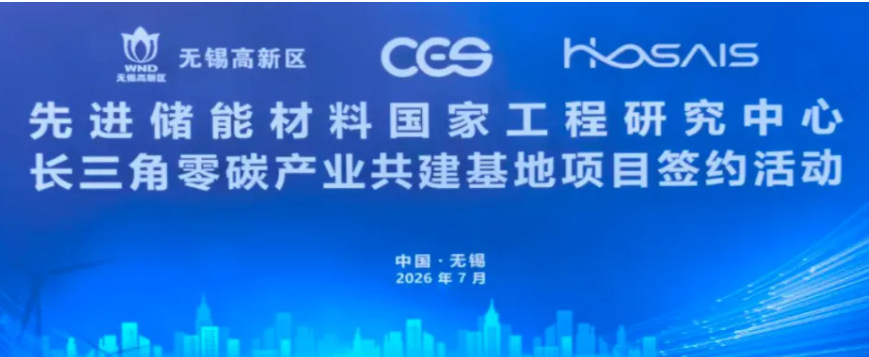
On July 22, the National Engineering Research Center for Advanced Energy Storage Materials (NERC-AESM) and Wuxi National High-Tech Zone (WND) signed an agreement to jointly develop a research, industrialization and demonstration base under the Yangtze River Delta Zero-Carbon Industry Joint Development initiative.
The partnership brings together a national-level research platform, energy storage companies and Wuxi’s established cleantech manufacturing ecosystem, creating a dual-engine model of “scientific innovation and advanced manufacturing.” The objective is to accelerate the commercialization of energy storage and other zero-carbon technologies across the Yangtze River Delta.
Established with the approval of China’s National Development and Reform Commission in 2009, NERC-AESM is a national-level research platform focused on advanced energy storage materials and technologies. The new base will combine its technology development and commercialization capabilities with industry expertise in AI-enabled energy storage, digital energy systems and commercial applications.
Its activities are expected to cover advanced energy-storage R&D, scenario-based demonstration projects, industry standards and the regional commercialization of scientific outcomes. The broader ambition is to create a Wuxi-based platform capable of connecting research, engineering, manufacturing and market deployment across the Yangtze River Delta.
The project also reflects a broader regional collaboration model. It was developed through partnership between WND and Lianyungang under the Wuxi-Lianyungang mutual-assistance program, linking Wuxi’s industrial and technological capabilities with Lianyungang’s coastal infrastructure and emerging clean energy opportunities.
Lianyungang is also emerging as an important node in China’s green ammonia export industry. In 2026, both Envision Energy and State Power Investment Corporation (SPIC) used Lianyungang as the export port for their first green ammonia shipments to South Korea, highlighting the city’s growing role in China’s green fuel supply chains.
WND: From industrial cluster to regional platform
The decision to establish the zero-carbon base in WND reflects years of investment in the clean and low-carbon economy. The zone has developed significant capabilities across photovoltaics, hydrogen, energy storage, energy efficiency and net-zero industries. As of 2025, WND was home to 174 cleantech and low-carbon enterprises, with annual industry output exceeding CNY 200 billion.
WND also hosts the National Quality Inspection and Testing Center for Advanced Energy Storage Products (CEST), the Yangtze River Delta region’s only national-level energy storage product quality-inspection center. It is also home to the National Centre of Inspection on Solar Photovoltaic Products Quality (CPVT), China’s first national-level photovoltaic inspection and quality center.
Leading equipment manufacturers, including Wuxi LEAD and Autowell, further strengthen the local industrial base. Together, these capabilities span energy-storage materials, battery cells, manufacturing equipment, system integration and emerging applications such as virtual power plants.
This concentration of research, testing, equipment manufacturing and industrial capabilities gives WND an environment in which new technologies can move relatively quickly from laboratory development to engineering, manufacturing and commercial deployment.
Financial infrastructure for cross-border technology flows
This industrial foundation is increasingly being complemented by financial mechanisms designed to accelerate cross-border capital and technology flows.
Wuxi has been developing complementary Qualified Foreign Limited Partnership (QFLP) and Qualified Domestic Limited Partnership (QDLP) mechanisms to connect international capital and overseas innovation with its advanced manufacturing base.
In simplified terms, QFLP helps bring overseas capital into China, while QDLP enables domestic capital to reach overseas investment and innovation opportunities.
The significance goes beyond financial access. Rather than treating investment, technology acquisition and manufacturing as separate activities, Wuxi is developing mechanisms connecting capital with its industrial economy, while giving domestic investors and companies greater access to overseas technologies, companies and markets.
QDLP provides qualified domestic investors with a framework for investing in overseas assets and complements established channels such as QDII and ODI. China’s first QDLP pilot was launched in Shanghai in 2012, and other cities have subsequently explored ways to use the mechanism to support international investment and technology development.
Wuxi has also been building the financial infrastructure to support this broader model. In 2023, the city approved its first QDLP fund, the USD 50 million Wuxi Guolian Tonghe Global Innovation Growth Investment Fund, targeting overseas opportunities in areas including AI, robotics and advanced technology. Combined with Wuxi’s QFLP program, the city now has complementary mechanisms for both inbound and outbound investment.
The combination of these financial channels with Wuxi’s manufacturing capabilities creates the potential for a two-way industrial platform: international capital can enter the local economy, while domestic investors can identify technologies and companies abroad and connect them with China’s commercialization ecosystem.
This is where Wuxi’s financial infrastructure becomes relevant to its industrial strategy. The objective is not simply to facilitate cross-border investment, but to use capital as a bridge between global technology resources and local industrial capabilities.
The zero-carbon base is therefore more than a research or manufacturing project. It forms part of a wider ecosystem connecting technology sourcing, capital formation, industrialization and market deployment.
Jiangyin turns QDLP into an industrial investment tool
A related development in Jiangyin, Wuxi, illustrates how this ecosystem is beginning to connect cross-border investment directly with technology commercialization.
In November 2025, Jiangyin launched Jiangsu Province’s first QDLP project, designed to combine cross-border investment with domestic industrial reinvestment for Hong Kong-based Luquos Energy, which is developing, manufacturing, and deploying MWh-scale sulphur-based flow-battery energy-storage systems.
The project brought together a consortium including the Yangtze River Delta National Innovation Center, the Chinese University of Hong Kong (CUHK), the CUHK Council Fund, Suhao Zhongshan and Xizhou International.
In April 2026, Luquos Energy completed its Pre-A financing round, bringing total funding to nearly HK$100 million. Wuxi-backed Surrich International and Suzhou-backed Yuanhe Zhongshan jointly led the round, with the Yangtze River Delta National Innovation Center and Gobi Partners participating as significant investors.
Luquos Energy has also been selected for Hong Kong’s Innovation and Technology Commission’s Research, Academic and Industry Sectors One-plus Scheme (RAISe+), providing additional support for the commercialization of its technology.
The startup is developing sulphur-based flow-battery technology focused on safety and long-duration energy storage. In 2024, it deployed what it describes as the world’s first commercial sulphur-based flow battery demonstration at a charging station in Shenzhen, where the system provides peak-shaving and load-management services while supporting renewable-energy integration.
In 2025, its second-generation system was deployed at a smart farm in Hong Kong. The project combined agrivoltaic generation with energy storage to support agricultural operations and demonstrate the technology’s potential in low-carbon distributed-energy applications.
The startup’s next phase is commercial-scale deployment, including high-reliability applications such as AI data centers. With support from its Pre-A financing and the RAISe+ program, Luquos Energy plans to accelerate the manufacturing capacity of MWh-scale systems in Jiangyin and demonstration projects in mainland China, Hong Kong, the Middle East and Southeast Asia, targeting applications across renewable energy, power grids and data centers.
The strategic significance of the Luquos Energy project in Jiangyin, however, extends beyond the battery technology itself.
It demonstrates how QDLP can evolve from a financial-access mechanism into a tool for technology sourcing, localization and industrial upgrading.
Rather than using QDLP solely to invest in overseas financial assets, Jiangyin is applying the mechanism to support access to technology developed outside mainland China and create a pathway for its commercialization and industrial deployment in China.
That approach aligns cross-border capital with Jiangyin’s substantial manufacturing base and Wuxi’s broader industrial ecosystem.
From demonstration to scale-up manufacturing, the Luquos Energy project illustrates how an overseas-developed technology can be brought into a Chinese industrial environment where engineering expertise, equipment suppliers, manufacturing capacity, investment capital and domestic application markets are available within a relatively concentrated geography.
The model could become increasingly relevant as emerging energy technologies move into commercialization.
Cross-border capital as a driver of industrial upgrading
For Jiangyin and Wuxi, the importance of the Luquos Energy project extends beyond energy storage. It points to a broader shift in the relationship between financial innovation and industrial policy.
In sectors such as advanced energy, semiconductors, robotics and AI infrastructure, access to frontier technology can be as important as access to capital. A city that can combine the two gains an additional pathway to accelerate industrial upgrading.
Wuxi’s manufacturing depth is particularly relevant. As one of China’s leading industrial economies, it has the engineering, supply-chain and manufacturing capabilities needed to help translate technology into industrial products. Its integration with the Yangtze River Delta’s broader financial and innovation ecosystem potentially shortens the path from technology identification and investment to engineering, manufacturing and market deployment.
This creates a model in which cross-border investment is not an end in itself. It becomes part of an industrial feedback loop: technology sourcing → investment → localization → manufacturing → demonstration → commercialization → global market expansion.
From cluster to commercialization platform
Taken together, the WND zero-carbon industry base and the Jiangyin QDLP project point to a broader evolution in how local governments are building innovation ecosystems. The emerging model combines national research platforms, universities, cross-border investment, advanced manufacturing and application markets rather than treating them as separate policy instruments.
For energy storage, this integration could help address one of the industry’s most persistent bottlenecks: the gap between breakthrough chemistry and commercially scalable deployment. For Wuxi, the opportunity is to build on its strengths in advanced manufacturing and green industry to create a broader cross-border innovation and commercialization platform connecting technology transfer, capital flows, domestic manufacturing and global scale-up.
Together, these initiatives suggest an integrated pathway for Wuxi—from sourcing and financing technologies to manufacturing, demonstrating and ultimately deploying them in global markets. The larger opportunity is not simply to build another energy-storage cluster, but to establish a regional platform that converts global innovation into industrial capacity and commercially deployable clean-energy infrastructure.