High-level engagement with Canada and large-scale industrial investments in Europe underscore Envision’s strategy to align AI-driven energy systems with national decarbonization and grid expansion agendas.
On January 15, Canada’s Prime Minister Mark Carney met Zhang Lei, Chairman of Envision Group, in Beijing, signalling a convergence between low-carbon energy policy and a fast-scaling global clean technology platform. With major manufacturing and R&D centers based in Wuxi, Envision is a global leader in AI-driven power systems, zero-carbon industrial parks, and green hydrogen solutions, domains that sit squarely at the intersection of software, hardware, and public policy.
For Canada, which is embarking on a long-term plan to double grid capacity and update its energy system, Envision’s integrated, systems-level solutions appear well aligned. The company’s ability to combine digital intelligence with physical energy infrastructure offers a practical pathway to scaling renewables while maintaining system reliability and cost discipline.
Coming just months after Envision’s battery arm inaugurated a major gigafactory in northern France, the meeting underscored how the Chinese green technology group is positioning itself as a strategic partner for governments grappling with grid expansion, electrification, and the economics of low-carbon energy at scale.
Low-carbon vision meets industrial execution
The Beijing meeting provided useful context for understanding how Envision’s capabilities relate to Canada’s broader national ambitions. The company’s practical experience deploying AI-based power systems closely aligns with Canada’s objectives to expand grid capacity, modernize infrastructure, and position itself as an “energy superpower”. Envision was clearly identified as a potential contributor to that agenda.
“Nothing is as powerful as an idea whose time has come.” – Victor Hugo (1802-1885)
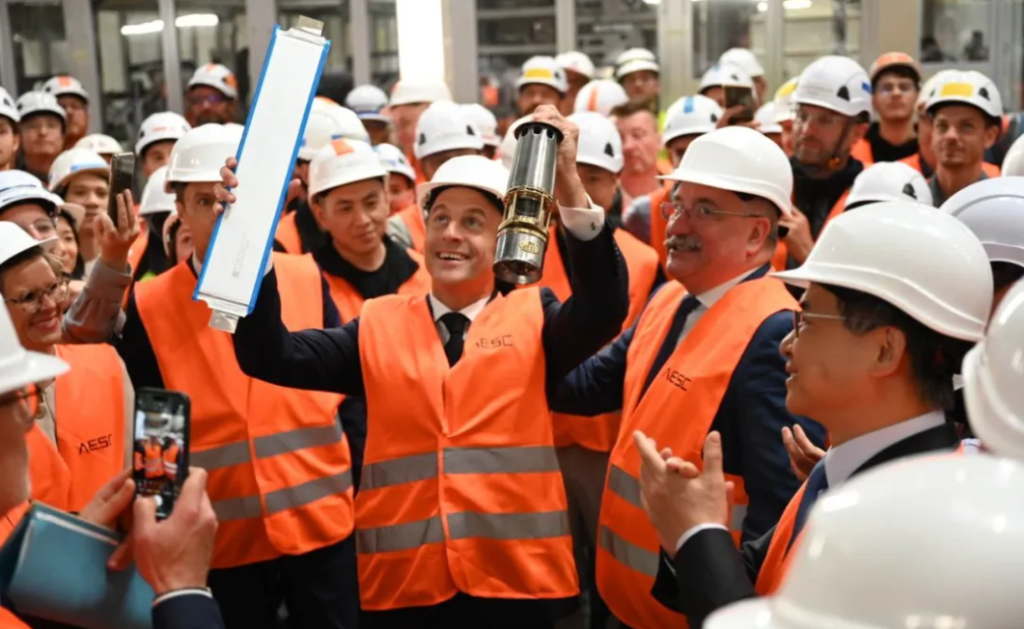
In Europe, the company has already moved from vision to execution. In June 2025, Envision AESC, Envision Group’s battery subsidiary, officially launched its battery gigafactory in Douai, France, in the presence of President Emmanuel Macron. The facility, now fully operational, has the capacity to supply batteries for up to 200,000 electric vehicles annually and is already powering Renault’s R5 electric model, which has become France’s best-selling EV.
Macron framed the Douai project as a flagship of France’s “Choose France” strategy and a cornerstone of national reindustrialization. The symbolism was deliberate: a former coal-mining region being repositioned at the heart of Europe’s clean, intelligent “new power era”.
Taken together, the meeting in Beijing and the industrial milestone in Douai illustrate Envision’s expanding role – not merely as a technology supplier, but as a geopolitical bridge in the industrialization of clean energy.
AI power systems, batteries, and green hydrogen
At the core of Envision’s value proposition is what it calls an “AI power system” – a digitally native architecture that integrates renewable generation, energy storage, hydrogen production, and flexible demand into a single, optimized system.
This model contrasts sharply with traditional grids, which balance supply and demand through centralized dispatch and fossil-fuel-based inertia. Envision’s approach relies instead on AI models trained on vast datasets. Its weather-large-model enhances the accuracy of wind and solar forecasting, while its energy-large-model continuously optimizes dispatch across generation assets, storage systems, and loads in real time.
The results are particularly significant for green hydrogen. Electrolyzer economics are highly sensitive to utilization rates and power price volatility. In Envision-developed green hydrogen industrial parks, surplus renewable electricity is dynamically routed to electrolyzers when conditions are most favourable, improving capacity factors and lowering the levelised cost of hydrogen.
On the hardware side, Envision’s battery technology has emerged as a commercial proof point. The Douai gigafactory produces high-performance lithium-ion batteries tailored to European OEMs. With output sufficient for 200,000 vehicles a year, it sits firmly among Europe’s leading gigafactories while anchoring a localized battery value chain aligned with EU industrial and climate policy.
Scale, customers, and policy fit
Commercially, Envision operates across multiple layers of the clean energy value chain. Its portfolio spans Envision Energy (smart wind turbines, energy storage systems, and hydrogen solutions), Envision AESC (advanced batteries), Envision Digital (industrial IoT and energy operating systems), a carbon-neutrality-focused venture capital arm, and a Formula E world championship-winning racing team that also serves as a technology and branding platform.
This breadth is important. As energy systems decarbonize, value increasingly accrues to players that can integrate assets across generation, storage, networks, and demand. For utilities and governments, the challenge is no longer simply adding renewable capacity, but ensuring reliability, affordability, and industrial competitiveness as electrification accelerates.
Canada’s grid expansion plans exemplify this shift. Doubling grid capacity implies substantial investment not only in generation and transmission, but also in digital control systems, flexibility, and storage. Envision’s AI power systems are designed to address these challenges precisely, extracting more usable energy from both existing and new assets.
In Europe, Envision’s battery investments align closely with policy priorities. The EU’s push for domestic battery manufacturing, driven by supply chain resilience, emissions reduction and industrial competitiveness, has created demand for partners capable of delivering both scale and advanced technology. Supplying Renault’s R5, a mass-market vehicle in one of the world’s most competitive automotive markets, provides Envision with a strong commercial reference.
Cost competitiveness remains central. Battery packs still account for roughly 30–40 per cent of an electric vehicle’s total cost. Localized, high-volume production reduces logistics expenses, currency exposure, and embedded emissions – an increasingly important consideration as carbon border adjustment mechanisms begin to take effect.
From component supplier to system architect
Strategically, Envision is repositioning itself from a component manufacturer to an architect of zero-carbon energy systems. Its corporate narrative frames wind and storage as the “new coal”, batteries and green hydrogen as the “new oil”, and AI-driven renewable grids as the foundation of a “new power system”.
This framing resonates with policymakers because it translates clean technologies into familiar industrial concepts. For countries such as Canada and France, the appeal lies in combining decarbonization with energy security, job creation, and technological sovereignty.
Envision’s global footprint reinforces this positioning. The company operates in more than 20 countries, with over 60 manufacturing bases and more than 20 R&D and operational hubs spanning China, Europe, North America, the Middle East, Asia-Pacific, and Latin America. This scale enables localization of production while capturing global learning curves and cost efficiencies.
External recognition further underpins its credibility. Envision has been named one of MIT Technology Review’s Top 10 Climate Tech Innovators, won Reuters’ AI for Sustainability Award, and featured on Time and Fortune rankings of the world’s most influential companies. On the ESG front, it has achieved EcoVadis Gold ratings for two consecutive years, a CDP Climate Change A rating in 2024, and carbon neutrality across global operations in 2022, with a stated goal of net zero by 2040.
In energy transition increasingly defined by system complexity rather than individual technologies, Envision is positioning itself exactly where policy ambition and industrial execution converge. For stakeholders closely watching low-carbon economics, its integrated model offers a compelling template: customers gain access to predictable, optimized energy inputs, while producers benefit from higher asset utilization and improved project economics.