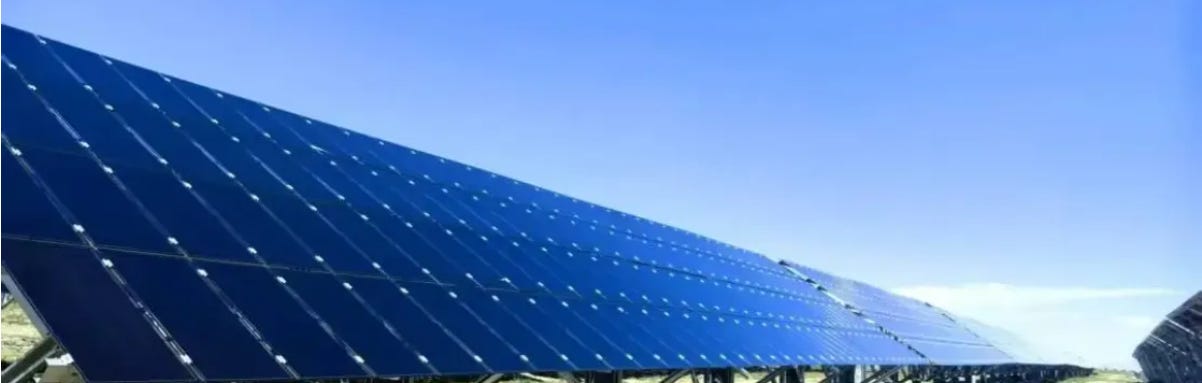
On August 23, China Huaneng commissioned the world’s first 5 MW-scale perovskite photovoltaic (PV) demonstration project at the Gonghe PV Park in Qinghai, northwest China. This marks a milestone in advancing perovskite technology from lab research to large-scale demonstration and pre-commercial deployment.
Located at an altitude of about 3,000 m in the Talatan region of Gonghe County, the site is designed to test performance under intense UV and high-irradiation conditions, generating critical real-world data for faster product iteration. Huaneng also plans to build an “R&D – Tech Services – Market Integration” ecosystem, positioning itself as a national leader in perovskite PV technology while expanding its renewable energy portfolio.
Mass Manufacturing Equipment for Perovskites
Manufacturing advances take perovskites from lab to pre-commercial production. In June 2025, Wuxi LEAD Intelligent Equipment, a leading supplier of renewable energy manufacturing equipment, delivered a complete perovskite solar cell production line to a major photovoltaic company in Shanghai.
The turnkey system covers the entire process from substrate preparation and coating to final module encapsulation, signalling the transition of perovskites from research promise to pre-commercialization and positioning Chinese equipment makers at the forefront of the next photovoltaic revolution.
From Lab to Pilot and Mass Manufacturing
Designed for flexibility and integration, the production line covers the entire perovskite processing chain: substrate cleaning, laser scribing, coating, physical vapor deposition (PVD), atomic layer deposition (ALD), vacuum evaporation, annealing, crystallization, and encapsulation. Key features include:
- Dual process compatibility: Supports both wet and dry processing routes, enabling flexibility in deposition methods and adaptation to evolving manufacturing approaches.
- Substrate versatility: Handles both rigid glass and flexible substrates, enabling the production across a range of module formats, from conventional rooftop PV to lightweight, portable, and building-integrated photovoltaics (BIPV).
- High speed and precision: Achieves a stable, reliable 1.2-meter coating width with product thickness accuracy deviations under ±20 nm over two square meters and thickness uniformity better than ±5%. The line operates at over 50 mm/s and is already running stably in GW-scale production environments.
The line supports multiple processing schemes with full compatibility across flexible, rigid, and laminated substrates. It accommodates lab-scale R&D, pilot production, and GW-level deployment, accelerating the “lab-to-fab” transition.
Perovskites: Unlocking a New Era for PV
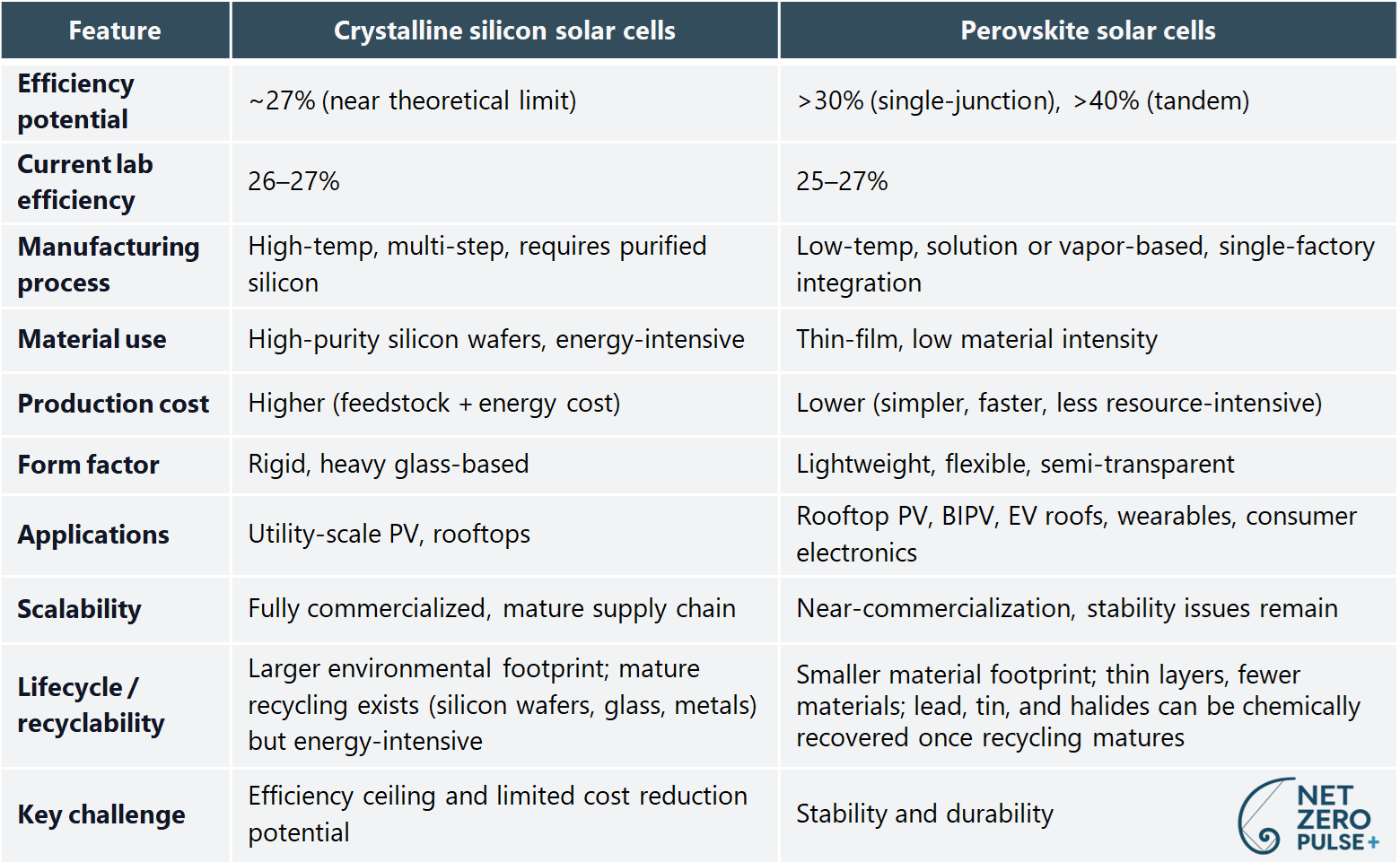
In solar energy, efficiency and cost are paramount. Crystalline silicon technology, after decades of refinement, has reached ~27% efficiency, approaching its theoretical limit, while production costs remain tied to high-purity silicon feedstock. Perovskites, by contrast, hold great promise for efficiency, cost, and applications, as shown in the table below:
In China, industry leaders such as LONGi, Tongwei, JinkoSolar, and Trina Solar are advancing tandem R&D, with some operating 100MW-level pilot lines. Startups such as GCL Optoelectronics, Microquanta, and UtmoLight are building GW-scale production lines. Cross-sector giants, such as PetroChina, CNNC, CATL, BYD, and BOE, are also entering the field.
In the short term, perovskites are likely to enter the market primarily as silicon–perovskite tandem cells, leveraging existing industrial capacity. Medium-term adoption could shift toward standalone modules in BIPV and consumer electronics. Over the long term, with stability breakthroughs, perovskites may ultimately challenge crystalline silicon’s dominance.
The next three to five years represent a critical “golden window” for validating commercial viability, with yield, cost, and durability set to determine the winners. China’s efforts to drive perovskite industrialization, through integrated production lines, value chains, and standard-setting, are expected to reshape the global PV market.
- Equipment-led industrialization: Unlike previous PV waves, where Chinese companies competed mainly on cost, perovskites may see China set the pace through equipment leadership and manufacturing standards.
- Value chain integration: With lab-to-GW-scale solutions, China’s equipment manufacturers are positioning themselves as full-spectrum partners, reinforcing long-term ties with PV producers.
- Global competitiveness: While Europe and the U.S. host world-class research centers such as Oxford PV and NREL, few have delivered integrated production lines, leaving China well-positioned for a first-mover advantage.
- Risk mitigation: Perovskite stability under real-world conditions remains a challenge. Therefore, equipment that supports both R&D and mass production helps mitigate risk, reduce retooling costs, and accelerate iteration.
Collaboration and Scale-up
In June 2025, TÜV Rheinland and leading Chinese enterprises launched the Perovskite PV Industry Technology Promotion Alliance to foster technical collaboration, supply chain partnerships, standardized testing, and industrial scaling. The initiative aims to accelerate the deployment of perovskites from prototype to utility-scale applications.
In 2020, Harvard Business Review published a case study that thoroughly analyzed Wuxi LEAD Intelligent Equipment’s commitment to scaling Li-ion battery technologies through precision, flexible, and highly automated manufacturing. Today, Chinese renewable energy equipment manufacturers’ substantial investments in AI-driven automation, intelligent control, and precision fabrication position them to bridge the critical gap between perovskite prototypes, product iteration, and commercialization.
If stable, scalable performance is achieved, perovskites are expected to transform the global PV industry – delivering higher efficiency at lower cost, enabling applications beyond conventional solar farms and rooftops, and accelerating renewable energy adoption to meet climate targets.