Spring Special Report II: Precision Manufacturing, Materials & Integration
Micron-scale additive manufacturing developed by LEAD pushes hinge precision beyond machining limits, enabling near crease-free displays while reshaping yields, cost structures, and advanced manufacturing pathways.
In a move that underscores the rising strategic importance of upstream manufacturing innovation, Wuxi LEAD Intelligent Equipment (LEAD) has emerged as the core technology enabler behind the introduction of chip-level 3D printing into foldable smartphone hinge production, in collaboration with OPPO.
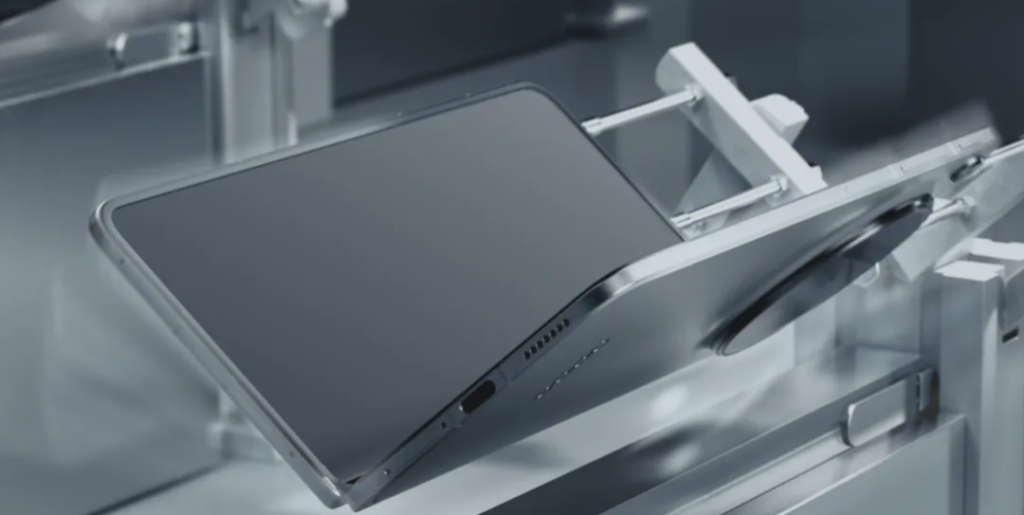
The solution underpins the hinge system of OPPO’s forthcoming Find N6, targeting what the industry has long considered elusive: a near “crease-free” folding display. Rather than iterating on display materials alone, LEAD’s approach addresses a deeper constraint: the microscopic structural interface beneath the screen.
By deploying micron-scale additive manufacturing, the company moves beyond the precision limits of traditional machining, with implications for both product performance and manufacturing economics.
Breaking the “microscopic bottleneck”
Foldable smartphones have rapidly transitioned from niche to a high-growth category, with global shipments projected to exceed 30 million units annually by the late 2020s. Yet a persistent barrier to mass adoption remains: the visible crease along the folding axis.
This limitation originates not in the display itself, but in the hinge system governing stress distribution over repeated folding cycles. Within the tightly constrained geometry of a smartphone, even micron-level deviations in flatness or alignment can amplify into visible deformation after tens of thousands of folds.
Conventional CNC machining and polishing have approached their physical limits: typically ±10–20 μm for complex components. At this level, incremental gains are increasingly marginal, constraining further improvements in surface uniformity.
Leveraging its expertise in high-end equipment systems, LEAD introduces a “dimensionality shift”: replacing subtractive processes with additive, micro-scale material deposition. This enables the reconstruction (rather than incremental refinement) of hinge surfaces with substantially higher precision and consistency.
Core technologies and specifications
At the centre of LEAD’s solution is an integrated manufacturing platform combining high-resolution sensing, controlled material deposition, and inline quality assurance:
I. Micron-level 3D contour scanning and positioning
The system performs high-resolution 3D contour scanning, effectively a “micro-CT” of the hinge surface, to map complex geometries in real time. Motion control achieves positioning accuracy of ±3 μm, approximately one-twentieth the diameter of a human hair, enabling precise deposition in highly irregular structures.
II. Ultra-fine droplet deposition (5–21 picolitres)
Material is deposited via microdroplet jetting, with each droplet controlled within a 5–21 pL range (1 pL = 10⁻¹² litres). Smaller than a typical human cell, these droplets are layered at resolutions of up to 5080 dpi, enabling the construction of an extremely uniform polymer surface through cumulative deposition.
III. Surface reconstruction via polymer support layers
The process forms a conformal, ultra-uniform polymer layer across hinge components. This layer acts as a stress-buffering interface, redistributing mechanical loads during folding and minimizing localized strain on the display—a critical factor in reducing visible creasing.
IV. High-throughput production capability
Designed for industrial deployment, the system achieves printing speeds of up to 1000 mm/s. Integrated thermal management ensures material stability, while inline AOI (automated optical inspection) supports continuous defect detection and process control.
V. Film thickness uniformity (<5% deviation)
The process maintains film thickness variation below 5%, ensuring consistent mechanical behaviour across large-scale production.
Collectively, these capabilities bring hinge manufacturing closer to semiconductor-grade precision, marking a convergence between electronics fabrication and mechanical engineering.
Strategic and market implications
Beyond the immediate application, the development reflects a broader shift from component-led innovation to process-driven differentiation. Increasingly, competitive advantage in hardware is being defined upstream—at the level of manufacturing technology and precision control.
I. Manufacturing as a competitive advantage
Precision manufacturing is emerging as a primary differentiator. LEAD’s capabilities position process innovation, not just product design, as a source of sustained competitive advantage.
II. Cross-industry technology convergence
By applying chip-level techniques to mechanical systems, LEAD bridges semiconductor and precision engineering domains. This convergence has potential applications across AR/VR, micro-optics, and wearable technologies.
III. Reinforcing advanced manufacturing ecosystems
The collaboration reflects deeper integration across China’s technology stack, linking equipment innovation with end-product development and supporting broader industrial upgrading.
IV. Platform scalability beyond smartphones
LEAD’s micro-scale deposition technology has clear relevance beyond consumer electronics, particularly in industries requiring ultra-precise surface engineering, such as medical devices, aerospace components, and advanced energy systems.
In particular, similar precision deposition approaches are gaining traction in next-generation solar technologies, such as perovskite photovoltaics, where uniform thin-film formation at the micron or sub-micron scale is critical to efficiency and stability. LEAD’s capabilities in controlled material deposition and inline inspection have already extended into these adjacent high-growth sectors.
From “invisible structures” to industrial leverage
By enabling precise control over the microscopic interface between hinge and display, LEAD transforms a structural constraint into a source of differentiation. If scaled successfully, the technology could accelerate foldables’ transition into a mainstream category while resetting cost and performance benchmarks.
More broadly, LEAD’s position extends well beyond consumer electronics. As a global supplier of equipment for lithium-ion battery production and other new energy sectors, the company is building a cross-industry platform in high-precision manufacturing, where core capabilities developed in one domain can be redeployed across others.
Notably, unlike many advanced manufacturing technologies, LEAD’s solution is engineered for seamless inline integration into existing production environments, thereby strengthening its commercial viability across diverse use cases.