Ultra-light gallium arsenide solar films and a rapidly scaling commercial aerospace cluster are converging to cut launch costs, extend satellite lifetimes, and unlock next-generation space-based computing infrastructure.
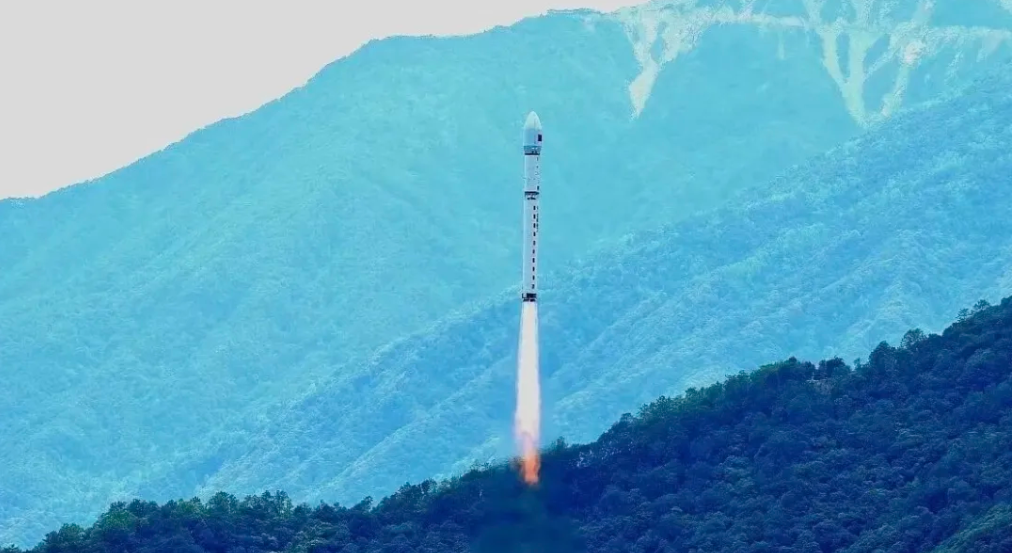
On April 24 at 14:35, a Long March 2D rocket lifted off from the Xichang Satellite Launch Center, placing four test satellites for satellite internet technology into orbit. Among them, one satellite carried a full set of next-generation flexible, thin-film gallium arsenide (GaAs) solar cells: ultra-light, bendable, and engineered to withstand the harshest conditions in space.

Developed by Yixing-based DR Technology, these cells represent a step change in space power systems. Compared with conventional rigid GaAs solar panels, they are ~80% thinner, 70% lighter, and use 90% fewer rare metals, while maintaining high efficiency. Described by engineers as “paper-thin and freely bendable in the hand,” the technology has now moved from laboratory promise to in-orbit validation.
At the same time, the satellite, built by GalaxySpace’s Wuxi facility, forms part of a broader push toward direct-to-smartphone satellite connectivity and integrated space–ground networks, signaling a new phase in global satellite communications competition.

DR Technology and space photovoltaics
A member of the Wuxi Space-Based Solar Power Industry Alliance (WSSA), DR Technology has rapidly emerged as a pivotal player in China’s aerospace supply chain, specializing in high-efficiency III–V compound semiconductor photovoltaics.
The company holds a full suite of intellectual property rights for flexible GaAs thin-film photoelectric chips and is engaged in multiple national-level aerospace R&D programs. Its trajectory reflects China’s broader push to localize and industrialize high-performance space components historically dominated by foreign suppliers.
As satellites evolve into platforms for communications, sensing, and computing, power systems are becoming both a constraint and a strategic differentiator, placing DR Technology at the center of next-generation space infrastructure.
Based in Yixing, the company benefits from a dense regional ecosystem in advanced materials and photovoltaics in the Wuxi area. Yixing itself hosts two dedicated industrial zones: the Yixing New Energy Materials Industrial Zone and the Yixing Photovoltaic Industrial Zone.
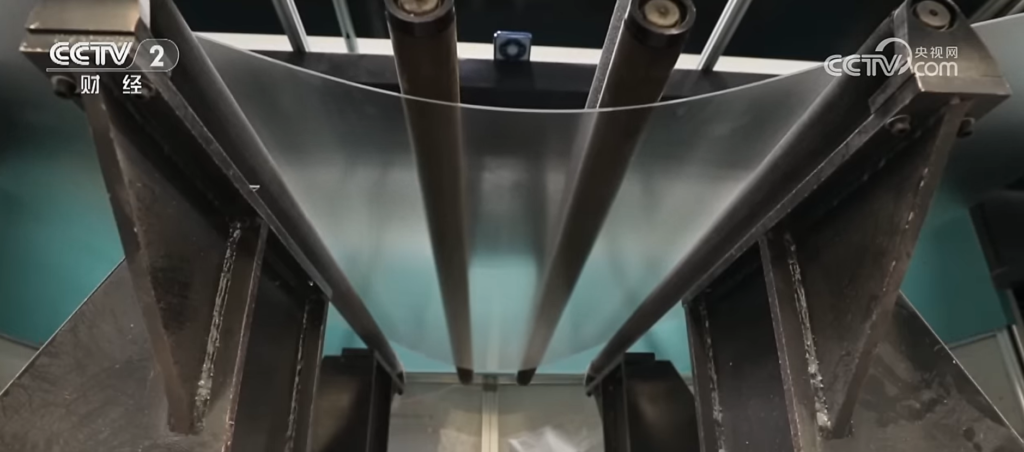
Also located in Yixing, CNBM (Yixing) New Energy, a subsidiary of China National Building Material (CNBM), is a national high-tech enterprise with annual production capacity exceeding 120 million square meters of premium PV glass – including the world’s thinnest commercial 1.5 mm PV glass featuring 90 MPa surface compressive stress from tempering, with a daily production capacity of 150,000 square meters. The photo above shows the 1.5 mm PV glass slightly bent but remaining intact under 135 MPa applied load.
Industrialization and technical depth
DR Technology’s progress is underpinned by a decade of sustained engineering development. Since establishing its flexible thin-film technology platform in 2014, the company has scaled rapidly, achieving early industrial production capability in 2018 and full-scale industrial maturity in the early 2020s.
Today, it is China’s only company to mass-produce flexible GaAs solar cells and a clear global leader in the space photovoltaic segment. Its production lines are operating at scale, supplying multiple satellite manufacturers as commercial space demand accelerates. This marks a transition from bespoke, high-cost components toward standardized, scalable production.
In 2025, the establishment of the National Key Laboratory for Photovoltaic Science and Technology (III–V Cell Research Center) at DR Technology further strengthened its innovation pipeline. The center focuses on advances in materials, device architectures, manufacturing equipment, and production processes to significantly reduce costs while expanding applications—from aerospace to broader commercial and consumer markets.
Wuxi’s emerging space ecosystem
DR Technology’s rise is closely tied to Wuxi’s rapidly developing aerospace ecosystem. The city has positioned itself as a key node in China’s commercial space landscape through a strategy combining industrial clustering, policy alignment, and vertical integration across the value chain—from advanced materials and manufacturing to launch services and downstream applications.
The result is a fast-maturing ecosystem that reflects both “Wuxi speed” and the operational efficiency of anchor companies such as GalaxySpace. The April 24 mission further underscores Wuxi’s growing role in the sector.
I. Building a full value-chain ecosystem
Wuxi’s rise is underpinned by highly concentrated industrial clusters that collectively form a full value-chain ecosystem.
Liangxi District:
- More than 120 commercial aerospace enterprises
- A strong concentration of satellite, launch, and component manufacturers
Citywide ecosystem:
- 325 companies in the aerospace value chain
- 14 national-level “Little Giant” high-tech firms
Capabilities span:
- Materials science
- Electronics
- Advanced manufacturing across the aerospace value chain
- Data services
Together, this constitutes a fully integrated value chain—from upstream materials to downstream applications.
II. Economic targets and scale
Wuxi aims to grow its aerospace sector to over CNY 40 billion (USD 5.5 billion) within three years, positioning itself as:
- A central node in China’s commercial space strategy
- A major manufacturing and innovation hub
III. Integration with reusable launch systems
As manufacturing and satellite capabilities scale, reducing launch costs becomes critical to unlocking full system-level efficiencies. Launch remains the single largest cost driver in space economics.
Wuxi-based Deep Blue Aerospace is advancing:
- Reusable “Nebula” series liquid rockets
- “Thunder-R” LOX–kerosene engines
Key performance indicators include:
- 120-tonne engine thrust
- More than eight successful first-stage reuses to date
- Approximately 40% reduction in launch costs
A full-scale launch attempt is targeted for 2026.
Combined cost impact: A structural shift
Wuxi’s ecosystem spans the full value chain. Lightweight power systems, scalable satellite manufacturing, and reusable launch technologies are compressing both capital and operational costs across the lifecycle, transforming space into a more economically scalable infrastructure layer.
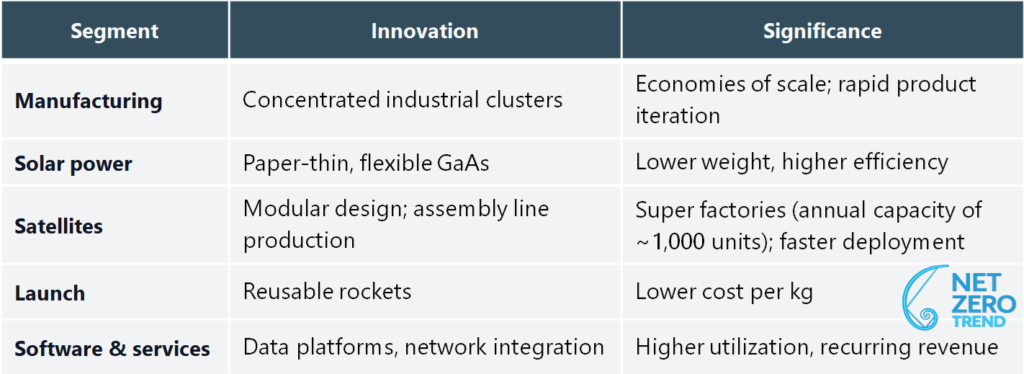
Vertically integrated, these factors enable:
- Lower total cost of ownership for satellite constellations
- Faster deployment cycles
- Greater scalability
Business model evolution
Wuxi’s rapid rise is closely aligned with national policy liberalization that has reshaped China’s commercial space sector:
- 2015: Civilian space infrastructure plans opened satellite development to the private sector
- 2016: China’s space white paper formalized private participation across the value chain
- 2019–23: Regulatory frameworks normalized commercial launch and operations in the private sector
- 2023: Commercial aerospace designated a strategic emerging industry
At the local level, Wuxi has expanded partnerships across China, from top universities in advanced materials and aerospace to launch infrastructure. Its agreements with Hainan International Commercial Aerospace Launch Co., Ltd. and the Wenchang government in Hainan aim to strengthen integration across launch, manufacturing, and infrastructure.
Against this backdrop of policy support and industrial coordination, the sector is moving beyond isolated capabilities toward fully integrated, commercially driven systems. The space value chain is now shifting:
Traditional model:
- Government-led
- Low launch frequency
- High cost
Emerging model:
- Private-sector participation
- High launch cadence
- Platform-based services
Revenue streams are diversifying into:
- Connectivity services
- Data services
- Infrastructure leasing
- Hardware manufacturing
Convergence defines the next phase
The April 24 launch encapsulates a broader transformation in China’s space sector, where technological innovation and industrial coordination are advancing in tandem. It highlights how localized ecosystems can now deliver globally competitive capabilities across the entire value chain.
DR Technology’s flexible GaAs solar cells are changing how satellites are powered—lighter, more efficient, and scalable—while Wuxi’s rapidly growing aerospace ecosystem is transforming how they are built, launched, and commercialized.
Together, they point toward a new paradigm:
- Lower-cost access to orbit
- Higher-performance satellite systems
- Expansion into space-based computing
As these trends converge, 2026 is shaping up to be a pivotal year—one in which space begins to transition from a high-cost frontier into an increasingly accessible, infrastructure-like layer of the global economy.